Transcription of What to Expect When Getting Port a Cath
1 What to Expect When Getting an Implanted PortInformation for patients and familiesRead this resource to learn: What an implanted port does What to Expect before, during and after you get your implanted port How to care for your implanted port Who to call if you have any questionsForm: D-51412My port will be inserted on: Date: Time: My port will be removed on: Date: Time: Check-in 30 minutes before your appointment at the Medical Imaging reception desk.
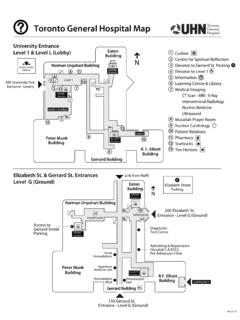
2 Your port will be inserted or removed at one of these sites: Toronto General Hospital Peter Munk Building, 1st Floor 585 University Avenue, Toronto General Inquiries: 416 340 3800 Toronto Western Hospital East Wing, 3rd Floor 399 Bathurst Street, Toronto General Inquiries: 416 603 25813 What is an implanted port?An implanted port (also called a port or port-a-cath ) is a type of central venous catheter. It is used to inject liquids directly into your vein as part of your treatment (called intravenous or IV therapy).
3 Why do I need to have a port inserted?Your doctor or nurse may recommend a port for you if: 9you need IV therapy many times over 6 months or longer 9you have small veins and need multiple pokes to get an IV in 9your IV treatment must be given through a port (for example, when Getting chemotherapy multiple days at home) Your nurse can use your port to collect blood samples, and to give: fluids medicines, like chemotherapy and antibiotics a blood transfusion IV nutrient (food) this is called Parenteral NutritionSome implanted ports can also be used for high speed injection during CT scan or MRI test (special kind of x-ray).
4 These ports are called power-injectable ports . Your nurse will let you know if you have a power-injectable port. How long can I have my port? Your port can stay in for the whole time you are on IV treatment, and as long as it is working well and shows no signs of infection. Your doctor will remove your port when you don t need it anymore. 4 What do I need to know about my port?Your implanted port has 2 parts: The port The port is usually placed under your skin about 2 to 3 centimetres below your collar bone.
5 You may feel a round or triangle shaped bump on your skin where the port middle part of the port (called septum or access site ) is made of a self-sealing rubber that holds the port needle safely in place during treatment. Your doctor may order one or two ports depending on your treatment needs. Having two ports means your nurse can inject two different IV treatments at the same time. 5 The catheter Your port is connected to a thin flexible tube called a catheter. The end of the catheter sits in a large blood vessel leading to your heart.
6 When you need IV therapy or blood sample, your nurse will insert a special needle into the port septum. This is called accessing the port . This needle allows fluid or medicine to flow from your port through the catheter and into your bloodstream. The port needle must be covered with a sterile dressing and must be changed every 7 days when in use. Your nurse will remove the port needle when your treatment is should I prepare for Getting a port? Get a blood test done 2 to 3 days before the port is put in, if your doctor asks you to.
7 Tell your doctor if you are taking any blood thinner medicine (such as Aspirin, Tinzaparin, ibuprofen, Advil, Motrin). Do not eat and drink after midnight the night before your procedure. You may have sips of water to take your regular medicine. You may eat a light snack first thing in the morning (no later than 6:00 am) if you have to. A light snack can include one cup of yogurt or one cracker or cookie. Based on the type of blood thinner medicine you take, your doctor may tell you to continue or stop taking the medicine.
8 For example: Type of medicineWhat to doNSAID (for example, ibuprofen, celecoxib, diclofenac, indomethacin)May continue to takeAspirinMay continue to takeAntiplatelet (for example, Plavix, ticagrelor)May continue to takeIf taking Aspirin with NSAID and/or antiplateletStop taking 7 days before procedureCoumadinStop taking 5 days before procedureDabigatran, rivaroxaban, apixabanStop taking 2 days before procedureLow molecular heparin subcutaneous injectionStop taking 1 day before procedure These examples are only recommendations.
9 Make sure to check with your doctor or nurse before stopping your coming to hospital, make sure to: bring your health card (OHIP) carry a list of all medicines you take regularly leave anything of value at home such as jewelry have a family or friend to drive you homeIt is not safe for you to drive home because you will get medicine that will make you drowsy (sleepy).What can I Expect during the procedure?Your port will be inserted in the Interventional Radiology department in Medical Imaging. We will ask you to change into a hospital gown.
10 A medical imaging staff person explains the procedure to you and answers any questions you have. You are asked to sign a consent form before the procedure can start. A needle is inserted into your arm to give you fluid and give you medication to keep you relaxed during the procedure. Let the staff know if you have an allergy to heparin. Heparin is used to prevent blood clots from forming inside your port and catheter. A different type of medicine will be used instead. You lie on a procedure table and stay awake while the port is put in.