Transcription of WISCONSIN EMERGENCY MANAGEMENT
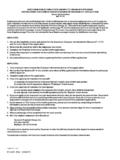
1 March 2015 - 1 - WISCONSIN EMERGENCY MANAGEMENT UNIFORM DISASTER SITUATION REPORT (UDSR) instructions FOR completing FORM The following instructions describe the types of information required to complete each entry on the Uniform Disaster Situation Report (UDSR). Only complete those entries that are applicable, leaving blank those that are not. If data for an entry is still being compiled, place a TBD (to be determined) in the block to indicate the data is forthcoming. The county EMERGENCY MANAGEMENT director is responsible for completing the UDSR and faxing or emailing it to both the WISCONSIN EMERGENCY MANAGEMENT regional office and the central office in Madison. This should be done as soon as possible after the disaster occurrence, but not more than 24 hours later. The county director should submit updates of the report as additional information becomes available. A map/s of the affected area should, if at all possible, be transmitted with the completed UDSR.
2 If you have questions with regard to completing the form, contact your WEM regional director or the central office in Madison at 608-242-3232. GENERAL SECTION 1. Enter the name, address and phone number of the individual completing this form. 2. Enter the date and time of the incident. Be specific. Indicate if several days are involved and specify exact times, , from 4:00 on 4-8-07 to 7:00 on 4-9-07. 3. Enter the type of disaster ( , tornado, flash flood, ice storm, etc.) 4. Enter the date the report is transmitted to the WEM regional and central offices. If it is the first submission of the report, check the original box. If it is a revision, indicate if it is a 1st, 2nd, 3rd, revision, etc. 5. Describe the primary location of the disaster. Be sure to indicate WEM region and county. Be specific in describing areas within a county and include a map showing the impacted areas. 6. Enter the number of persons who have died or been injured as a result of the disaster or its effects.
3 Also enter the number of persons who are homeless as a result of the disaster and the number who were evacuated. PRIVATE SECTOR DAMAGE 7. Enter the number of homes affected or sustaining minor or major damage, as well as the number destroyed. Estimate the dollar amount of damage to those homes. Also estimate the amount (a percentage) of the damage that is covered by insurance. In completing this section, refer to the Quick Reference Guide for Damage Assessment which follows for definitions of affected, minor, major and destroyed and to the Sample Methodology for Calculating Residential Damage for assistance in estimating losses. March 2015 - 2 - Enter the number of businesses sustaining minor and major damage and the number destroyed. Estimate the dollar amount of damage to those businesses. Also estimate the amount (a percentage) of the damage that is covered by insurance. Circle yes or no to indicate whether farms buildings and crops have been damaged or affected and whether any livestock have been lost.
4 8. Add the dollar amounts listed in box 7 and enter the sum in this block. PUBLIC SECTOR DAMAGE In this section estimate those costs that have been incurred by county and local government agencies and private non-profit organizations in their response to the disaster or damages to facilities they own. 9. Category A Debris Clearance. Determine the costs incurred for clearing debris from public roads and streets in order to maintain traffic flow. Also determine costs incurred for removing debris from all other public property to restore public services and protect the public health and safety. Costs for removing public buildings damaged by the disaster that are a threat to public safety should also be considered, as should costs for removing debris from private property by government forces to protect the public health and safety. Add Category A costs and enter the total in box A. Category B Protective Measures. Determine the following costs: those incurred for performing EMERGENCY flood protection including sandbagging, diking, pumping and EMERGENCY stream clearance; costs incurred for the EMERGENCY purchase of safety barricades, signs and other warning, safety or traffic control devices; those incurred for EMERGENCY search and rescue operations including extra law enforcement and fire personnel needed and overtime pay; costs incurred for EMERGENCY security and traffic control including extra law enforcement personnel and overtime pay; those incurred for other EMERGENCY protective measures taken to protect public health and safety including warning of further risks and hazards, dissemination of public information on health and safety measures, etc.
5 Add Category B costs and enter the total in box B. Category C Road Systems. Determine the amount of damage to highways, roads and streets. Include costs of damage to normal right-of-ways such as culverts, curbs, gutters, public sidewalks, shoulders, embankments, drainage ditches, road or street signs, traffic control signs, street lights, signal lights, etc. Also determine the costs for repairing or replacing damaged bridges. Add Category C costs and enter the total in box C. Category D Water Control Facilities. Determine if costs have been incurred to repair or replace dikes, levees, drainage channels, irrigation works, dams or other water control facilities. Add Category D costs and enter the total in box D. Category E Public Buildings and Related Equipment. Estimate the amount of damage to public buildings. Also estimate the cost of replacing operating supplies and inventory contained in the damaged buildings. Determine of any publicly owned March 2015 - 3 - equipment, such as squad cars or fire trucks, was damaged as a result of the disaster and estimate the cost to repair or replace it.
6 If any of these costs are covered by insurance, put a comment in box 14 as to the extent of that coverage. Add Category E costs and enter the total in box E. Category F Public Utility Systems. Determine if storm and/or sanitary sewer systems have been damaged and estimate the cost of repair or replacement. Also determine if any sewage or water treatment plants, public water systems or public light/power facilities have been damaged and estimate the cost of repair or replacement. Include any damage to rural electric cooperatives in this section. Add category F costs and enter the total in box F. Category G Other. Estimate the cost of damage incurred in municipal parks or recreational facilities. Include in this category any other disaster-related costs incurred by local governments which are not already accounted for in any of the above sections. Add category G costs and enter the total in box G. 10. Add the dollar amounts listed in each category in box 9 and enter the total in this block.
7 OTHER 11. This section should describe the extent of local response efforts, including agencies involved and personnel and equipment committed to disaster operations. The information will help state decision-makers determine if local resources have been exhausted and if the situation is beyond local capabilities. 12. This section should specifically state what is needed, why, where it is needed and for what duration. Assistance may include personnel, specialized equipment or other resources and financial assistance. 13. Describe as accurately as possible the impact the disaster has had on the community in terms of physical destruction, socio-economic impacts and curtailment or disruption of vital services. Also enter any other pertinent information which is not included elsewhere on the form but which may be useful to better understand the needs of the jurisdiction. 14. Check this box if the county intends to apply for the WISCONSIN Disaster Fund.
8 Further information on the fund is available through your regional director. March 2015 - 4 - QUICK REFERENCE GUIDE FOR DAMAGE ASSESSMENT SINGLE OR MULTI FAMILY Tornado Event Flood Event Livable Destroyed * Foundation only remains * Not economically repairable No * 2 or more walls destroyed * Pushed off foundation * Roof substantially damaged Major * 2 walls and roof substantially damaged * 2 or more feet on 1st floor no basement No * Structural damage; collapsed basement walls Minor * 1 wall, section of roof damaged * Less than 2 feet on first floor no basement No * 1 to 8 feet in basement Affected * Intermittent shingle damage * Less than 1 foot in basement Yes * Minor access problem MOBILE HOMES Destroyed * Frame twisted * Water above floor level No * Knocked off piers * Unit swept from foundation Major * Wall and roof damage * Water-soaked bottom-board No * Shifted on piers * Shifted on piers Minor * Utility connections broken * Utilities flooded No * Foundation shifted * Piers shifted/washed out Affected * Minor indentations to roof and siding * Access problems, no water touched the unit Yes In all flood events, provide information regarding water levels and duration of flood.
9 March 2015 - 5 - SAMPLE METHODOLOGY FOR CALCULATING RESIDENTIAL DAMAGE Overall average method 1. Damage Factors: Affected/Minor 1- 30% use 15% as median Major 31-80% use 55% as median Destroyed 81-100% use 100% 2. For each Category (Affected/Minor, Major, Destroyed): Average Market Value of Home in Township/Municipality x Number of Homes Damaged per Category x Damage Factor = Estimated Dollar Damages 3. Sample Calculation: The Average Market Value of a single-family home in Badger County is $100,000. 12 homes were judged to have minor damage, 2 had major damages and 1 was destroyed. $100,000 x 12 x = $180,000 $100,000 x 2 x = $110,000 $100,000 x 1 x 1 = $100,000 Total Damages Estimated At $390,000