Transcription of Withdrawn NIST Technical Series Publication
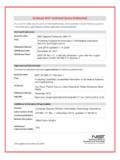
1 Date updated: May 31, 2019 Withdrawn NIST Technical Series Publication Warning Notice The attached Publication has been Withdrawn (archived), and is provided solely for historical purposes. It may have been superseded by another Publication (indicated below). Withdrawn Publication Series /Number NIST Special Publication 800-64 Revision 2 Title Security Considerations in the System Development Life Cycle Publication Date(s) October 2008 Withdrawal Date May 31, 2019 Withdrawal Note This Withdrawn Publication includes content that is out of date. It is provided here for historical reference. Readers should refer to NIST SP 800-160 Volume 1 for current information about system life cycle processes and systems security engineering. NIST intends to develop a white paper that describes how the Risk Management Framework (SP 800-37 Rev.)
2 2) relates to system development life cycle processes and stages. Superseding Publication (s) (if applicable) The attached Publication has been superseded by the following Publication (s): Series /Number Title Author(s) Publication Date(s) URL/DOI Additional Information (if applicable) Contact Computer Security Division (Information Technology Laboratory) Latest revision of the attached Publication Related Information Withdrawal Announcement Link Security Considerations in the System Development Life Cycle Richard Kissel Kevin Stine Matthew Scholl Hart Rossman Jim Fahlsing Jessica Gulick NIST Special Publication 800-64 Revision 2 I N F O R M A T I O N S E C U R I T Y Computer Security Division Information Technology Laboratory National Institute of Standards and Technology Gaithersburg, MD 20899-8930 October 2008 Department of Commerce Carlos M.
3 Gutierrez, Secretary National Institute of Standards and Technology Patrick D. Gallagher, Deputy Director Reports on Computer Systems Technology The Information Technology Laboratory (ITL) at the National Institute of Standards and Technology (NIST) promotes the economy and public welfare by providing Technical leadership for the Nation s measurement and standards infrastructure. ITL develops tests, test methods, reference data, proof of concept implementations, and Technical analyses to advance the development and productive use of information technology. ITL s responsibilities include the development of management, administrative, Technical , and physical standards and guidelines for the cost-effective security and privacy of sensitive unclassified information in federal computer systems.
4 This Special Publication 800- Series reports on ITL s research, guidelines, and outreach efforts in information security, and its collaborative activities with industry, government, and academic organizations. i Authority This document has been developed by the National Institute of Standards and Technology (NIST) in furtherance of its statutory responsibilities under the Federal Information Security Management Act (FISMA) of 2002, Public Law 107-347. NIST is responsible for developing standards and guidelines, including minimum requirements, for providing adequate information security for all agency operations and assets, but such standards and guidelines shall not apply to national security systems. This guideline is consistent with the requirements of the Office of Management and Budget (OMB) Circular A-130, Section 8b(3), Securing Agency Information Systems, as analyzed in A-130, Appendix IV: Analysis of Key Sections.
5 Supplemental information is provided A-130, Appendix III. This guideline has been prepared for use by federal agencies. It may also be used by nongovernmental organizations on a voluntary basis and is not subject to copyright regulations. (Attribution would be appreciated by NIST.) Nothing in this document should be taken to contradict standards and guidelines made mandatory and binding on federal agencies by the Secretary of Commerce under statutory authority. Nor should these guidelines be interpreted as altering or superseding the existing authorities of the Secretary of Commerce, Director of the OMB, or any other federal official. Certain commercial entities, equipment, or materials may be identified in this document in order to describe an experimental procedure or concept adequately. Such identification is not intended to imply recommendation or endorsement by NIST, nor is it intended to imply that the entities, materials, or equipment are necessarily the best available for the purpose.
6 Ii Acknowledgements The authors, Richard Kissel, Kevin Stine, and Matthew Scholl from NIST, wish to thank their colleagues, Hart Rossman, Jim Fahlsing and Jessica Gulick, from Science Applications International Corporation (SAIC), who helped update this document, prepare drafts, and review materials. In addition, special thanks are due to the original authors, as well as our reviewers, Arnold Johnson, John Garguilo, Marianne Swanson, and Elizabeth Lennon from NIST who greatly contributed to the document s development. NIST also gratefully acknowledges and appreciates the many contributions from individuals in the public and private sectors whose thoughtful and constructive comments improved the quality and usefulness of this Publication . iii Table of Contents EXECUTIVE PURPOSE AND VALUE TO AGENCY MISSIONS, SECURITY PROGRAMS, AND IT DOCUMENT OVERVIEW OF INFORMATION SECURITY AND THE SYSTEM DEVELOPMENT LIFE CYCLE ESTABLISHING A COMMON LEGACY SYSTEM KEY ROLES AND RESPONSIBILITIES IN THE INCORPORATING SECURITY INTO THE SDLC PHASE: SDLC PHASE: SDLC PHASE: IMPLEMENTATION / SDLC PHASE: OPERATIONS AND SDLC PHASE.
7 ADDITIONAL SECURITY SUPPLY CHAIN AND SOFTWARE SERVICE-ORIENTED SPECIFIC ACCREDITATION OF SECURITY MODULES FOR CROSS-ORGANIZATIONAL TECHNOLOGY ADVANCEMENT AND MAJOR DATA CENTER OR IT FACILITY APPENDIX A - APPENDIX B - APPENDIX C - C-1 APPENDIX D - NIST REFERENCE MATRIX AND D-1 APPENDIX E - OTHER SDLC APPENDIX F - ADDITIONAL ACQUISITION PLANNING F-1 APPENDIX G - ADDITIONAL GRAPHICAL VIEWS OF SECURITY WITHIN G-1 iv v TABLE OF FIGURES FIGURE 2-1. POSITIONING SECURITY FIGURE 3-1. THE SDLC A CONCEPTUAL FIGURE 3-2. RELATING SECURITY CONSIDERATIONS IN INITIATION FIGURE 3-3. RELATING SECURITY CONSIDERATIONS IN THE DEVELOPMENT/ACQUISITION FIGURE 3-4. RELATING SECURITY CONSIDERATIONS IN THE IMPLEMENTATION/ASSESSMENT FIGURE 3-5. RELATING SECURITY CONSIDERATIONS IN THE OPERATIONS/MAINTENANCE FIGURE 3-6.
8 RELATING SECURITY CONSIDERATIONS IN THE DISPOSAL EXECUTIVE SUMMARY The National Institute of Standards and Technology (NIST) Special Publication (SP) 800-64, Security Considerations in the System Development Life Cycle, has been developed to assist federal government agencies in integrating essential information technology (IT) security steps into their established IT system development life cycle (SDLC). This guideline applies to all federal IT systems other than national security systems. The document is intended as a reference resource rather than as a tutorial and should be used in conjunction with other NIST publications as needed throughout the development of the system. This Publication serves a federal audience of information system and information security professionals, including information system owners, information owners, information system developers and program managers.
9 To be most effective, information security must be integrated into the SDLC from system inception. Early integration of security in the SDLC enables agencies to maximize return on investment in their security programs, through: Early identification and mitigation of security vulnerabilities and misconfigurations, resulting in lower cost of security control implementation and vulnerability mitigation; Awareness of potential engineering challenges caused by mandatory security controls; Identification of shared security services and reuse of security strategies and tools to reduce development cost and schedule while improving security posture through proven methods and techniques; and Facilitation of informed executive decision making through comprehensive risk management in a timely manner.
10 This guide focuses on the information security components of the SDLC. First, descriptions of the key security roles and responsibilities that are needed in most information system developments are provided. Second, sufficient information about the SDLC is provided to allow a person who is unfamiliar with the SDLC process to understand the relationship between information security and the SDLC. This document integrates the security steps into the linear, sequential ( waterfall) SDLC. The five-step SDLC cited in this document is an example of one method of development and is not intended to mandate this methodology. Lastly, SP 800-64 provides insight into IT projects and initiatives that are not as clearly defined as SDLC-based developments, such as service-oriented architectures, cross- organization projects, and IT facility developments.