Transcription of Working Memory and Second Language Processing - crr
1 RUNNING HEAD: Working Memory and LanguageWorking Memory and ( Second ) Language processingArnaud Szmalec, Marc Brysbaert, Wouter Duyck Ghent University, BelgiumContact:Arnaud SzmalecDepartment of Experimental PsychologyGhent UniversityHenri Dunantlaan 2B-9000 Ghent Chapter submitted for:J. Altarriba and L. Isurin (Eds.). Memory , Language , and bilingualism: Theoretical and applied approaches. Cambridge: Cambridge University Press. Working Memory and Language 1 AbstractThis chapter discusses the interactions between two of the most important human cognitive functions: Memory and Language .
2 First, the concept of Working Memory is introduced, along with a brief summary of the evolutions that Working Memory theory has undergone in the last decades. The Second part of the chapter focuses on the role of (verbal) Working Memory in Language acquisition and Processing . It is argued that Working Memory , and especially the ability to temporarily represent serial-order information, is crucially involved in both native and foreign word learning , and perhaps also in sentence and text comprehension. The third and final part of the chapter explores the other direction of the interaction, by questioning whether Language Processing can influence Working Memory functioning.
3 This question is addressed with recent behavioral and neurological evidence for a general executive control advantage in bilinguals, which makes a strong case for the trainability of some aspects of Working Memory . Keywords: Working Memory , Language acquisition, Language Processing , executive control, bilingualism Working Memory and Language 2 Working Memory and ( Second ) Language Processing From intelligence testing to Working Memory In 1887, Jacobs published a series of studies in which he reported that older children could repeat longer strings of digits read out to them than younger children.
4 Jacobs also reported that intelligent children (as assessed by the teacher) could repeat more digits than less intelligent children. This idea was picked up by Binet and Simon in the early 20th century when they developed the first valid intelligence test. They found that 3-year old children could repeat only sequences of two digits, whereas children of 4 years could repeat sequences of three digits, and most healthy children of 7 years could repeat sequences of five digits. Therefore, Binet and Simon included digit repetition in their intelligence test (Binet & Simon, 1905). Ever since, the digit span task (as it became called) has been part of intelligence tests, because it correlates reasonably well with the scores of other subtests of intelligence (such as arithmetic, general information, and the discovery of similarities).
5 The task received further impetus when Miller (1956) argued it was a good measure of a person s short-term Memory capacity. In the early 1970s several authors felt uneasy with the digit-span as a measure of Memory capacity. It seemed to consider short-term Memory too much as a passive storage buffer, rather than an active part of human information Processing . As a result, the concept of Working Memory , representing both storage and executively controlled manipulation of information, was put forward. An important publication in this respect was the Working Memory model of Baddeley and Hitch (1974).
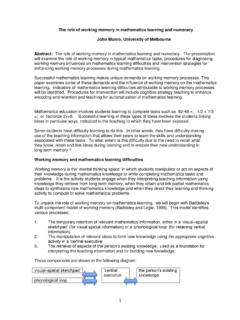
6 This model consisted of three parts: (i) a modality-free central executive related to attention, (ii) a phonological loop holding information in a speech-based form, and (iii) a visuo-spatial sketchpad for the coding of visual and spatial information. A further milestone was the publication by Daneman and Working Memory and Language 3 Carpenter (1980) of an article in which they presented the reading span task as a measure of Working Memory capacity. This task (also known as the complex span task) was developed to simultaneously tax the storage and Processing functions of Working Memory .
7 Participants had to read sentences (the Processing component) while maintaining and retrieving the final words of the sentences (the storage component). An example of a test item with two sentences was:- When at last his eyes opened, there was no gleam of triumph, no shade of The taxi turned up Michigan Avenue where they had a clear view of the reading aloud these two sentences the participant had to retrieve the two last words (anger, lake). The number of sentences was increased until the participants made errors. Daneman and Carpenter (1980) observed that reading span typically varied from 2 to 5 words.
8 They further discovered that this span correlated much better with reading comprehension and performance on the Scholastic Aptitude Test (SAT; a standardized test for college admission in the US) than the traditional, passive word span (measured by presenting lists of words of varying length to participants and asking them to repeat the lists). Subsequent reviews confirmed the high correlations between Working Memory capacity and Language comprehension (Daneman & Merikle, 1996), and between Working Memory capacity and fluid intelligence (Ackerman, Beier, & Boyle, 2005; Engle, Tuholski, Laughlin, & Conway, 1999).
9 A wide variety of immediate serial recall tasks and complex span measures are in use today to increase our understanding of the structure and the functioning of Working Memory . At the same time, the conceptualization of Working Memory has gone through some substantial changes. Whereas Daneman and Carpenter (1980) considered Working Memory as a unitary system with a single capacity, later research provided evidence for several subcomponents with their own capacities. For instance, Jarrold and Towse (2006), in line with Working Memory and Language 4 Baddeley and Hitch s (1974) model, argued that Working Memory capacity depended on (i) Processing efficiency, (ii) storage capacities for the maintenance of verbal/numerical information and spatial information, and (iii) controlled attention needed for the coordination and integration of storage and Processing , and for the inhibition of irrelevant information.
10 Still other Working Memory theorists started to question the idea of Working Memory as a separate module. Partially inspired by the work of Cowan (1988), which was further elaborated by Oberauer (2009), they have questioned the multiple-component view of Memory and argued that short-term Memory , long-term Memory , and Working Memory are not separate structures but differ from each other in terms of activation levels of representations in Memory and the amount of attentional control dedicated to those representations. Working Memory then is seen as an activated subset of long-term Memory , with information in a directly accessible state and shielded against interference from other Memory contents through attentional control ( , Szmalec, Verbruggen, Vandierendonck, & Kemps, 2011).