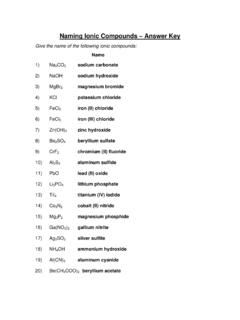
Transcription of Worksheet 5 - Naming Ionic Compounds Naming
1 Worksheet 5 - Naming Ionic Compounds Part 1 (Binary Compounds with Group 1, 2 or 13 metals) Binary Compounds : have only two kinds of elements, if there are three or more it is not a binary compound . Naming 1. Metal goes first and you get the name directly from the periodic table. 2. Non-metal goes second. The ending changes to ide Name of element Name at end of compound Name of element Name at end of compound Fluorine Fluoride Oxygen Oxide Chlorine Chloride Sulfur Sulfide Bromine Bromide Nitrogen Nitride Iodine Iodide Phosphorus Phosphide Write the chemical formula for each of the following.
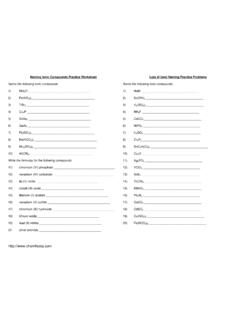
2 1. lithium chloride 2. beryllium chloride 3. sodium oxide 4. potassium sulfide 5. magnesium phosphide 6. aluminum fluoride 7. calcium nitride 8. magnesium oxide 9. beryllium nitride 10. potassium carbide 11. potassium nitride 12. potassium fluoride 13. aluminum nitride 14. sodium fluoride 15. calcium carbide 16. barium bromide 17. francium phosphide 18. gallium sulfide Write the chemical names of the following Compounds . 1. LiF 2. Li2O 3. AlP 4. NaCl 5. K2S 6. Ca3N2 7. MgO 8. BeS 9. Ca2C 10. Li4C 11. AlF3 12. KBr 13. Ga2O3 14. CsI 15. SrAt2 16.
3 Rb3P 17. BaS 18. Al4C3 Worksheet 6 - Naming Ionic Compounds Part 2 (Binary Compounds with Group 3 - 12 metals) Naming (STOCK SYSTEM) 1. Metal goes first and you get the name directly from the periodic table. 2. Immediately after the metal in brackets write the charge of the metal ion in roman numerals. 3. Non-metal goes second. The ending changes to ide The metals in Groups 3 12 can have more then one charge on the ion (polyvalent ions) so when you name them you have to add in the charge of the metal ion by using roman numerals. This method of Naming is called the stock system and is used only for the polyvalent ions.
4 There is another method of Naming the polyvalent ions, which we will look at in part 3 of Naming Ionic Compounds . Element Cations Name of Cation Element Cations Name of Cation Antimony Sb3+ Antimony (III) Lead Pb2+ Lead (II) Sb5+ Antimony (V) Pb4+ Lead (IV) Arsenic As3+ Arsenic (III) Manganese Mn2+ Manganese (II) As5+ Arsenic (V) Mn4+ Manganese (IV) Cobalt Co2+ Cobalt (II) Mercury Hg+ Mercury (I) Co3+ Cobalt (III) Hg2+ Mercury (II) Copper Cu+ Copper (I) Nickel Ni2+ Nickel (II) Cu2+ Copper (II) Ni3+ Nickel (III) Gold Au+ Gold (I) Tin Sn2+ Tin (II) Au3+ Gold (III) Sn4+ Tin (IV) Iron Fe2+ Iron (II) Titanium Ti3+ Titanium (III) Fe3+ Iron (III) Ti4+ Titanium (IV)
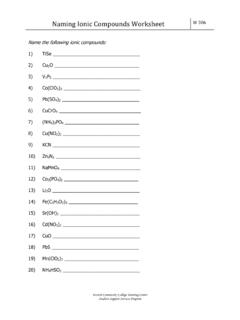
5 Example copper chloride CuCl or CuCl2 Both are copper chloride copper (I) chloride copper (II) chloride Need the charge on copper Write the names of the following Compounds . 1. CuO 2. Cu2O 3. Sb2O5 4. Sb2O3 5. PbCl4 6. NiBr2 7. AuP 8. Au3P 9. FeO 10. Sn3P4 11. Fe2C 12. Co4C3 13. Hg3N 14. MnS2 15. AsI5 16. SnO 17. Ti2S3 18. TiF4 Write the chemical formulas of the following 1. manganese (IV) oxide 2. arsenic (V) sulfide 3. cobalt (II) chloride 4. antimony (III) bromide 5. iron (II) carbide 6. gold (I) iodide 7. mercury (II) nitride 8. cobalt (III) phosphide 9.
6 Nickel (III) oxide 10. titanium (IV) carbide 11. antimony (V) oxide 12. tin (II) fluoride 13. lead (IV) nitride 14. arsenic (V) bromide 15. gold (II) sulfide 16. antimony (V) phosphide 17. copper (I) oxide 18. gold (I) carbide Worksheet 7 - Naming Ionic Compounds Part 3 (Binary Compounds with Group 3 - 12 metals) Naming (CLASSICAL SYSTEM) 1. Metal goes first. Some metals use special names. For all of the metals the ending changes to ous or ic ( ous is for the lower ion of the metal, while ic is for the higher ion of the metal) 2. Non-metal goes second. The ending changes to ide Element Cations Name of Cation Element Cations Name of Cation Antimony Sb3+ Antimonous Lead Pb2+ Plumbous Sb5+ Antimonic Pb4+ Plumbic Arsenic As3+ Arsenous Manganese Mn2+ Manganous As5+ Arsenic Mn4+ Manganic Cobalt Co2+ Cobaltous Mercury Hg+ Mercurous Co3+ Cobaltic Hg2+ Mercuric Copper Cu+ Cuprous Nickel Ni2+ Nickelous Cu2+ Cupric Ni3+ Nickelic Gold Au+ Aurous Tin Sn2+ Stannous Au3+ Auric Sn4+ Stannic Iron Fe2+ Ferrous Titanium Ti3+ Titaniumous Fe3+ Ferric Ti4+ Titaniumic Example copper chloride CuCl (Cu+) or CuCl2 (Cu2+)
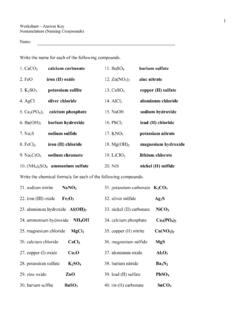
7 Both are copper chloride cuprous chloride cupric chloride Must indicate the charge with ous or ic Write the names of the following Compounds . 1. CuO 2. Cu2O 3. Sb2O5 4. Sb2O3 5. PbCl4 6. NiBr2 7. AuP 8. Au3P 9. FeO 10. Sn3P4 11. Fe2C 12. Co4C3 13. Hg3N 14. MnS2 15. AsI5 16. SnO 17. Ti2S3 18. TiF4 Write the chemical formulas of the following 1. manganic oxide 2. arsenic sulfide 3. cobaltous chloride 4. antimonous bromide 5. ferrous carbide 6. aurous iodide 7. mercuric nitride 8. cobaltic phosphide 9. nickelic oxide 10. titaniumic carbide 11.
8 Antimonic oxide 12. stannous fluoride 13. plumbic nitride 14. arsenic bromide 15. auric sulfide 16. antimonic phosphide 17. cuprous oxide 18. aurous carbide Worksheet 8 - Naming Ionic Compounds Part 4 (For Compounds that are not binary) There are groups of non-metals that like to stay together and have a total charge these are called polyatomic ions. Naming 1. Metal goes first and all previous rules for the metals apply. 1a) Group 1, 2, 13 metals name directly from periodic table 1b) Group 3 12 metals STOCK SYSTEM name from periodic table plus identify the charge using roman numerals 1c) Group 3 12 metals CLASSICAL SYSTEM ous identifies lower ion and ic identifies higher ion 2.
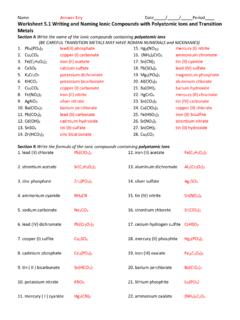
9 Negative polyatomic ion second and you get the name from the table below. Polyatomic ions Name of polyatomic ion Ion formula Name of polyatomic ion Ion formula Nitrite NO2- Hydrogen Carbonate (Bicarbonate) HCO3- Nitrate NO3- Sulfite SO32- Carbonate CO32- Sulfate SO42- Phosphate PO43- Chlorite ClO2- Acetate C2H3O2- Chlorate ClO3- Cyanide CN- Arsenite AsO33- Hydroxide OH- Arsenate AsO43- Ammonium NH4+ Name the following Compounds 1. LiNO3 2. Be(HCO3)2 3. AlPO4 4. CaCO3 5. NaNO2 6. Ga(OH)3 7. Cu2SO4 8. Cu(NO3)2 9. Mg3(PO4)2 10. Sn(OH)4 11. Ba3(AsO4)2 12. (NH4)2CO3 13. Sb(C2H3O2)5 14. KCN 15.
10 Al2(SO3)3 16. FrClO3 17. SrCO3 18. Li3(PO4) Write the chemical formula for the following Compounds 1. lithium chlorite 2. beryllium nitrate 3. calcium phosphate 4. aluminum phosphate 5. manganese (IV) hydroxide 6. ammonium sulfate 7. sodium acetate 8. nickel (II) arsenite 9. ferric cyanide 10. cobaltous sulfite 11. auric bicarbonate 12. ammonium phosphate 13. potassium acetate 14. cesium nitrate 15. magnesium arsenite 16. tin (IV) hydroxide 17. antimony (V) arsenate 18. gallium chlorate