Transcription of www.thelancet.com
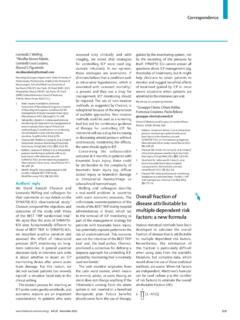
1 Vol 21 March 2022 2155 Hardmeier M, Leocani L, Fuhr P. A new role for evoked potentials in MS? Repurposing evoked potentials as biomarkers for clinical trials in MS. Mult Scler 2017; 23: 1309 19. The reality of multiple sclerosis assessment in middle-income countries The Position Paper by Mike Wattjes and colleagues1 recommends frequent monitoring of patients with multiple sclerosis using MRI. However, in middle-income countries such as Brazil, the reality is that there is low availability of neuroimaging for the diagnosis and monitoring of patients with neurological diseases. Outpatients might wait for months, and in some cases, never obtain neuroimaging through the public health-care system, or they have to pay for private health care, with prices that are unaffordable for a great number of people. The need for anaesthetic sedation of patients largely precludes the use of MRI in children because of the high cost of anesthesia in both the public and the private health-care systems.
2 We did a short online survey of 150 neurologists in Brazil. When asked Do you think that performing MRI is a problem for patients (whether due to cost or other reasons)? , 19 (32%) of 60 respondents answered frequently , and 33 (55%) answered sometimes (appendix p 2).Finding alternatives to MRI for diagnosis and monitoring that can improve the care of our patients is a necessity. Despite the low specificity and low topographic resolution of evoked potentials, their high sensitivity to neural alterations is particularly promising, as even subclinical impair-ments in nerve conduction can disrupt wave latency, wave magnitude, and 4 However, the rise of neuroimaging with higher specificity and spatial resolution than evoked potentials has allowed the location of lesions to be determined much more accurately and has significantly improved the diagnosis of neurological disorders, including multiple Therefore, evoked potentials have been losing ground despite their high sensitivity to demyelinating is irreplaceable in obtaining a specific diagnosis in neurology.
3 However, patients with an established diagnosis of multiple sclerosis or optic neuritis might benefit from a follow-up using evoked potentials, given that these examinations are easier and cheaper than MRI, and are sensitive to changes in the functional state of the nervous system. Around 30 years after the rise of high-resolution neuroimaging, evoked potentials have been proposed to show a stronger association with clinical symptoms than In our survey, when asked whether they use evoked potentials, 34 (57%) neurologists replied that they do or would adopt this exam in their general practice (appendix p 2). We therefore call for new clinical techniques and studies using evoked potentials, in the hope that future recommendations for the diagnosis and monitoring of people with multiple sclerosis can include this approach in patient and PRG are developing a new technology for recording and analysing evoked potentials in the diagnosis of neurological diseases.
4 All other authors declare no competing interests.*Dimitri Marques Abramov, Daniel Souza de Silva, Tania Regina Saad Salles, Paulo Ricardo Galhanone, Vladimir V of Neurobiology and Clinical Neurophysiology, National Institute of Women, Children and Adolescents Health Fernandes Figueira, Oswaldo Cruz Foundation (FIOCRUZ), Ministry of Health, 22250-020 Rio de Janeiro, Brazil1 Wattjes MP, Ciccarelli O, Reich DS, et al. 2021 MAGNIMS-CMSC-NAIMS consensus recommendations on the use of MRI in patients with multiple sclerosis. Lancet Neurol 2021; 20: 653 Leocani L, Comi G. Clinical neurophysiology of multiple sclerosis. Handb Clin Neurol 2014; 122: 671 Grecescu M. Optical coherence tomography versus visual evoked potentials in detecting subclinical visual impairment in multiple sclerosis. J Med Life 2014; 7: 538 41. Erratum in: J Med Life 2014; 7: 627. 4 Comi G, Leocani L, Medaglini S, et al. Measuring evoked responses in multiple sclerosis.
5 Mult Scler 1999; 5: 263 67. See Online for appendixAuthors replyWith great interest we read the Correspondence in response to our Magnetic Resonance Imaging in Multiple Sclerosis (MAGNIMS), Consortium of Multiple Sclerosis Centres (CMSC), North American Imaging in Multiple Sclerosis Cooperative (NAIMS) recommendations on the use of MRI in multiple We would like to thank Dimitri Marques Abramov and colleagues for bringing to light an important issue in the care of people with multiple sclerosis the concern about limited access to neuroimaging facilities, particularly MRI, for the diagnosis and monitoring of people with neurological diseases in countries with developing concern is certainly relevant in multiple sclerosis monitoring, for which there is compelling evidence that brain (and occasionally spinal cord) MRI should be done yearly, at least in patients receiving a disease-modifying drug, for monitoring of treatment effectiveness and prediction of treatment response, and for monitoring of drug safety.
6 This annual interval could be extended in patients who are clinically stable after the first few years, particularly if monitoring of drug safety is not required, and in patients for whom MRI assessment of disease activity would not have any effect on their therapeutic management. According to the MAGNIMS-CMSC-NAIMS recommendations,1 an abbreviated protocol with high-quality three-dimensional fluid-attenuated inversion recovery and, in some cases, gadolinium-enhanced T1-weighted sequences, is generally sufficient for monitoring purposes. This shortened protocol can be obtained in less than 15 20 min and can be implemented more easily than the full MRI protocol used for diagnostic purposes. Correspondence216 Vol 21 March 2022 Brain health in the PhilippinesYour Editorial1 emphasised the need for public health strategies to reduce the burden of stroke and dementia in low-income and middle-income countries, and highlighted hypertension as a key risk factor that must be addressed to achieve brain health.
7 In the Philippines, a lower-middle income country in southeast Asia, the department of health has implemented the Philippine Package of Essential Noncommunicable Disease Inter ventions (Phil PEN), modelled after WHO s low-cost screening and treatment protocol for non-communicable diseases. Through Phil PEN, Filipinos at risk of hypertension can be identified at the primary care level and then provided education, initial management, and if necessary, further work-up and specialist , 9 years after the pro-gramme s creation, hypertension remains the fourth most common cause of morbidity, and stroke the second most common cause of Challenges include a severe lack of primary health-care workers and the logistically hampered distribution of essential medicines and other resources to different parts of the Philippine archipelago.
8 Additionally, the country s devolved health system has made the implementation of national health programmes like Phil PEN highly dependent on political support from local governments. Furthermore, health care for non-communicable diseases is still largely out-of-pocket, with the national health insurance providing limited coverage for preventive and outpatient therefore agree with your Editorial in that universal health coverage and primary care are central to addressing hypertension and achieving brain health. In the Philippines, the recently passed Universal Health Care (UHC) Act aims to create robust primary care delivery systems for more sustainable health It also supports the expansion of national health insurance coverage for preventive and outpatient services, a crucial factor in reducing the out-of-pocket expenses of hypertension management and in improving health-care access.
9 As UHC gains momentum, local health centres must be given greater responsibility and capability, as they Although the cost of an MRI scan varies greatly between countries, it is generally lower in developing economies than in developed economies. By contrast, the cost of disease-modifying drugs appears to be higher, at least in some Latin American countries, than in North America and the This means that the cost of obtaining an annual MRI scan for monitoring purposes is low compared with the total cost of multiple sclerosis, which is mainly dominated by use of disease-modifying and colleagues propose consideration of multimodal evoked potentials in settings where MRI has limited availability. Evoked potentials have shown some value in supporting the diagnosis of multiple sclerosis, although they are not included in the 2017 McDonald diagnostic criteria.
10 Evoked potentials might also contribute to predicting prognosis, and visual evoked potentials have been proposed as a response biomarker in clinical trials, particularly in those studies aiming to promote remyelination or halt multiple sclerosis Evoked potentials, however, have low accuracy in terms of spatial resolution of pathology and limited reliability, are incapable of identifying treatment-related adverse events, and are neither sensitive nor specific for detecting focal inflammatory activity, particularly outside of the examined Local programmes must be established to ensure the availability of MRI for the monitoring of patients with multiple sclerosis at a low cost through use of abbreviated and standardised protocols. This change would contribute to better and more cost-efficient management of individuals with multiple sclerosis than is currently possible in some countries with developing serves on scientific advisory boards for Novartis, Sanofi-Genzyme, Synthetic MR, Roche, Biogen, TensorMedical, and OLEA Medical, and has received speaker honoraria from Bayer, Sanofi-Genzyme, Merck-Serono, Teva Pharmaceutical Industries, Novartis, Roche, and Biogen.