Transcription of www2.deloitte.com
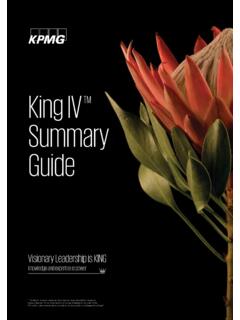
1 KINGIVBOLDERTHAN EVER01 king IV Bolder than ever | IntroductionWhile we acknowledge that most companies suffer from regulation fatigue, we welcome this new version of the king Code as it not only provides a more practical, principle-based approach to good corporate governance, but also incorporates both global public sentiment and international regulatory change since king III was issued in 2009. In our view, king IV is bolder than ever before. Firstly, the Code is principle based and follows an outcomes-based rather than rules-based approach. This is in line with current international sentiment which promotes greater accountability and transparency and speaks to the expressed view that the application of the Code should contribute to the performance and health (sustainability) of the company. In this regard it is clear that king IV aims to establish a balance between conformance and performance.
2 The Code is further bold in its relentless effort to reinforce corporate governance as a holistic set of arrangements that concerns itself with ethical leadership, attitude, mind-set and behaviour. This echoes global developments in the conduct risk arena and also seeks to address and prevent recent examples of corporate failure. Lastly, the boldness of the Code is evident in the clear focus on transparency and targeted disclosures in all areas, specifically in the introduction of far more extensive executive remuneration disclosure than ever seen before. While we believe that this matter still warrants debate in the South African context, we acknowledge that the suggestions are in line with global developments and perhaps more relevant than ever before in a country where the income differential remains higher than this document we specifically highlight our assessment of what is different and what is new, both in the underpinning philosophy and principles of king king Committee published the king IV report on Corporate Governance for South Africa 2016 ( king IV) on 1 November 2016.
3 king IV is effective in respect of financial years commencing on or after 1 April 2017. king IV replaces king III in its IV Bolder than ever | Executive summaryEXECUTIVE summaryFrom an application point of view, the king IV report has been structured as a framework that can be applied more easily across listed and unlisted companies, profit and non-profits as well as private and public entities. As such the Code refers to organisations and governing bodies . For purposes of this publication we refer to companies and Board .The approach of apply or explain of king III is replaced with apply and explain application of all the principles is assumed and companies should explain the practices that have been implemented to give effect to each principle. Explanation should be provided in the form of a narrative account, with reference to practices that demonstrate application of the principle.
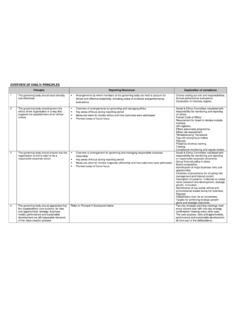
4 The explanation should address which recommended or other practices have been implemented, and how these achieve or give effect to the principle. So, what s new in king IV? king IV applies a principle-and-outcomes based approach, and moves away form a tick-box approach. The 75 king III principles have been consolidated into 16 principles, each aimed at the achievement of one or more very distinct governance outcomes. The focus in king IV is clearly on ensuring that the application of the principles achieves specifically identified outcomes, including ethical culture, good performance, effective control and/or legitimacy. Each principle is supported by a limited number of recommended practices, and requires specific disclosures. In line with international developments, remuneration has received far greater prominence in king IV.
5 While king III required the remuneration policy to be tabled for a non-binding advisory vote of shareholders, king IV recommends that both the remuneration policy and an implementation report (stipulating the various aspects of remuneration together with a link to performance) be tabled for a non-binding advisory vote. The remuneration policy should set out the measures that the board commits to take in the event that either the remuneration policy or the implementation report , or both have been voted against by 25% or more of the voting rights exercised. Such measures should provide pro-active engagement with shareholders to address their concerns. The Board has been tasked to ensure fair and responsible executive remuneration practices in light of overall employee remuneration. 03 king IV Bolder than ever | Executive summary In light of the prevalence of the Fourth Industrial Revolution, king IV has deliberately separated technology and information.
6 king III first officially introduced IT Governance to Corporate Governance in South Africa and demanded a greater level of IT risk awareness at director level. king IV recognises information in isolation of technology as a corporate asset that is part of the company s stock of intellectual capital and confirms the need for governance structures to protect and enhance this asset. king IV recommends the establishment of a Social & Ethics Committee (SEC) as a prescribed Board committee as best practice for all organisations. king IV recommends that the role of this committee goes beyond the functions listed in the Companies Act, and be extended to include matters pertaining to ethical behaviour and ethics management. Also, king IV proposes greater integration between the role and function of the SEC and other Board committees.
7 king IV emphasises the critical role of stakeholders in the governance process. Not only must the Board consider the legitimate and reasonable needs, interests and expectations of stakeholders as a matter that enjoys intrinsic value, but king IV now specifically recognises the role responsibilities of stakeholders - active stakeholders are required to hold the Board and the company accountable for their actions and disclosures. king IV has a strong focus on opportunity management in addition to risk management, and as such it tasks the Risk Committee with the identification of opportunities linked to certain risks. In addition it requires the Board to pay specific attention to opportunities in the process of strategic planning. Perhaps more significantly, the Code recommends overlap of membership of the Risk and Audit Committee s where these function as separate committees, for better functioning.
8 If the roles are combined in a single committee, king IV requires that the audit committee should be satisfied itself that it dedicates sufficient time to this responsibility. king IV has acknowledged the need to assess and confirm the external auditor s independence, but does not specifically address audit firm rotation. king IV suggests that the audit committee oversees auditor independence, considering the impact of non-audit services, audit firm tenure and audit partner rotation. king IV proposes a number of specific disclosures which may be included in the Audit Committee report , including any significant audit matters considered and how the committee has addressed the matters. Where king III included a separate principle in which a governance framework should have been agreed upon between the group Board and its subsidiary Boards, king IV deals with group governance differently in that it allocates responsibility for the implementation of a group governance framework to the holding company Board.
9 04 king IV Bolder than ever | Executive summaryAnd, what s different? king IV has refined the concept and requirements of combined assurance by no longer prescribing the three lines of defence model. Instead it requires that the Board ensures that a combined assurance model is designed and implemented to cover the organisation s significant risks and material matters adequately through a combination of a number of assurance services and functions, including the organisation s line functions that own and manage risks, the organisation s specialist functions that facilitate and oversee risk management and compliance, internal auditors, internal forensic fraud examiners and auditors, safety and process assessors and statutory actuaries, independent external assurance service providers such as external auditors, other external assurance providers such as sustainability and environmental auditors or external actuaries, and external forensic fraud examiners and auditors and lastly regulatory inspectors.
10 The concept of independence has evolved from king III where a list of disqualifications from independence was provided. king IV takes a more practical approach and focuses on the perception of independence by an informed third party, rather than factual independence or a tick-box approach. king IV further emphasises the fact that independence is predominantly a state of mind which is a moral characteristic and legal duty of all directors (executive, non-executive as well as independent non-executive directors). From a strategy and performance point of view king III encouraged the Board to play a prominent role in the strategy-development process, which has been controversial in that many Board members felt that management should develop the strategy, with the Board providing oversight to the process. king IV clarifies this position and specifically requires the Board to approve the formal strategy and then provide oversight over the policies and plans that are developed from the approved strategy.