Transcription of YAESU FT-101ZD - Craig Williams
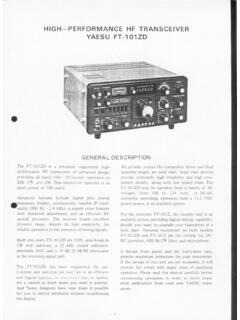
1 1 This manual was downloaded from Fox Tango PGAYAESUFT-101 ZDSurvival GuideVersion 4 Updated spring 2016 UPDAUPDAUPDAUPDAUPDATEDTEDTEDTEDTED2 This manual was downloaded from Fox Tango PGAFT-101Z MK03 This manual was downloaded from Fox Tango PGAY aesu FT-101Z/ZD series transceiverYaesu FT- 101zd pagePresented by:Fox Tango Internationaland PA PGAThe FT-101 historyThe original YAESU FT-101 series transceivers, produced in 1970-1978 in ever increasing numbers were a very goodalternative for the very expensive American made receivers and transmitters of the were full of useful options, for which you had to pay much $$$ extra (if available) in other ham like a battleship, with a modular construction, it was easy to repair, and the big numbers which are still around,prove the sound work of the YAESU engineers at the FT-101 series was very successful, and there were many versions of it, starting with the FT-101, released in 1970 tothe FT-101F, who was released in 1978.
2 See the FT-101 page on the FoxTang website for more information for the FT-101series of YAESU FT- 101zd was brought on the market in 1979, as a low-cost alternative for the FT-901ZD, which is the realdescendant of YAESU s famous FT-101 series of YAESU already had a very good reputation for performance and durability, it is no wonder that the new seriestransceivers became very popular in the ham community, special in Europe, because the high $$$ price of the availableAmerican equipment and the high import taxes on them, and the fact that there where almost no agents prohibited abroad distribution of American equipment. I still think the American industry at the time missed a chance Heathkit had a representative over here, and was very popular at the time for their nice had a small sales network in Europe and the Swiss firm Sommerkamp imported the same sets under their owntypenumbers and under the name Sommerkamp, they were a big success in Italy and manual was downloaded from Fox Tango PGAThe FT-101Z/ZDIn 1979 YAESU announced a new version of the FT-101, called the FT-101Z (analog dial) and ZD, (with digital dial).
3 The FT- 101zd looked very much like the FT-901, but had a simpler internal construction with just a couple of plug-in boardsfor HF, premixer and oscillator. The IF and the audio board, were connected with plugs from a wire harnass, the power supplyboards are soldered direct to the wire harnass, thus not the overall modular construction that made the older FT-101 andnew FT-901 so the construction of the FT- 101zd was simpler, the transceiver was packed with useful features, that appealed tomany hams, (including myself, I bought one in 1979, and still use it almost daily,).It had a very sensitive receiver, SSB and CW modes, a digital display, very liniair VFO, smooth tuning, a good set of filters, aPA with real transmitting tubes (6146B s), speech processor, IF shift with passbands between 300hz and , a clarifier,a calibrator and a noise blanker, making it a very complete package for a very reasonable price.
4 Later models had also AFnotch/peak filters, WARC bands and AM/FM capability. There were outputs for connection to a transverter and liniar amplifier,inputs for a second VFO and phone patch. It was one of the best buys you could made at the FT-901 had even more bells & whistles, but had also a $ 1000 higher transceiver is very well build, with good quality components, and, if used normally, will last forever. Weight is in excessof 15 kg, due the built-in power supply, giving it the feel of a powersupply can be fed from 100/110/117 or 200/220/235 Volts 50/60hz, and with the optional switching unit, evenfrom Vdc, altough you need a heavy-duty car battery. (current in voice peaks around 20 Amps).MK3FT- 101zd MK1 Analog model FT-101Z5 This manual was downloaded from Fox Tango PGAThe FT- 101zd is updated several times during its lifetime, and there are in fact 4 different types, using the same the introduction in 1979, the transceiver had only SSB and CW, later there was a AM (tx/rx) option, still later the Warcbands were introduced, and the last version had it all, including a optional AM or FM board, and Audio notch/peak later models have more features, so they are more in demand, and are normally higher priced in auctions or on theinternet.
5 It seems difficult to see what the difference is between the first and last models because there is not much changedon the there is a easy way to see at a glance the difference between the various models, the only thing you need toknow is the serial number of the YAESU serial number on the back of the set consists of a number, a letter and 6 numbers:The first number is the year of production:9=1979, 0=1980, 1=1981 letter is the production month:C=jan D=feb E=march next 2 numbers are the production run:from 01 (first series) to 30 and higher (last series)The next 4 numbers are the serial numbers:from 0001 to 9999 Identification of the model is easy by the use of the production run:FT-101Z/ZD MK0 Production run:01 07, all in 1979160-10m, SSB/CW, only, WWV rx-only, auxFT-101Z/ZD MK1 Production run:08 16160-10m, SSB/CW/AM, WWV rx-only, auxOnly Run 16 has the new type MK2 Production run:17 23160-10m + WARC, SSB/CW/AMFT-101Z/ZD MK3 Production run: 24 30 and + WARC, SSB/CW/AM or FMThe last serie is also easely identified by the grey and silver knobs on the FT-101Z, FT- 101zd :Type:Amateur HF transceiverFrequency Range:10-160m,(early models had no WARC bands)Mode:SSB/CW,(later models also AM or FM)RF Power output:SSB/CW100 WAM35 WSensitivity:SSB/ uV (10db S/n) uV (10db S/n)Selectivity: khz @ -6db,4 khz @ -60dbCW600 or 300 hz, (optional)Image rejection:- 60 db (160-15m)- 50 db (10m)DisplayFT-101 Zanalog dialFT-101 ZDanalog + digital dialPower:Mains,100-235 V ac 50 Vdc optionCurrent drain DC: Amps, Amps with heater off)Transmit:Max.
6 21 :50 75 ohms,SO-239 connectorDimensions345 * 157 * 326 mm (W*H*D)Weight:15 kilogramsManufactured:1979 1982 Accessoires:FV-101 Zexternal VFOFV-101 DMexternal scanning VFO (only for the Mk3)FL-2100 ZLinear Amplifier 1200W SSB, 1000W CWSP-901 PExternal Speaker/Phone PatchFC-901 Antenna CouplerTIP6 This manual was downloaded from Fox Tango PGAD ifferences between the Mk0/1/2/3 The MK0 model has SSB and CWonly, and covers the bands160,80,40,20,15 and switchboard in all models of theFT- 101zd has the same functions,but in the MK0, MK1 and MK2 modelsthey have black tumblers, in the Mk3they have silver tips, fitting by thesilver rings on the models have a width control forvarying the passband of the IFfilter(s), the MK3 has additional aaudio APF/Notch MK1 model has SSB, CW andAM , and covers the bands160,80,40,20,15 and MK2 model has SSB, CW andAM and covers the bands160,80,40,30,20,17,15,12 and MK3 model has SSB, CW andAM or FM and covers the bands160,80,40,30,20,17,15,12 and manual was downloaded from Fox Tango PGAThe Bandswitch of the MK0 and MK1 have 11 positions for the standard amateurs bands 160, 80, 40, 20, 15, 10m, areceive only position for 5 - Mhz, and a position for a optional band.
7 The MK2 and MK3 bandswitch has 12positions for the 160, 80, 40, 30, 20, 17, 15, 12 and 10M bands, so includes the WARC Preselector and the Plate tuning have in the MK0 and MK1 positions for the old hambands, in the MK2 and MK3they have also positions for the WARC bands that overlap here and three models have a clarifier, wich allows tuning of +/- 5 khz around the original frequency, just enough for split-frequency DX work, or for round-table QSO s, if one of the members is not spot-on the frequency. The clarifier can beused in receive or transmit mode, or the MK3 model ( here on the right) there is also a Squelch knob for use with the optional FM the FT- 101zd , a CW filter is an option, and can easely be installedon the IF board. The normal CW filter has a bandwith of 600 hz. Laterthere was also a filter of 300hz, but using this filter, there is aserious loss of signal, both on receive and transmit, because thesmaller CW FilterThe FT-101Z was the budget version of the FT- 101zd , with a nice andsurprisingly exact mechanical dial instead of a digital dial, but otherwiseboth models are the same in every FT-101Z was delivered in all the versions, from MK0 to digital counter module was an option and update is easy if you can findone because all wiring is available in every transceiver.
8 Just plug it all models with a serial number under 159999 you need the early typecounter module with TTL IC s, above 16000 the newer counter with LSI FT-101Z story8 This manual was downloaded from Fox Tango PGAThe used boards in detail:RF boardsPB1960A and PB2154 AContains the RF pre-amplifier, the receiver and transmitter mixer and a buffer stage,The mixer output of goes to the IF board. The in and output tuning of theRF amplifier is done by permeability-tuned circuits, resulting in high sensitivity andexcellent rejection of unwanted out-of-band difference between the two boards is the mixer. The PB1960A uses a balancedmixer with 2 Fet s, the later PB2154A board uses a diode ring mixer, for a better bigsignal RF board component sidePB-9060A RF board solder sideThe various models and the used boardsFT- 101zd MK0FT- 101zd MK1FT- 101zd MK2FT- 101zd MK3Sn#01 07xxxx08 16xxxx17 23xxxx24 upxxxxRF boardPB1960 APB1960 APB2154PB2154NB/FixPB1961 BPB1961 BPB1961 BPB1961 BPremixPB1962 APB1962 APB2152PB2152 IFPB1963 BPB1963 CPB1963 CPB1963 CAFPB1964 APB1964 APB1964 APB1964 APremix APB1967PB1967PB1967PB1967 Rect BPB1968 APB1968 APB1968 APB1968 ACapacitorPB1969 APB1969 APB1969 APB1969 ATrimmer APB1970PB1970PB1970PB2193 BTrimmer BPB1970PB1970PB1970PB2192 BTrimmer CPB1092PB1092PB1092PB1092 BandwidthPB1972PB1972PB1972-APF---PB2217 DriverPB1714 APB1714 APB1714 APB1714 AFinalPB1715 APB1715 APB1715 APB1715 AClarifierPB1973 APB1973 APB1973 APB1973 ALEDPB1974 APB1974 APB1974 APB1974 ALever switchPB1975 APB1975 APB1975 APB1975 ADisplayPB1978PB1978 (*)
9 PB2098 APB2098 ADecoderPB1979PB1979 (*)--CounterPB1980PB1980 (*)PB2086 APB2086 AAM (**)-PB2040PB2040PB2040FM (**)---PB2218(*)only production numbers starting 16xxxx had the PB2086A counter(**)optional, the AM board, or the FM board can be installed (MK3 only).PB-2154A RF board component side9 This manual was downloaded from Fox Tango PGAIF boardPB1963B/CThe IF board is the heart of the transceiver, and is the same in every type of signal is first passed trough a monolithic filter with a bandwith of 10 khz, to have a wide band point for noiseblanking. The signal pass then the noise blanker gate and is fed trough the SSB filter or the optional CW filter to the IFfirst mixer. Here the incoming signal is heterodyned with a Mhz local signal. This local signal is delivered from aXCO and the resulting mixing frequency is Mhz. This Mhz signal is fed trough a second SSB filter, and mixeswith the same Mhz local signal back to the original IF frequency of Mhz.
10 The Mhz XCO is tunedwith a varicap over a close range, and the result is that the passband of the first and second filter shifts along each other,so in effect making the passband smaller or broader, depending of the frequency of the XCO. It is a very useful item, youcan make the band pass as low as 300 hz, and as high as the original passband of the first filter. (SSB khz, CW 300 or600 hz). The skirt of the filters add, so the filter passband improves output from the second IF mixer is fed to a 2-stage IF amplifier, and is delivered to the AF the board are also a AGC amplifier and S-meter amplifier, the SSB tx IF filtering and the speech processor with board has the SSB filter installed, and there is room for installing a 300 or 600 hz CW filter ( ).NB-Fix unitPB1961 This board is also used in every FT- 101zd , and contains the noise blankercircuitry and a x-tal oscillator for 2 fixed frequencies.