Transcription of Your Guide to Breastfeeding
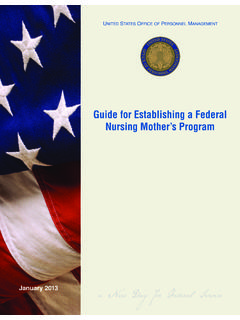
1 your Guide toBreastfeedingCommon Questionstear-outFeedingChart!Why Breastfeedingis imPortantWhy Breastfeedingis imPortantLearn about the health benefits for both mom and baby ! Pages 4-5 Learning to BreastFeedWhat you can do even before your baby is born. Page 11 Common QuestionsCan I breastfeed even if I am sick? Find out the answer to this question and others. Page 26tear-outFeedingChart! Page 45 Breastfeeding in PuBlicTips for making it work. Page 33commonchallengesLearn tips for saying farewell to sore nipples! Page Department of Health and Human Services, Office on Women s Health2 your Guide to BreastfeedingJanuary 2011 IntroductionThe experience of Breastfeeding is special for so many rea-sons, including:The joyful bonding with your baby The perfect nutrition only you can provide The cost savings The health benefits for both mother and baby In fact, breast milk has disease-fighting antibodies that can help protect infants from several types of illnesses.
2 And moth-ers who breastfeed have a lower risk of some health problems, including breast cancer and type 2 diabetes. Keep in mind that Breastfeeding is a learned skill. It requires patience and practice. For some women, the learning stages can be frustrating and uncomfortable. And some situations make breast-feeding even harder, such as babies born early or health problems in the mother. The good news is that it will get easier, and support for Breastfeeding mothers is growing. You are special because you can make the food that is unique-ly perfect for your baby . Invest the time in yourself and your baby for your health and for the bond that will last a Department of Health and Human Services Office on Women s Health (OWH) is raising awareness of the importance of Breastfeeding to help mothers give their babies the best start possible in life.
3 In addition to this Guide , OWH offers online content at and provides the National Breastfeeding Helpline at 800-994-9662. The Surgeon General s Call to Action to Support Breastfeeding puts forth steps that family members, communities, clinicians, health care systems, and employers can take to make Breastfeeding an easy choice for mothers. Learn more at OWH also partners with the Health Resources and Services Administration s Maternal and Child Health Bureau to educate employers about the needs of Breastfeeding mothers via The Business Case for Breastfeeding . The Affordable Care Act (health care reform) helps pregnant women and Breastfeeding mothers get the medical care and support they and their children need. Learn more at Department of Health and Human Services, Office on Women s HealthContents4 Why Breastfeeding is importantHealth benefits for babies and mothers6 finding support and informationTypes of health professionals who can help with breast-feeding, and how to find support by phone 8 how Breast milk is madeHow your body meets your baby s nutrition needs10 Before you give BirthSteps you can take before the baby arrives, and what your family members can do11 Learning to BreastfeedHow to hold your baby and know if your baby is getting enough breast milk18 Common ChallengesTips for troubleshooting common problems25 Common QuestionsFind out if your baby needs cereal, if you can take medicine, and more28 Breastfeeding a baby with health ProblemsDealing with jaundice, reflux.
4 And cleft palate and lip30 Breastfeeding and special situationsInformation for mothers of multiples, mothers who are adopting, and more33 Breastfeeding in PublicWays to feel comfortable feeding your baby while out and about34 Pumping and milk storageDifferent ways to express breast milk and how to store it37 going Back to WorkYour rights and how to talk to your employer about your Breastfeeding needs39 nutrition and fitnessHow to take care of yourself while breastfeeding42 handling stressCoping tips to keep stress at bay43 tear-out tools Write down questions to ask your doctor and your baby s doctor, and keep track of diapers and feedings 3 Tools you can useBreast milk storage Guide , page 36 Jot it down: questions to ask your baby s doctor (page 43) and questions to ask your health care provider (page 44)tear-out feeding chart, page 454 Why Breastfeeding is importantBreastfeeding Protects BabiesEarly breast milk is liquid Known as liquid gold, colostrum (coh-LOSS-trum) is the thick yellow first breast milk that you make during pregnancy and just after birth.
5 This milk is very rich in nutrients and anti-bodies to protect your baby . Although your baby only gets a small amount of colostrum at each feeding, it matches the amount his or her tiny stomach can hold. (See page 17 to see just how small your newborn s tummy is!) your breast milk changes as your baby Colostrum changes into what is called mature milk. By the third to fifth day after birth, this mature breast milk has just the right amount of fat, sugar, water, and pro-tein to help your baby continue to grow. It is a thinner type of milk than colostrum, but it provides all of the nutrients and antibodies your baby needs. Breast milk is easier to For most babies especially premature babies breast milk is easier to digest than formula. The proteins in formula are made from cow s milk, and it takes time for babies stomachs to adjust to digesting milk fights The cells, hormones, and antibodies in breast milk protect babies from illness.
6 This pro-tection is unique; formula cannot match the chemical makeup of human breast milk. In fact, among formula-fed babies, ear infections and diarrhea are more common. Formula-fed babies also have higher risks of:Necrotizing (nek-roh-TEYE-zing) entero- colitis (en-TUR-oh-coh-lyt-iss), a disease that affects the gastrointestinal tract in pre-term respiratory infections Atopic dermatitis, a type of skin rash Asthma Obesity Type 1 and type 2 diabetes Childhood leukemia Breastfeeding has also been shown to lower the risk of SIDS (sudden infant death syndrome).Formula-feeding can raise health risks in babies, but there are rare cases in which formula may be a necessary alternative. Very rarely, babies are born unable to tolerate milk of any kind. These babies must have soy formula. Formula may also be needed if the mother has certain health conditions and she does not have access to donor breast milk.
7 To learn more about rare Breastfeeding restrictions in the mother, see page 26. To learn more about donor milk banks, see page Glossarynutrients are any food substance that provides energy or helps build (AN-teye-bah-deez) are blood proteins made in response to germs or other foreign substances that enter the body. Antibodies help the body fight illness and disease by attaching to germs and marking them for gastrointestinal system is made up of the stomach, and the small and large intestines. It breaks down and absorbs respiratory system includes the nose, throat, voice box, windpipe, and lungs. Air is breathed in, delivering oxy-gen. Waste gas is removed from the lungs when you breathe out. 5 Mothers Benefit from BreastfeedingWays that Breastfeeding can make your 1. life easier. Breastfeeding may take a little more effort than formula feeding at first. But it can make life easier once you and your baby settle into a good routine.
8 When you breastfeed , there are no bottles and nipples to sterilize. You do not have to buy, measure, and mix formula. And there are no bottles to warm in the middle of the can save Formula and feeding supplies can cost well over $1,500 each year, depending on how much your baby eats. Breastfed babies are also sick less often, which can lower health care can feel great. 3. Physical contact is important to newborns. It can help them feel more secure, warm, and comforted. Mothers can benefit from this closeness, as well. Breastfeeding requires a mother to take some quiet relaxed time to bond. The skin-to-skin contact can boost the mother s oxytocin (OKS-ee-TOH-suhn) levels. Oxytocin is a hormone that helps milk flow and can calm the can be good for the mother s 4. health, too. Breastfeeding is linked to a lower risk of these health problems in women:Type 2 diabetes Breast cancer Ovarian cancer Postpartum depression Experts are still looking at the effects of Breastfeeding on osteoporosis and weight loss after birth.
9 Many studies have reported greater weight loss for Breastfeeding mothers than for those who don t. But more research is needed to understand if a strong link During an EmergencyWhen an emergency occurs, Breastfeeding can save lives: Breastfeeding protects babies from the risks of a contaminated water can help protect against respi- ratory illnesses and diarrhea. These diseases can be fatal in populations displaced by milk is the right temperature for babies and helps to prevent hypothermia when the body temperature drops too milk is readily available without need- ing other mothers miss less Breastfeeding mothers miss fewer days from work because their infants are sick less Benefits SocietyThe nation benefits overall when mothers breast-feed. Recent research shows that if 90 percent of families breastfed exclusively for 6 months, nearly 1,000 deaths among infants could be prevented.
10 The United States would also save $13 billion per year medical care costs are lower for fully breast-fed infants than for never-breastfed infants. Breast-fed infants typically need fewer sick care visits, prescriptions, and hospitalizations. Breastfeeding also contributes to a more produc-tive workforce because mothers miss less work to care for sick infants. Employer medical costs are also lower. Breastfeeding is also better for the environment. There is less trash and plastic waste compared to that produced by formula cans and bottle supplies. 6 Finding support and informationWhile Breastfeeding is natural, you still may need some advice. There are many sources of support available for Breastfeeding mothers. You can seek help from different types of health professionals, organizations, and members of your own family. Under the Affordable Care Act (health care re-form), more and more women will have access to Breastfeeding support without any out-of-pocket costs.