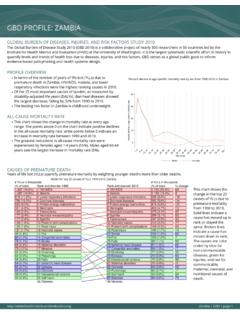
Transcription of Zambia: Nutrition Profile
1 1 Updated June 2014 zambia : Nutrition Profile Background zambia has experienced rapid economic growth over the past decade and has graduated from a low-income to a lower-middle-income country. A combination of prudent macroeconomic management, market liberalization and privatization efforts, and investments in the copper industry and related infrastructure has helped achieve average annual GDP growth of about percent. zambia s economic growth has not translated into significant poverty reduction, however: 60 percent of the population live below the poverty line, and 42 percent live in extreme Regional disparities are very strong, with 70 percent of the rural population living in poverty, compared to 22 percent in the Copperbelt and 34 percent in Lusaka. With a predominantly young and rural population, and 67 percent of the labor force engaged in agriculture,2 zambia will need to focus on its largely untapped agricultural potential and improve the rural economy in order to accelerate growth and reduce poverty.
2 zambia is unlikely to meet many of the Millennium Development Goal (MDG) targets by 2015, including reducing extreme poverty and hunger (MDG 1) and improving maternal health (MDG 5). Child mortality rates have declined since the early 1990s, which can be attributed to increases in immunization coverage, exclusive breastfeeding, vitamin and mineral supplementation, and malaria prevention and treatment, but these and other interventions must be accelerated if the MDG 4 goal is to be met by Nutrition Situation zambia s food security challenges are exacerbated by high dependence on rain-fed agriculture and the lack of market incentives that would encourage a shift from subsistence farming. The number of people at risk of food insecurity rose from 63,000 in 2012 to about 209,000 in 2013 as a result of poor crop production caused by poor weather Food insecurity and chronic undernutrition remain critical issues, with almost half of children under 5 years of age High morbidity, limited access to health services, poverty and food insecurity are the major determinants of undernutrition in children.
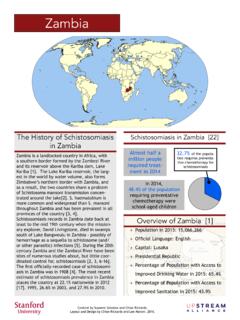
3 Though the 2007 Demographic and Health Survey did not include data on micronutrient deficiencies, data from 2003 showed that anemia and subclinical vitamin A deficiency are highly prevalent, affecting at least 50 percent of children under 5, while 30 percent of women of reproductive age are Such widespread deficiencies are not unexpected, given that the diet is mainly composed of cereals (maize) and starchy roots and very little micronutrient-dense food such as animal products, fruits and vegetables. Though rates of exclusive breastfeeding during early infancy have increased, only 37 percent of children 6-23 months receive a minimum acceptable diet, which has a major impact on their growth and development. zambia Nutrition Data Population Million Population under 5 years of age (0-59 months) Million 20017 20075 Prevalence of stunting among children under 5 (0-59 months) 53% 45% Prevalence of underweight among children under 5 (0-59 months) 23% 15% Prevalence of wasting among children under 5 (0-59 months) 6% 5% Prevalence of anemia among children aged 6-59 months n/a n/a Prevalence of anemia among women of reproductive age (15-49 years) n/a n/a Prevalence of thinness among women of reproductive age (15-49 years) 15% 10% Prevalence of children aged 0-5 months exclusively breastfed 40% 61% Prevalence of breastfed children aged 6-23 months receiving a minimum acceptable diet n/a 37% National Nutrition Policies zambia is fully committed to improving the food security and Nutrition of its population.
4 A National Food and Nutrition Strategic Plan (2011-2015) is coordinated by the National Food and Nutrition Commission (NFNC), the designated convening body to coordinate action on Nutrition . A Cooperating Partner Nutrition Group includes development partners and agencies that provide financial and technical support for Nutrition -related programming. Both direct Nutrition interventions and Nutrition -sensitive programs have been aligned around five priorities of the First 1,000 Most Critical Days Program (1st 1000 MCDP). In 2010, zambia joined Scaling Up Nutrition (SUN), a global movement that unites national leaders, civil society, bilateral and multilateral organizations, donors, businesses and researchers in a collective effort to improve Nutrition . UNICEF and DFID are the donor conveners for SUN in zambia . The Government s commitment to agricultural development is demonstrated by its 2011 CAADP (Comprehensive Africa Agriculture Development Programme) Compact. CAADP is an African-led program bringing together governments and diverse stakeholders to reduce hunger and poverty and promote economic growth in African countries through agricultural development.
5 The CAADP is congruent with the government s Sixth National Development Plan (SNDP), which runs from 2011 to 2015, and it fits in zambia s Vision 2030 target of becoming a middle-income country. USAID Program s: Accelerating Progress in Nutrition Highlighted Bilateral Nutrition Projects in zambia Project Name Year Awarded End Date Objective(s) Funding Stream(s) Mawa ( zambia Economic Resilience for Improved Food Security) 2012 2017 Sustainably improve the food and economic security of smallholder households in the Chipata and Lundazi districts of Eastern Province through increased diversified agricultural production for Nutrition and market, improved health and nutritional status, and increased income and productive assets. PEPFAR and Feed the Future Thrive (formerly ZAMNACS) December 2012 November 2017 Provide Nutrition assessment, counseling and support for people living with HIV, prevention of mother-to-child transmission clients, and orphans and vulnerable children, and to support local food processors to produce high-energy protein supplements.
6 PEPFAR 2 Updated June 2014 zambia Integrated System Strengthening Program (ZISSP) June 2010 December 2014 Improve health outcomes by strengthening health systems and service delivery related to Nutrition and other public health programs. The program improves planning, implementation and monitoring of essential Nutrition actions. PEPFAR and MCH Feed the Future Progress Feed the Future, the Government s global hunger and food security initiative, is composed of four major projects. The overall Feed the Future strategy is meant to raise incomes; diversify production of staple foods; improve food security through upgrading agricultural value chains, targeting crops that are nutritious or key to food security; and change behavior practices related to food consumption and Nutrition . Feed the Future programs are being implemented in Eastern Province, with a value chain focus on oilseeds, legumes and maize, and in selected peri-urban districts near Lusaka that connect to Eastern Province, with a focus on USAID/ zambia Feed the Future Targets for 2015 Help an estimated 263,000 vulnerable Zambian women, children and family members mostly smallholder farmers escape hunger and poverty.
7 Reach more than 170,000 children with services to improve their Nutrition and prevent stunting and child mortality. Achieve improved income and nutritional status for significant numbers of additional rural populations through strategic policy engagement and institutional investments. 3 Updated June 2014 The zambia Economic Resilience Program for Improved Food Security (ZERS) (branded as the Mawa Project) is the newest Feed the Future project and is designed to assist farming households in two districts in realizing the nutritional and economic benefits of diversified agricultural production. It will support vulnerable risk-averse farmers, particularly women, in adopting improved technologies and farming practices, and prepare them to enter the marketplace. The ZERS project will also provide Nutrition assessment, counseling and support (NACS) to households, focusing on the first 1,000 days. Care Groups will promote and support essential Nutrition actions (ENA) and community-based growth monitoring and promotion (GMP).
8 Two additional Feed the Future projects are the zambia Agricultural Research and Development Program, which is improving crop varieties and technologies, promoting bio-fortified maize and orange sweet potatoes, and pursuing aflatoxin reduction in maize and groundnuts; and the PROFIT+ project, which focuses on value chain upgrading for small-scale farmers on staple food commodities such as groundnuts, soy and maize to diversify production and consumption. In FY2012, Feed the Future Washington completed a cost-benefit analysis of PROFIT+ and found that it was one of the best Feed the Future investments worldwide, with a 59 percent economic rate of return, compared to an average of 22 percent for most Feed the Future Another project, Better Life Alliance, targets vulnerable households in Eastern Province to improve household-level promoted land management practices through conservation farming. In FY2012, this project trained 30,009 farmers in conservation agriculture and agroforestry, resulting in 11,610 hectares under improved management.
9 Yields increased by 79 percent for groundnuts, 55 percent for beans and 117 percent for rice over one The main USAID (GHCS) health project implementing Nutrition intervention in zambia is the zambia Integrated Systems Strengthening Program (ZISSP), which supports the Ministry of Health and NFNC, builds capacity of health providers and volunteers, and conducts behavior change communication (BCC) activities in line with ENA. A second USAID (GHCS, PEPFAR, PMI) health project is the Communications Support for Health (CSH) project, which is helping the NFNC to develop and implement a national Nutrition communications campaign called the 1,000 Most Critical Days Nutrition Campaign, and comprises posters, billboards, TV advertisements and radio programs. zambia : Feed the Future Zones of Influence 4 Updated June 2014 Active Global Nutrition Mechanisms The Food and Nutrition Technical Assistance (FANTA) III project has been working with the Ministry of Health, Ministry of Community Development, Mother and Child Health, National HIV/AIDS/STI/TB Council, NFNC and other partners to develop guidelines and a flip chart to provide updated information on NACS to people living with HIV and to orphans and vulnerable children (OVC).
10 Ot her USAID Nut rit ion-Related Development Assistance The main USAID HIV multisectoral response dealing with Nutrition is the zambia Nutrition Assessment, Counseling, and Support (ZAMNACS), now renamed as the Thrive project, which focuses on NACS services to clients of HIV services. It will provide therapeutic and supplemental feeding to severely and moderately malnourished HIV clients, pregnant women, children under 2, and OVC at the health facility and community levels. For people living with HIV, the project aims to improve nutritional status, antiretroviral therapy (ART) and palliative care outcomes. zambia joined the Committing to Child Survival: A Promise Renewed campaign in 2012, and pledged to reduce under-5 mortality to 20 or fewer deaths per 1,000 live births by 2035 by reducing the leading preventable causes of child mortality, including undernutrition. References 1. The World Bank zambia Country Overview, 2013: 2. zambia Commercial Value C hains in Zambian A griculture: Do Smallholders B enefit?