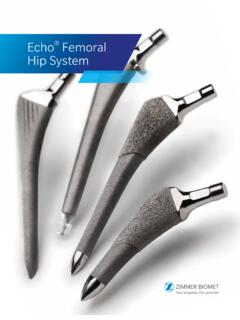
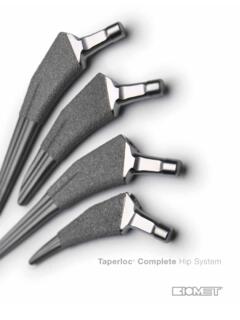
Transcription of Zimmer Hip Prosthesis
1 Zimmer M/L Taper Hip ProsthesisSurgical TechniqueZimmer M/L Taper Hip ProsthesisFA DRAFT August 11, 2014 11:44 AM1 Zimmer M/L TaperHip Prosthesis Surgical TechniqueTable of ContentsPreoperative Planning 2 Determination of Leg Length 2 Determination of Abductor Muscle Tension and Femoral Offset 2 Component Size Selection/Templating 3 Surgical Technique 5 Exposure 5 Determination of Leg Length 5 Osteotomy of the Femoral Neck 5 Preparation of the Femur 6 Femoral Rasping 7 Rasp Options 7 Differentiating Between System and 0mm Rasp 7 Torque the Rasp (Optional) 7 Calcar Planing (Optional) 7 Trial Reduction 8 Insertion of the Femoral Component 8 Optional Insertion Technique 9 Femoral Component Extraction 9 Attachment of the Femoral Head 9 Wound Closure 9 Postoperative Management 9 Zimmer M/L Taper Hip Prosthesis Dimensions 10 Zimmer M/L Taper Hip Prosthesis Instrumentation 12 2 Zimmer M/L Taper Hip ProsthesisFA DRAFT August 11, 2014 11:44 AMPreoperative PlanningEffective preoperative planning allows the surgeon to predict the impact of different interventions in order to perform the joint restoration in the most accurate and safe manner.
2 Optimal femoral stem fit, the level of the femoral neck cut, the prosthetic neck length, and the femoral component offset can be evaluated through preoperative radiographic analysis. Preoperative planning also allows the surgeon to have the appropriate implants available at objectives of preoperative planning include:1 Determination of leg length2 Establishment of appropriate abductor muscle tension and femoral offset3 Determination of the anticipated component sizeThe overall objective of preoperative planning is to enable the surgeon to gather anatomic parameters which will allow accurate intraoperative placement of the femoral of Leg LengthDetermining the preoperative leg length is essential for restoration of the appropriate leg length during surgery. If there are concerns regarding lower extremity or lumbar abnormalities, such as equinus of the foot, flexion or varus/valgus deformities of the knee, or scoliosis, perform further radiographic evaluation to aid in the determination of preoperative leg length anterior/posterior (A/P) pelvic radiograph often gives enough documentation of leg length inequality to proceed with surgery.
3 If more information is needed, a scanogram or CT evaluation of leg length may be helpful. From the clinical and radiographic information on leg lengths, determine the appropriate correction, if any, to be achieved during the limb is to be significantly shortened, osteotomy and advancement of the greater trochanter or a subtrochanteric shortening osteotomy may be necessary. If the limb is shortened without osteotomy and advancement of the greater trochanter, the abductors will be lax postoperatively, and the risk of dislocation will be high. Also, gait will be compromised by the laxity of the abductors. If leg length is to be maintained or increased, it is usually possible to perform the operation successfully without osteotomy of the greater trochanter. However, if there is some major anatomic abnormality, osteotomy of the greater trochanter may be of Abductor Muscle Tension and Femoral OffsetOnce the requirements for establishing the desired postoperative leg length have been decided, the next step is to consider the requirement for abductor muscle tension.
4 When templating, center the femoral component in the canal. Choose the offset (standard or extended) that most closely approximates that of the patient when the new center of rotation is determined (after acetabular component templating). For patients with a very large distance between the center of rotation of the femoral head and the line that is centered in the medullary canal, insertion of a femoral component with a lesser offset will, in effect, medialize the femoral shaft. To the extent that this occurs, laxity in the abductors will result with a heightened dislocation rare, it may not be possible to restore offset in patients with an unusually large preoperative offset or with a severe varus deformity. In such cases, tension in the abductors can be increased by lengthening the limb, a method that is especially useful when the involved hip is short. If this option is not advisable and if the disparity is great between the preoperative offset and the offset achieved at surgery by using the longest head/neck piece possible, some surgeons may choose to osteotomize and advance the greater trochanter to eliminate the slack in the abductor muscles.
5 Technical variations in the placement of the acetabular components can also reduce the differences in M/L Taper Hip ProsthesisFA DRAFT August 11, 2014 11:44 AMComponent Size Selection/TemplatingPreoperative planning for insertion of a cementless femoral component requires at least two radiographic views of the involved femur: an A/P view of the pelvis centered at the pubic symphysis, and a frog leg lateral view on an 11x17-inch cassette. Both views should show at least 8 inches of the proximal femur. In addition, it may be helpful to obtain an A/P view of the involved side with the femur internally rotated. This compensates for naturally occurring femoral anteversion and provides a more accurate representation of the true medial-to-lateral dimension of the metaphysis. When templating, magnification of the femur will vary depending on the distance from the x-ray source to the film, and the distance from the patient to the film. Magnification markers can be used to identify the actual magnification of the radiograph.
6 Knowing this will help to more accurately predict the component size when templating. The Zimmer M/L Taper Hip System Templates (Fig. 1) use standard 20 percent magnification, which is near the average magnifica-tion on most clinical radiographs. Preoperative planning is important in choosing the optimal acetabular component, and in providing an estimation of the range of acetabular components that might ultimately be required. The initial templating begins with the A/P radiograph. Superimpose the acetabular templates sequentially on the pelvic radiograph with the acetabular component in approximately 40 degrees of abduction. Range of motion and hip stability are optimized when the socket is placed in approximately 35 to 45 degrees of abduction. Assess several sizes to estimate which acetabular component will provide the best fit for maximum coverage. (Refer to your preferred Zimmer acetabular system surgical technique for further details on acetabular reconstruction.)
7 Consider the amount of medialization and liner options in estimating the optimum femoral neck length to be used. Mark the acetabular size and position, and the center of rotation on the objectives in templating the femoral component include determining the anticipated size of the implant to be inserted and the location of the femoral neck osteotomy. The Zimmer M/L Taper Hip Prosthesis is available in 14 body sizes ( through ).The femoral templates show the neck length and offset for each of the head/neck combinations ( to + , depending on head diameter). Note: Skirts which may limit range of motion are present on 26mm +7mm, and 26/28/32/36mm + femoral heads. WARNING: Higher offsets may increase the potential for ceramic head 14 Zimmer M/L Taper Hip ProsthesisFA DRAFT August 11, 2014 11:44 AMTo estimate the femoral implant size, assess the body size on the A/P radiograph. Superimpose the template on the metaphysis and estimate the appropriate size of the femoral stem.
8 The body of the femoral component should fit, or nearly fit, the medial- lateral dimensions of the medullary canal on the A/P x-ray film, and should not be superimposed onto cortical bone. It is not necessary for the stem to have cortical contact in the medul-lary establishing the proper size of the femoral component, determine the height of its position in the proximal femur and the amount of offset needed to provide adequate abductor muscle tension. Generally, if the leg length and offset are to remain unchanged, the center of the head of the Prosthesis should be at the same level as the center of the femoral head of the patient s hip. This should also correspond to the center of rotation of the templated acetabulum. To lengthen the limb, raise the template proximally. To shorten the limb, shift the template distally. The extended offset option offers lateral translation of 5mm. This allows for an offset increase of 5mm without changing the vertical height or leg length.
9 The femoral head neck length will also affect leg length and offset. Once the height has been determined, note the distance in millimeters from the underside of the osteotomy line to the top of the lesser trochanter by using the millimeter scale on the template. For example, one might decide from the templating that a 52mm OD socket, with a size 15 Prosthesis and a + x 28mm diameter femoral head, placed 15mm above the lesser trochanter, are the appropriate choices. Proximal/distal adjustments in Prosthesis position can reduce the need for a femoral head with a skirt. The Zimmer M/L Taper Hip System accommodates a variety of Zimmer head diameters with a 12/14 internal taper. The intermediate femoral heads allow the use of an acetabular compo-nent with an outside diameter small enough to seat completely in the bone while also allowing for a polyethylene liner of sufficient thickness. In special circumstances, such as the treatment of small patients and patients with congenital hip dysplasia and small acetabular volume, size 22mm heads are available.
10 5 Zimmer M/L Taper Hip ProsthesisFA DRAFT August 11, 2014 11:44 AMSurgical TechniqueExposureIn total hip arthroplasty, exposure can be achieved through a variety of methods based on the surgeon s preference. The Zimmer M/L Taper Hip Prosthesis can be implanted using a variety of standard surgical more information regarding vari-ous surgical approaches, contact your Zimmer of Leg LengthEstablish landmarks and take measurements before dislocation of the hip so that after reconstruction, a comparison of leg length and femoral shaft offset can be obtained. From this comparison, adjustments can be made to achieve the goals established during preoperative planning. There are several methods to measure leg length. One method is to fix a leg length caliper to the wing of the ilium. Then, take baseline measurements to a cautery mark at the base of the greater trochanter while marking the position of the lower limb on the neutral alignment has been determined, move the template proxi-mally or distally to the correct height as determined by preoperative planning.