081-2011: Building Match Code Using SAS®
1 Paper 081-2011 Building Match Code Using SAS® David Li, Prime Therapeutics, Eagan, MN, United States ABSTRACT Business analysis frequently entails joining data from different sources.
Download 081-2011: Building Match Code Using SAS®

Information
Domain:
Source:
Link to this page:
Documents from same domain
027-2009: Tips and Tricks for Creating the Reports …
support.sas.comPaper 027-2009 TIPS AND TRICKS FOR CREATING THE REPORTS YOUR CLIENTS NEED TO SEE Michael J Molter, INC Research, Raleigh, NC ABSTRACT Advanced reporting tools such as PROC REPORT have progressed by leaps and …
Step-by-Step Programming with Base SAS Software
support.sas.comThe correct bibliographic citation for this manual is as follows: SAS Institute Inc. 2001. Step-by-Step Programming with Base SAS® Software.Cary, NC: SAS Institute Inc.
227-2012: Executing a PROC from a DATA Step - …
support.sas.com2 Using RUN_MACRO to execute a PROC from a DATA step requires writing three blocks of code, described in the Introduction: a macro to execute a PROC, a user-written function to execute the macro, and a DATA step to call the
149-2012: Queries, Joins, and WHERE Clauses, Oh …
support.sas.comPaper 149-2012 Queries, Joins, and WHERE Clauses, Oh My!! Demystifying PROC SQL Christianna S. Williams, Chapel Hill, NC ABSTRACT Subqueries, inner joins, outer joins, HAVING expressions, set operators…just the terminology of PROC SQL might
158-2010: How to Use Arrays and DO Loops: Do I …
support.sas.com1 Paper 158-2010 How to Use ARRAYs and DO Loops: Do I DO OVER or Do I DO i? Jennifer L Waller, Medical College of Georgia, Augusta, GA ABSTRACT
248-2009: Learning When to Be Discrete: …
support.sas.com1 Paper 248–2009 Learning When to Be Discrete: Continuous vs. Categorical Predictors David J. Pasta, ICON Clinical Research, San Francisco, CA ABSTRACT
338-2011: An Introduction to Survival Analysis …
support.sas.com2 (Censored) Study Ends (From Applied Survey Data Analysis, p. 306) Figure 1. Prospective View of Event History Survey Data Time can be regarded as continuous or discrete and this basic distinction affects the analytic approach selected.
Dongsheng Yang and Jarrod E. Dalton - SAS
support.sas.com1 Paper 335-2012 A unified approach to measuring the effect size between two groups using SAS® Dongsheng Yang and Jarrod E. Dalton Departments of Quantitative Health Sciences and Outcomes Research
SAS/STAT 9.2 User's Guide: Introduction to Power …
support.sas.comSAS/STAT ® 9.2 User’s Guide Introduction to Power and Sample Size Analysis (Book Excerpt) SAS® Documentation
249-2012: A Tutorial on the SAS® Macro Language
support.sas.com1 Paper 249-2012 A Tutorial on the SAS® Macro Language John J. Cohen, Advanced Data Concepts LLC, Newark, DE ABSTRACT The SAS macro language is another language layering on top of regular SAS code.
Related documents
Minimum Academic and Relevant Work Experience …
sas.undp.orgMinimum Academic and Relevant Work Experience Requirements for Recruiting Staff in UNDP (Including Step Determination) Effective 1 July 2009
Proc SQL – A Primer for SAS Programmers
scsug.orgProc SQL – A Primer for SAS Programmers Jimmy DeFoor Citi Card Irving, Texas The Structured Query Language (SQL) has a very different syntax and, often, a very different method
MERGING vs. JOINING: Comparing the DATA Step with SQL
support.sas.com1 Paper 036-2009 MERGING vs. JOINING: Comparing the DATA Step with SQL Malachy J. Foley, Chapel Hill, NC ABSTRACT Which merges files better: the SAS DATA Step or SAS SQL?

NTSYSpc - Exeter Software
www.exetersoftware.comNTSYSpc Numerical Taxonomy and Multivariate Analysis System Version 2.1 User Guide F. James Rohlf Department of Ecology and Evolution State University of New York
Advanced Subqueries In PROC SQL - Welcome to Systems ...
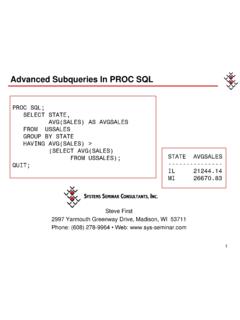
www.sys-seminar.com3 Review of PROC SQL Basics • Introduction / Features • The SELECT Statement • Writing reports using SQL • Creating a SAS dataset • Joining Tables
249-30: Merging versus Joining: Comparing the DATA ... - SAS
www2.sas.comPaper 249-30 MERGING vs. JOINING: Comparing the DATA Step with SQL Malachy J. Foley University of North Carolina at Chapel Hill, NC ABSTRACT Which merges files better: the SAS DATA Step or SAS …

Tom Enders - Airbus
www.airbus.comTom Enders Dr. Thomas (“Tom”) Enders was appointed Chief Executive Officer (CEO) of Airbus SE, on 1 June 2012, after having been CEO of the Airbus Commercial

Note : saying that the real qualification data base is the ...
www.aljo.deIn accordance with Airbus Procedure AP5270, this attestation is granted to This attestation demonstrates recognition of Airbus Qualifications for :
178-2008: Joining Data: DATA Step Merge or SQL?
www2.sas.comDec 14, 2007 · 2 THE DATA This paper will use two different sets of data to illustrate the join dynamics using data step MERGE and SQL JOIN. The initial data is a small subset ( found in the Appendix A ) used to illustrate the effect of the various
Related search queries
Academic and Relevant Work Experience, Academic and Relevant Work Experience Requirements, A Primer for SAS Programmers, MERGING vs. JOINING: Comparing the DATA Step, Numerical Taxonomy and Multivariate Analysis, Advanced Subqueries In PROC SQL, JOINING, 30: Merging versus Joining: Comparing the, Tom Enders, Airbus, Tom”) Enders, 2008: Joining Data: DATA Step Merge