
1.11. Hazard Classification
Classification of hazards Sudden or slow onset Natural (physical) Manmade/Technological Weather related (meteorological Earth movement 1. External (topographical) 2. Internal (tectonics & tellurics) − Industrial disasters − Nuclear accidents − Chemical accidents − Fires − Wars, civil strife − Structural failures Natural (biological) 1.
Download 1.11. Hazard Classification

Information
Domain:
Source:
Link to this page:
Documents from same domain
Annex 9 - World Health Organization
apps.who.intAnnex 9 Guide to good storage practices for pharmaceuticals1 1. Introduction 1 2. Glossary 2 3. Personnel 3 4. Premises and facilities 4 5. Storage requirements 5
Pharmaceutical regulation: A twelve country study …
apps.who.intThis document should be considered a draft report as not all of the data presented has been officially endorsed by national authorities Page 2
Annex 2 Stability testing of active pharmaceutical ...
apps.who.int88 1. Introduction 1.1 Objectives of these guidelines These guidelines seek to exemplify the core stability data package required for registration of active pharmaceutical ingredients (APIs) and
chapter 44 Medical stores management - WHO
apps.who.intchapter 44 Medical stores management Summary 44.2 44.1 Information for materials management 44.2 Manual versus computerized systems • Figure 44-2Procurement
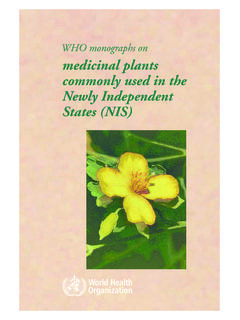
WHO monographs on medicinal plants commonly …
apps.who.intWHO Library Cataloguing-in-Publication Data WHO monographs on medicinal plants commonly used in the Newly Independent States (NIS). 1.Plants, Medicinal. 2.Medicine, Traditional. 3.Angiosperms. 4.Commonwealth of Independent States.
WHO guidelines for assessing
apps.who.intvii Foreword The use of medicinal plants for treating diseases is probably the oldest existing method that humanity has used to try to cope with illness.
MOHFormulary Drug List - WHO
apps.who.int8 9 INTRODUCTION USE of FORMULARY MOH Formulary Drug List Is Divided Into Three Sections. The First Section Is a Compilation of Selected Policies , Guidelines,
The Logistics Handbook - WHO
apps.who.intThe Logistics Handbook A Practical Guide for the Supply Chain Management of Health Commodities 2011 . This publication was produced for review by the U.S. Agency for International Development.

Contents
apps.who.intHealth Systems Profile- Egypt Regional Health Systems Observatory- EMRO 1 Contents FOREWORD.....5
Regulatory Situation of Herbal Medicines A …
apps.who.intRegulatory Situation of Herbal Medicines A worldwide Review FOREWORD Although modern medicine is well developed in most of the world, large sections of the
Related documents
Science Georgia Standards of Excellence Seventh Grade ...
www.georgiastandards.orgreproduction, autotroph, heterotroph, and unique cell structures. Modern classification will be addressed in high school.) S7L2. Obtain, evaluate, and communicate information to describe how cell structures, cells, tissues, organs, and organ systems interact to maintain the basic needs of …
Waste Disposal Procedures - Cornell University
ehs.weill.cornell.eduManual to instruct generators in the proper management of chemical, biological, and universal wastes. The Office of Health Physics manages and provides guidance on the disposal of radioactive wastes. Special consideration must be taken when wastes consist of mixtures of chemical, biological, and/or radiological materials (“mixed wastes”).
<88> BIOLOGICAL REACTIVITY TESTS, IN VIVO
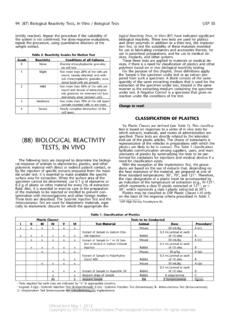
www.drugfuture.comUSP 35 Biological Tests / 〈88〉 Biological Reactivity Tests, In Vivo 95 This classification does not apply to plastics that are in-Table 2. Evaluation of Skin Reactions (Continued) tended for use as containers for oral or topical products, or that may be used as an integral part of a drug formulation.Moderate to severe erythema 3
The Approved List of biological agents - MISC208
www.hse.gov.ukbiological agents in Hazard Groups 2, 3 and 4 to assess the risk of exposure to those biological agents. One of the matters to take into account in such a risk assessment is the approved classification of the relevant biological agents. COSHH specifies four containment levels for activities which involve working with biological agents.
HAPTER 2 BIOLOGICAL CLASSIFICATION
ncert.nic.inBIOLOGICAL CLASSIFICATION 21 2.2.2 Dinoflagellates These organisms are mostly marine and photosynthetic. They appear yellow, green, brown, blue or red depending on the main pigments present in their cells.

TABLE OF CONTENTS - OPM.gov
www.opm.govBiological Sciences Group, 0400, for General Schedule and other “white collar” pay plans. In the General Schedule position classification system established under chapter 51 of title 5, United States Code, the positions addressed here would be two-grade interval positions. This JFS is divided into three parts.

C 2 IOLOGICAL CLASSIFICATION
ncert.nic.inBIOLOGICAL CLASSIFICATION 17 R.H. Whittaker (1969) proposed a Five Kingdom Classification. The kingdoms defined by him were named Monera, Protista, Fungi, Plantae and Animalia. The main criteria for classification used by him include cell structure, thallus organisation, mode of nutrition,