
1. Engineering Structures and Materials - Memphis
Mechanics of materials is a branch of applied mechanics that deals with the behavior of ... fields. Of course, statics and dynamics are also essential, but they deal primarily with the ... The mechanical properties of materials used in engineering are determined by tests per-
Download 1. Engineering Structures and Materials - Memphis

Information
Domain:
Source:
Link to this page:
Documents from same domain
Chapter 11 SEISMIC DESIGN CRITERIA - Civil …
www.ce.memphis.eduP1: JsY ASCE003-11.tex ASCE003/SIE-v1.cls September 29, 2005 17:5 Chapter 11 SEISMIC DESIGN CRITERIA 11.1 GENERAL 11.1.1 Purpose. Chapter 11 presents criteria for the design and
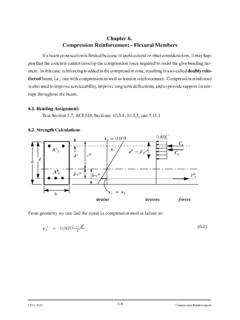
Chapter 6. Compression Reinforcement - Flexural …
www.ce.memphis.eduCIVL 4135 118 Compression Reinforcement Chapter 6. Compression Reinforcement - Flexural Members Ifabeamcrosssectionislimitedbecauseofarchitecturalorotherconsiderations,itmayhap-
Review of Engineering Fundamentals - University …
www.ce.memphis.eduReview of Engineering Fundamentals CIVL 4197. Course Format ... FE Chemical 853 77% FE Civil 4,874 70% FE Electrical & Computer 1,217 …

ASCE Requirements for Citations f13 - Civil …
www.ce.memphis.eduASCE Requirements for Citations Books Feld, J. and Carper, K. (1997). Construction Failure, 2nd Ed., Wiley, New York. Book references must include author, book title, publisher, and the publisher’s

2 - Aggregate Gradation and Sampling - Civil …
www.ce.memphis.eduCIVL 3137 3 Gradation Analysis percent coarser or percent retained percent finer or percent passing
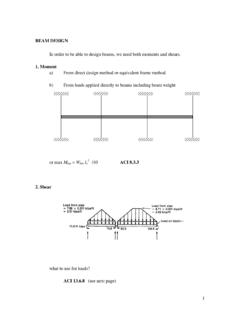
BEAM DESIGN - University of Memphis
www.ce.memphis.edu6 2. SHEAR DESIGN IN FLAT PLATES AND FLAT SLABS When two-way slabs are supported directly by columns, as in flat slabs and flat plates, or when slabs carry concentrated loads, as in footings, shear near the columns is of critical
Topic 14 - Foundation Design - Civil Engineering
www.ce.memphis.eduInstructional Materials Complementing FEMA 451, Design Examples Foundation Design 14-7 Reinforced Concrete Footings: Basic Design Criteria (concentrically loaded) d/2 …
Curing Concrete, Chapter 12 - The University of …
www.ce.memphis.edu221 Chapter 12 Curing Concrete 3. Methods that accelerate strength gain by supplying heat and additional moisture to the concrete. This is usually accomplished with live steam, heating coils,
AAA CE4135 ver2 - Civil Engineering
www.ce.memphis.eduCIVL 4135 Chapter 1. Introduction • 2 A problem unique to the design of reinforced concrete structures is the need to detail each member throughout.

Aggregates for Concrete - Department of Civil …
www.ce.memphis.eduT 27). The range of particle sizes in aggregate is illustrated in Fig. 5-4. The aggregate particle size is determined by using wire-mesh sieves with square openings.
Related documents
SOLID MECHANICS TUTORIAL – MECHANISMS …
www.freestudy.co.ukSOLID MECHANICS TUTORIAL – MECHANISMS KINEMATICS - VELOCITY AND ACCELERATION DIAGRAMS This work covers elements of the syllabus for the Engineering Council exams C105 Mechanical and Structural Engineering and D225 Dynamics of Mechanical Systems. On completion of this short tutorial you should be able to do the following. • Describe …
Lecture 9 – Modeling, Simulation, and Systems Engineering
web.stanford.eduControl Engineering 9-10 ( , ,) ( , , ) y g x u t x f x u t = &= Modeling approaches • Controls analysis uses deterministic models. Randomness and uncertainty are usually not dominant. • White box models: physics described by ODE and/or PDE • Dynamics, Newton mechanics • Space flight: add control inputs u and measured outputs y x&= f (x,t)
Solving Practical Engineering Mechanics Problems: Statics
www.morganclaypoolpublishers.comproblems independently. This book is a part of a four-book series designed to supplement the engineering mechanics courses. This series instructs and applies the principles required to solve practical engineering problems in the follow-ing branches of mechanics: statics, kinematics, dynamics, and advanced kinetics. Each book contains between 6 ...
Introduction to STATICS DYNAMICS Chapters 1-10 - Fisica
www.fisica.netJan 21, 2001 · This is a statics and dynamics text for second or third year engineering students with an emphasis on vectors, free body diagrams, the basic momentum balance principles, and the utility of computation. Students often start a course like this thinking of mechanics reasoning as being vague and complicated. Our aim is to replace this
Introduction to the Mechanics of Waves
www3.nd.eduThis is a set of notes written for seniors or beginning graduate students in engineering, especially for those in the mechanical sciences like mechanical, chemical, civil, or aerospace engineering. ... statics, dynamics, solid mechanics, uid mechanics, and heat transfer. vii. Chapter 1 …

LECTURE NOTES ON ENGINEERING MECHANICS B. Tech III ...
www.iare.ac.inINTRODUCTION TO ENGINEERING MECHANICS Mechanics It is defined as that branch of science, which describes and predicts the conditions of rest or motion of bodies under the action of forces. Engineering mechanics applies the principle of mechanics to design, taking into account the effects of forces. Statics

Engineering Mechanics: Dynamics Dynamics - IIT Guwahati
www.iitg.ac.inEngineering Mechanics: Dynamics • Basis of rigid body dynamics –Newton’s 2nd law of motion •A particle of mass “m” acted upon by an unbalanced force “F”experiences an acceleration “a”that has the same direction as the force and a magnitude that is directly proportional to the force •a is the resulting acceleration measured ...