
1 Theory: The General Linear Model
ANOVA “factor” is the type of SSRI and it would have four levels, one for each drug. A oneway ANOVA is an ANOVA that has one and only one factor. The terms n-way ANOVA and factorial ANOVA refer to the design when there are two or more categorical independent variables. Suppose that the animals in the above study were
Download 1 Theory: The General Linear Model

Information
Domain:
Source:
Link to this page:
Documents from same domain

•Nature and nurture combine forces in prenatal …
psych.colorado.edu1 Prenatal Development •Nature and nurture combine forces in prenatal development. •Much of development is generated by the fetus itself. Conception

SAS Output for Repeated Measures - University of …
psych.colorado.eduQMIN SAS Output for Repeated Measures - 3 Next we want to do a repeated measures analysis of variance. Here, drug is the independent variable (often called a “between subjects factor” in repeated measures) and

Psychology 3102: Introduction to Behavioral …
psych.colorado.eduPsychology 3102: Introduction to Behavioral Genetics (Carey) Problem Set: Heritability and Environmentability Two basic equations are required to calculate heritability and environmentability. The first equation is h2 + e2 = 1 where h2 is the heritability and e2 is the environmentability. This equation simply states that the total …

Chapter 18: Quantitative Genetics I – Important …
psych.colorado.eduChapter 18: Quantitative Genetics I – Important Concepts Introduction In the chapter on Mendel and Morgan, we saw how the transmission of genes from one generation to another follows a precise mathematical formula. The traits discussed in that chapter, however, were discrete traits—peas are either yellow or green, someone either has a …
Chapter 13: The Five Forces Behind Human Evolution
psych.colorado.eduChapter 13: The Five Forces Behind Human Evolution Introduction ... relative importance of each force. The fourth and fifth forces are new in the sense that they

Functional magnetic resonance imaging: Basic …
psych.colorado.eduFunctional magnetic resonance imaging (fMRI) has quickly become the preferred technique for imaging normal brain activity, especially in the typically developing child. This technique takes advantage of specific magnetic properties and physiological

Piaget’s Theory - University of Colorado Boulder
psych.colorado.edu1 Piaget’s Theory •The first “cognitive” theory, developed by Jean Piaget beginning about 1920. •Piaget observed and described children at
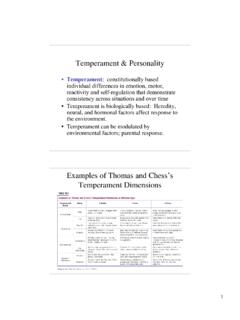
Temperament & Personality
psych.colorado.edu1 Temperament & Personality •Temperament: constitutionally based individual differences in emotion, motor, reactivity and self-regulation that demonstrate consistency across situations and over time

Positive and N egative Affectivity and T heir R elation to ...
psych.colorado.eduPositive and N egative Affectivity and T heir R elation ... (N A ) and Positive A ffectivity (PA ). N egative A ffect is a general factor of subjective distress, and subsum es a broad range of negative m ood states, including fear, anxiety, hostility, scorn, and disgust. M ood states related to de-
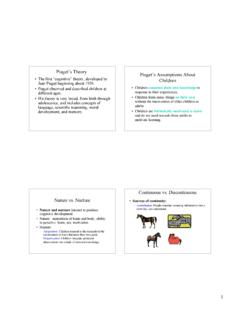
Piaget’s Theory Piaget’s Assumptions About Children
psych.colorado.edu3 Piaget’s Stages • Sensorimotor stage (birth to 2 years) •Preoperational stage (2 to 7 years) –Knowledge is represented by language, mental imagery,
Related documents
Anova Experimental Design Analysis - IIT Kanpur
home.iitk.ac.inIt is important to understand first the basic terminologies used in the experimental design. Experimental unit: For conducting an experiment, the experimental material is divided into smaller parts and each part is referred to as an experimental unit. The experimental unit is randomly assigned to treatment is the experimental unit.
Repeated Measures ANOVA - Stony Brook
www.ams.sunysb.eduAs with any ANOVA, repeated measures ANOVA tests the equality of means. However, repeated measures ANOVA is used when all members of a random sample are measured under a number of different conditions or at different time points. As the sample is exposed to each condition, the measurement of the dependent variable is repeated.

ANOVA MC QUESTIONS FINAL 4PDF - Dalhousie University
awarnach.mathstat.dal.ca7. Which of the following is an assumption of one-way ANOVA comparing samples from three or more experimental treatments? a. All the response variables within the k …

Quantitative Research Designs: Experimental, Quasi ...
samples.jbpub.comexperimental and control groups. Correlational studies look at associations. Table 6.1 shows examples of statistics that may be used to answer these two questions. TIP When you read a study, first read the abstract to determine whether there is an intervention. If so, the study is either experimental or quasi-experimental.

One-Way ANOVA Exam Practice - Discovering Statistics
www.discoveringstatistics.comC8057 (Research Methods II): One-Way ANOVA Exam Practice Dr. Andy Field Page 3 4/18/2007 The Muppet Show Futurama BBC News No Program 11 4 4 7 78 37 86 25 14 11 2 4 11 9 3 3 10 8 6 4 5 4 4 Mean 9.43 7.67 3.33 4.75 Variance 8.95 5.87 2.27 2.21 Grand Mean Grand Variance 6.30 10.06 • Carry out a one-way ANOVA by hand to test the hypothesis that ...
Pretest-posttest designs and measurement of change
www.phys.lsu.eduregression coefficients, ANOVA on residual scores re-sults in an inflated α-level of significance and (b) when the regression coefficient for the total sample of all groups combined is used, ANOVA on residual scores yields an inappropriately conservative test [16]. 3.4. Repeated measures ANOVA with pretest-posttest data
Chapter 4 Experimental Designs and Their Analysis
home.iitk.ac.inIt is important to understand first the basic terminologies used in the experimental design. Experimental unit: For conducting an experiment, the experimental material is divided into smaller parts and each part is referred to as an experimental unit. The experimental unit is randomly assigned to treatment is the experimental unit.
The ANOVA Procedure - SAS
support.sas.comThe ANOVA procedure performs analysis of variance (ANOVA) for balanced data from a wide variety of experimental designs. In analysis of variance, a continuous response variable, known as a dependent variable, is measured under experimental conditions identified by classification variables, known as independent variables.

COMPLETELY RANDOM DESIGN (CRD) - NDSU
www.ndsu.edu-Design can be used when experimental units are essentially homogeneous. -Because of the homogeneity requirement, it may be difficult to use this design for field experiments. -The CRD is best suited for experiments with a small number of treatments. Randomization Procedure -Treatments are assigned to experimental units completely at random.

Experimental Design and Analysis - CMU Statistics
www.stat.cmu.eduUniversity. This is appropriate because Experimental Design is fundamentally the same for all fields. This book tends towards examples from behavioral and social sciences, but includes a full range of examples. In truth, a better title for the course is Experimental Design and Analysis, and that is the title of this book.