
16-1
to a particular reactor type; markedly different reactors and reactor sequencing can display identical RTDs. Nevertheless, the RTD exhibited by a given reactor yields distinctive clues to the type of mixing occurring within it and is one of the most informative characterizations of the reactor. 16.2 Measurement of the RTD
Download 16-1

Information
Domain:
Source:
Link to this page:
Documents from same domain

Proficiency Evaluation Test Intermediate to Advanced
websites.umich.eduIntermediate to Advanced I. Grammar / Vocabulary II. Reading Comprehension III. Writing Sample IV. Conversation / Interview Directions for the Tutor: Allow the participant to take as much time as is necessary to complete this assessment. The participant does not have to complete every section. After
July 2017 in the United States Michael Sivak and Brandon ...
websites.umich.edudivergent patterns of urban and rural driving are notfully accounted for by the corresponding changes in the amounts of urban and rural populations. 17. Key Words distance driven, VMT, urban, rural, population, trends, U.S.A. 18. Distribution Statement Unlimited 19. Security Classification (of this report) None 20. Security Classification (of ...
Chapter 13 Radioactive Decay - websites.umich.edu
websites.umich.eduRadioactive Decay Note to students and other readers: This Chapter is intended to supplement Chapter 6 of Krane’s excellent book, ”Introductory Nuclear Physics”. Kindly read the relevant sections in Krane’s book first. This reading is supplementary …

Developing a Staffing Model that Responds to Varying Flow ...
websites.umich.eduDec 09, 2014 · Patients in Pre-Op are pre-surgery, while Phase 1 and Phase 2 are post-surgery patients, with Phase 1 patients requiring a higher level of care than Phase 2 patients. Patients entering the PACU are designated into three types. First, hospital outpatient surgery patients come from home the day of surgery and go home that day after surgery.
The Social Responsibility of Business is to Increase its ...
websites.umich.edutaxes and make expenditures to foster "social" objectives, then political machinery must be set up to make the assessment of taxes and to determine through a political process the objectives to be served. This is the basic reason why the doctrine of "social responsibility" involves the acceptance of
UMTRI-2016-5 February 2016 Vehicles UMTRI-2016-5
websites.umich.edubattery-electric vehicle, BEV, fuel -cell vehicle, FCV, hydrogen infrastructure, greenhouse gases, petroleum usage, internal combustion engine 18. Distribution Statement Unlimited 19. Security Classification (of this report) None 20. Security Classification (of this page) None 21. …
Environmental Finance - University of Michigan
websites.umich.edu- Environmental Finance 1 Compendium Introduction "Environmental Finance: Value and Risk in an Age of Ecology" Naronal Pol~ri;r Preventm Center tor Higher Educatorl Un~versity 01 M~chigan I May be reprodilced Daqa Bullding 43C Easl Un~versily Anq Arbor MI 48105.11 15 ' freely !or non-commercial I 734 704 ,412 Fax 734.647.5841 - nppc@urnrch edu - ...

and Reaction - University of Michigan
websites.umich.educross-sectional area that is normal to diffusion. 2 It is a function of the ratio of maximum to minimum pore areas (Figure 12-2(a)). When the two areas, A 1 and A 2, are equal, the constriction factor is unity, and when 10, the con-striction factor is approximately 0.5. Example 12–1 Finding the Tortuosity
Distributions of Residence Times for Chemical Reactors
websites.umich.eduideal reactor. The functions E(t) and F(t) will be developed for ideal PPRs, CSTRs and laminar flow reactors. Examples are given for diagnosing prob-lems with real reactors by comparing t m and E(t) with ideal reactors. We will then use these ideal curves to help diagnose and troubleshoot bypassing and dead volume in real reactors.
Chapter 17
websites.umich.eduorders of magnitude in [H3O +]. Part 2. Calculate the pH change upon adding 10.0 mL 0.10 M NaOH to 90 mL buffer containing 1.0 M NH3 and 1.0 M NH4Cl. The key reaction with the buffer will be: NH4 + + OH-Æ H 2O + NH3 The strong base will react with the ammonium cation in the buffer and completely convert it to ammonia. The number of moles of ...
Related documents
Fundamentals of Chemical Reactor Theory1
www.seas.ucla.eduA Continuous-Stirred Tank Reactor (CSTR) is a well-mixed vessel that operates at steady-state (Qin=Qout=Q). The main assumption in this case is that the concentration of the incoming fluid will become instantaneously equal to the outgoing upon entering the vessel. Fig. 2 explains visually this concept.
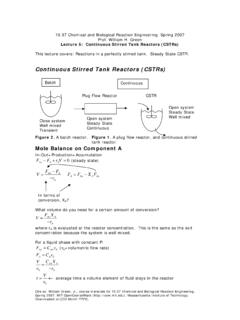
Continuous Stirred Tank Reactors (CSTRs)
ocw.mit.eduApproach to steady state in a continuous stirred tank reactor (CSTR). The time at which ½ of the steady state concentration of C A is achieved is the h time: ln(2) τ 1+Da CSTRs in Series (Liquid and at constant pressure) alf C C A0 Da 1 Da 2 Figure 4. Two tanks in series. The output of the first tank is the input of the second tank.

Boiling Water Reactor (BWR) Systems
www.nrc.govStorage Tank Reactor Core Isolation Cooling The reactor core isolation cooling (RCIC) system provides makeup water to the reactor vessel for core cooling when the main steam lines are isolated and the normal supply of water to the reactor vessel is lost. The RCIC system consists of a turbine-driven pump, piping, and valves necessary to deliver ...
Wastewater Technology Fact Sheet: Sequencing Batch Reactors
www3.epa.govand secondary clarification in a single tank using a timed control sequence. This type of reactor does, in some cases, also perform primary clarification. In a conventional activated sludge system, these unit processes would be accomplished by using separate tanks. A modified version of the SBR is the Intermittent

Total Solids, Volatile Solids - University of Florida
biogas.ifas.ufl.eduTotal Solids, Volatile Solids Total Solids (TS)= Dry matter content of substrate Inverse of moisture content one of the most variable parameters between substrates water Volatile Solids (VS)= Combustible proportion of TS, organic matter Non-volatile Solids (Ash)= Inorganic material (Minerals, salts), does not contribute to methane
Distributions of Residence Times for Chemical Reactors
websites.umich.eduIn a gas–liquid continuous-stirred tank reactor (Figure 13-1), the gaseous reactant was bubbled into the reactor while the liquid reactant was fed through an inlet tube in the reactor’s side. The reaction took place at the gas–liquid interface of the bubbles, and the product was a …
Elements of Chemical Reaction Engineering
ptgmedia.pearsoncmg.com1.4.1 Continuous-Stirred Tank Reactor (CSTR) 12 1.4.2 Tubular Reactor 14 1.4.3 Packed-Bed Reactor (PBR) 18 1.5 Industrial Reactors 22 CHAPTER 2 CONVERSION AND REACTOR SIZING 31 2.1 Definition of Conversion 32 2.2 Batch Reactor Design Equations 32 2.3 Design Equations for Flow Reactors 35 2.3.1 CSTR (Also Known as a Backmix Reactor or a Vat) 36
Design and Control of a Methanol Reactor/Column Process
terpconnect.umd.eduJun 02, 2010 · evaluated. These variables include reactor pressure, reactor size, concentration of inert components in the recycle gas, and pressure in a flash tank upstream of the column. The purpose of the flash tank is to keep light components from entering the column that would blanket the condenser. The investigation reveals that the economics are ...
Reactor Design Lectures Notes - University of Technology, Iraq
www.uotechnology.edu.iqreactor, exit stream has the same composition as in the tank. •The reaction rate associated with the final (output) concentration. •Reactor equipped with an impeller to ensure proper mixing. •Dividing the volume of the tank by the average volumetric flow rate through the tank gives theresidence time, or the average