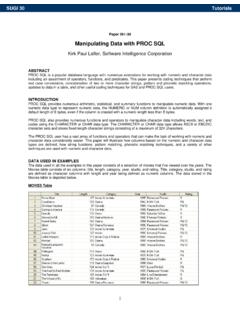
261-30: Manipulating Data with PROC SQL - SAS
The CHARACTER or CHAR data typeallows ASCII or EBCDIC character sets and stores fixed-length character strings consisting of a maximum of 32K characters. The PROC SQL user has a vast array of functions and operators that can make the task of working with numeric and
Download 261-30: Manipulating Data with PROC SQL - SAS

Information
Domain:
Source:
Link to this page:
Documents from same domain
027-2009: Tips and Tricks for Creating the Reports …
support.sas.comPaper 027-2009 TIPS AND TRICKS FOR CREATING THE REPORTS YOUR CLIENTS NEED TO SEE Michael J Molter, INC Research, Raleigh, NC ABSTRACT Advanced reporting tools such as PROC REPORT have progressed by leaps and …
Step-by-Step Programming with Base SAS Software
support.sas.comThe correct bibliographic citation for this manual is as follows: SAS Institute Inc. 2001. Step-by-Step Programming with Base SAS® Software.Cary, NC: SAS Institute Inc.

227-2012: Executing a PROC from a DATA Step - …
support.sas.com2 Using RUN_MACRO to execute a PROC from a DATA step requires writing three blocks of code, described in the Introduction: a macro to execute a PROC, a user-written function to execute the macro, and a DATA step to call the
149-2012: Queries, Joins, and WHERE Clauses, Oh …
support.sas.comPaper 149-2012 Queries, Joins, and WHERE Clauses, Oh My!! Demystifying PROC SQL Christianna S. Williams, Chapel Hill, NC ABSTRACT Subqueries, inner joins, outer joins, HAVING expressions, set operators…just the terminology of PROC SQL might
158-2010: How to Use Arrays and DO Loops: Do I …
support.sas.com1 Paper 158-2010 How to Use ARRAYs and DO Loops: Do I DO OVER or Do I DO i? Jennifer L Waller, Medical College of Georgia, Augusta, GA ABSTRACT
248-2009: Learning When to Be Discrete: …
support.sas.com1 Paper 248–2009 Learning When to Be Discrete: Continuous vs. Categorical Predictors David J. Pasta, ICON Clinical Research, San Francisco, CA ABSTRACT

338-2011: An Introduction to Survival Analysis …
support.sas.com2 (Censored) Study Ends (From Applied Survey Data Analysis, p. 306) Figure 1. Prospective View of Event History Survey Data Time can be regarded as continuous or discrete and this basic distinction affects the analytic approach selected.

Dongsheng Yang and Jarrod E. Dalton - SAS
support.sas.com1 Paper 335-2012 A unified approach to measuring the effect size between two groups using SAS® Dongsheng Yang and Jarrod E. Dalton Departments of Quantitative Health Sciences and Outcomes Research

SAS/STAT 9.2 User's Guide: Introduction to Power …
support.sas.comSAS/STAT ® 9.2 User’s Guide Introduction to Power and Sample Size Analysis (Book Excerpt) SAS® Documentation
249-2012: A Tutorial on the SAS® Macro Language
support.sas.com1 Paper 249-2012 A Tutorial on the SAS® Macro Language John J. Cohen, Advanced Data Concepts LLC, Newark, DE ABSTRACT The SAS macro language is another language layering on top of regular SAS code.
Related documents

Working with Strings in S7-SCL
cache.industry.siemens.comwhere hh indicated the hexadecimal value of the corresponding ASCII-character. Example: 'Text1$0D$0AText2' 5 Existing standard functions STEP7 contains a Standard-Library with standard functions for the handling and comparaison of strings or for string conversions. These functions will be shortly explained here, with a synthax description.
Notes on Exploring Data - Princeton University
dss.princeton.edu# Reading ASCII record form, numbers represent the width of variables, negative sign excludes variables not wanted (you must include these). # To get the width of the variables you must have a codebook for the data set available (see an example below). # To get the widths for unwanted spaces use the formula: Start of var(t+1) – End of var(t) - 1
Logix 5000 Controllers ASCII Strings, 1756-PM013G-EN-P
literature.rockwellautomation.comThis manual shows how to manipulate ASCII strings in Logix 5000 controllers. This manual is one of a set of related manuals that show common procedures for programming and operating Logix 5000 controllers. For a complete list of common procedures manuals, refer to …
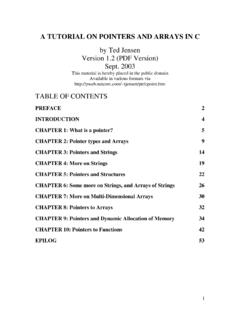
A TUTORIAL ON POINTERS AND ARRAYS IN C
pdos.csail.mit.eduCHAPTER 6: Some more on Strings, and Arrays of Strings 26 CHAPTER 7: More on Multi-Dimensional Arrays 30 CHAPTER 8: Pointers to Arrays 32 ... way, with the help of an ASCII text editor, you can copy a given block of code to a new file and compile it on your system. I recommend that readers do this as it will help in

Platform Management FRU Information Storage …
www.intel.comFeb 02, 2013 · character encoding and Strings in the “Type/Length Byte” section and in the Management Access Record (Record Type 0x03). Added “Extended DC Output” and “Extended DC Load” records, per Errata E447, to support larger maximum DC currents. Deleted Table 16 – System Enclosure or
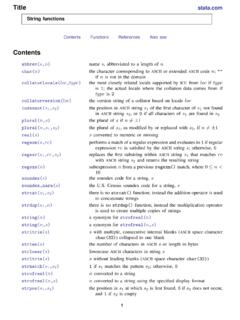
Title stata.com String functions
www.stata.comindexnot() is intended for use with onlyplain ASCII strings. For Unicode characters beyond the plain ASCII range, the position and character are given in bytes, not characters. Domain s 1: ASCII strings (to be searched) Domain s 2: ASCII strings (to search for) Range: integers 0 plural(n,s) Description: the plural of sif n6= 1