
4.1.3. BUFFER SOLUTIONS
4.1.3. Buffer solutions EUROPEAN PHARMACOPOEIA 7.0 Succinate buffer solution pH 4.6.4001500. Disssolve 11.8 g ofsuccinic acid R in a mixture of 600 mL of water R and 82 mL of 1 M sodium hydroxide and dilute to 1000.0 mL with water R. Acetate buffer solution pH 4.7. 4001600. Dissolve 136.1 g ofsodium acetate R in 500 mL of water R. Mix 250 mL of this …
Download 4.1.3. BUFFER SOLUTIONS

Information
Domain:
Source:
Link to this page:
Documents from same domain
<1117> MICROBIOLOGICAL BEST LABORATORY …
www.drugfuture.com708 〈1117〉 Microbiological Best Laboratory Practices / General Information USP 35 glassware or from prior materials used in the glassware. Be Media should be labeled properly with batch or lot num-
<1227> VALIDATION OF MICROBIAL RECOVERY …
www.drugfuture.comUSP 35 General Information / 〈1227〉 Validation of Microbial Recovery 883 〈1227〉 VALIDATION OF culture preparation. The conditions of organism preparation and storage must be standardized for the neutralizer evalua-MICROBIAL RECOVERY FROM tion and should reflect the conditions of the antimicrobial
2.2.32. LOSS ON DRYING - 药物在线-快捷药物信息 …
www.drugfuture.com2.2.33. Nuclear magnetic resonance spectrometry EUROPEAN PHARMACOPOEIA 7.0 01/2009:20233 2.2.33. NUCLEAR MAGNETIC RESONANCE SPECTROMETRY INTRODUCTION Nuclearmagneticresonance(NMR)spectrometryisananalytical
2.2.46. CHROMATOGRAPHIC SEPARATION …
www.drugfuture.com2.2.45. Supercritical fluid chromatography EUROPEAN PHARMACOPOEIA 7.0 Control solutions.In addition to the TOC water control, prepare suitable blank solutions or other solutions needed for establishing the baseline or for calibration adjustments
2.6.12. MICROBIOLOGICAL - DrugFuture
www.drugfuture.com2.6.12. Microbial enumeration tests EUROPEAN PHARMACOPOEIA 7.0 Table 2.6.12.-1. – Preparation and use of test micro-organisms Growth …
2.4. LIMIT TESTS - DrugFuture
www.drugfuture.comEUROPEAN PHARMACOPOEIA 7.0 2.4.4. Chlorides 2.4. LIMIT TESTS 01/2008:20401 2.4.1. AMMONIUM Unlessotherwiseprescribed,usemethodA. METHOD A ...
2.2. PHYSICAL AND PHYSICOCHEMICAL METHODS
www.drugfuture.com2.2.2. Degree of coloration of liquids EUROPEAN PHARMACOPOEIA 7.0 dilute suspensions containing small particles. Linearity between turbidity and concentration must be established by constructing
EUROPEAN PHARMACOPOEIA 7 - DrugFuture
www.drugfuture.com2.2.25. Absorption spectrophotometry, ultraviolet and visible EUROPEAN PHARMACOPOEIA 7.0 acquired using suitable purged instruments or ensuring that sample and background single beam spectra are acquired under
5.1.3. EFFICACY OF ANTIMICROBIAL PRESERVATION
www.drugfuture.comEUROPEAN PHARMACOPOEIA 7.0 5.1.3. Efficacy of antimicrobial preservation suspensions may be presented in sealed ampoules. Biological indicators are prepared in such a way that they can be stored
<1151> PHARMACEUTICAL DOSAGE FORMS - …
www.drugfuture.com766 〈1151〉 Pharmaceutical Dosage Forms / General Information USP 35 Figure 1. Compendial Taxonomy for Pharmaceutical Dosage Forms. volumes recommended in the accompanying table are usu- Identification—Identification tests are discussed in the
Related documents

4.2.2. VOLUMETRIC SOLUTIONS 4.2. VOLUMETRIC ANALYSIS …
www.uspbpep.comadd 2 volumes ofhydrochloric acid R.Collectthecrystals formed and wash with hydrochloric acid R1.Removethe hydrochloric acid by heating on a water-bath and dry the crystals to constant mass at 300 °C. Sulphanilic acid. C6H7NO3S. (Mr 173.2). 2000700. [121-57-3]. Recrystallise sulphanilic acid R from boiling water R.Filter

Exp12F Mg Rxn Hess Law 1010
www.usna.eduReaction of Magnesium Metal and Hydrochloric Acid 1. Using the graduated cylinder, add 100.0 mL of 1.0 M HCl to the empty calorimeter. Wait for a few minutes to allow the set-up to reach thermal equilibrium. 2. While waiting, determine the mass of a sample of magnesium ribbon (about 0.15 g) on the analytical balance,
MATERIAL SAFETY DATA SHEET (MSDS) HYDROCHLORIC …
ittehadchemicals.comJan 01, 2019 · phosphide reacts with hydrochloric acid to release spontaneously flammable phosphines. Rubidium acetylene carbides burns with slightly warm hydrochloric acid. Lithium silicide in contact with hydrogen chloride becomes incandescent. When dilute hydrochloric acid is used, gas spontaneously flammable in air is evolved.

Hydrochloric Acid Handbook - Occidental Petroleum
www.oxy.comHydrochloric acid is an important and widely used chemical. The largest end uses for hydrochloric acid are steel pickling, oil well acidizing, food manufacturing, producing calcium chloride, and ore processing. Steel pickling Hydrochloric acid is used in pickling operations for carbon, alloy and stainless steels.

4.2. VOLUMETRIC ANALYSIS 4.2.1. PRIMARY STANDARDS FOR ...
www.drugfuture.comEUROPEAN PHARMACOPOEIA 7.0 4.2.2. Volumetric solutions 0.05 M Barium perchlorate. 3000700. Dissolve 15.8 g ofbarium hydroxide Rin a mixture of 7.5 mL of perchloric acid Rand 75 mL ofwater R, adjust the solution to pH 3 by addingperchloric acid Rand filter if necessary.Add 150 mL of ethanol (96 per cent) Rand dilute to 250 mL with water R.Dilute to 1000.0 mL …

Basic Chemicals Hydrochloric Acid Calculate pH Values of ...
www.oxy.compH of Hydrochloric Acid Acidity and Alkalinity (pH) + An acid is a substance that yields hydrogen ions (H+) when dissolved in water, while bases are substances that yield hydroxide ions (OH-). Strong acids or bases ionize nearly completely in water to …

4.1.3. BUFFER SOLUTIONS - uspbpep.com
uspbpep.comDissolve 21.0 g ofcitric acid R in 200 ml of 1Msodium hydroxide anddiluteto1000mlwithwaterR.Dilute40.3ml of this solution to 100.0 ml with0.1 M hydrochloric acid. 0.25 M Citrate buffer solution pH 3.0. 4012600. Dissolve 4.8 g ofcitric acid R in 80 ml of water R.Adjust the pH (2.2.3)with1 M sodium hydroxide and dilute to 100.0 ml with water R.
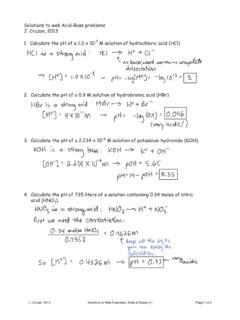
1. Calculate the pH of a 1.0 x 10⁻³ M solution of ...
www.xaktly.comstrong acid (HCl). It is a drug used as a muscle relaxant. Pap-HCl is a weak acid overall. At 25˚C, a 205 mM solution of pap-Hl has a pH of 3.31. Compute the Ka of pap-HCl. 11. A 0.040 M solution of a weak acid (call it HA) has a pH of 4.70. Calculate the K a and pK a of the acid. J. Cruzan, 2013 Solutions to Web Exercises: Acids & Bases (1 ...

Thiosulphate Acid - University of York
www.york.ac.uksodium thiosulphate and hydrochloric acid Here is a suggested method to investigate the effect of varying the concentration of sodium thiosulphate. Prepare the following solutions • Hydrochloric acid 0.1 mol dm-3 • Sodium thiosulphate 1 mol dm-3 You will need to think about how much of each solution to prepare. This will