5. OBSERVING, RECORDING, AND REPORTING …
self-help skills. These checklists provide information about what a child can and cannot do in each developmental area. Teachers can use this information to help set goals for a child and plan activities that help the child progress. An example of a developmental checklist, Observation Checklist for Teachers, is at the end of this chapter.
Download 5. OBSERVING, RECORDING, AND REPORTING …

Information
Domain:
Source:
Link to this page:
Documents from same domain
Child Growth and Development Pregnancy and …
laffranchinid.faculty.mjc.eduPregnancy and Prenatal Development Chapter 4 Prepared by: Debbie Laffranchini From: Papalia, Olds, Feldman Child Growth and Development
Child Growth and Development Chapter 5: Birth …
laffranchinid.faculty.mjc.eduChild Growth and Development Chapter 5: Birth and the Newborn Baby Prepared by Debbie Laffranchini From Papalia, Olds, and Feldman

Child Growth and Development Chapter 9: Physical ...
laffranchinid.faculty.mjc.eduChild Growth and Development Chapter 9: Physical Development & Health in Early Childhood Prepared by Debbie Laffranchini From Papalia, Olds, and Feldman ... development •Lead poisoning can lead to neurological and ... 103 Ch 9 Papalia and Olds [Read-Only] [Compatibility Mode]

Kubler-Ross’ Five Stages of Grief Laffranchini, Instructor
laffranchinid.faculty.mjc.eduKubler-Ross’ Five Stages of Grief . Laffranchini, Instructor . Swiss-born psychiatrist Dr. Elisabeth Kubler-Ross has counseled hundreds of patients and their …
Related documents
Parent-Child Interactions: A Home Visitor’s Guide
ahvna.orga rough or intrusive manner or the parent-child interaction may be characterized by fear, helplessness, withdrawal, or low levels of responsiveness.” 4 Reduced parental sensitivity to the infant’s cries may set in motion a pattern of negative parent-child interactions with both parent and child …
Evidence-Based Practice Brief: Social Skills Groups
autismpdc.fpg.unc.eduJournal of Clinical Child and Adolescent Psychology, 37(1), 8-38. Using these criteria, the empirical studies referenced below provide documentation for supporting the use of social skills training groups as an evidence-based practice for children with ASD. This list is not exhaustive; other quality studies may exist that were not included.

Hawaii Early Learning Profile (HELP)
blogs.illinois.eduthe child’s CA, or OK, rather than the age range. 2. Age gaps within a Strand. Sometimes there is a several month gap between skills within a Strand. If so, and, if the child’s CA is higher than the last skill credited “+”, but lower than the highest age on the next skill, report approximate DAL as “OK”, or as the child’s CA. WP íí

Autism Observation Checklist - Medical Home
medicalhome.orgAutism Observation Checklist Child’s Name ... that you have observed with child & you may add comments according to your observation of child Communication Delay in, or total lack ... Difficulty using nonverbal behaviors Cto regulate social interaction omments Inconsistent eye contact (unusual quality or coordination) ...

Special Education Coding Criteria, 2020/21
open.alberta.caA functional assessment includes both formal (objective data such as a standardized checklist) and anecdotal and/or direct observations. The assessment report should provide information about the impact the diagnosis has on the ECS child’s/student’s functioning in the educational environment in areas such as: social interaction;
Observing and assessing children’s learning and development
study.sagepub.com• what a child knows and can do which will establish a child’s developmental progress/level; • to get to know a child better – open-ended. Schemas Athey (2007) describes schemas as patterns of behaviour and thinking in children that exist under the surface features of various contents, contexts and specific experiences.
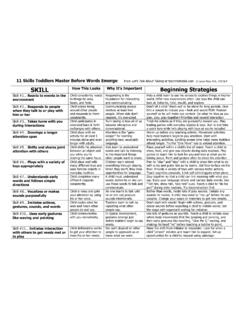
11 Skills Toddlers Master Before Words Emerge Let’s Talk ...
teachmetotalk.comDon’t let a child ‘check out’ or be alone for long periods. Give him a reason to include you – look and sound FUN! Position yourself so he will make eye contact. Do what he likes as you play, play, play together! Prioritize and reward interaction. Skill #3… Takes turns with you during interactions Child participates in extended back ...
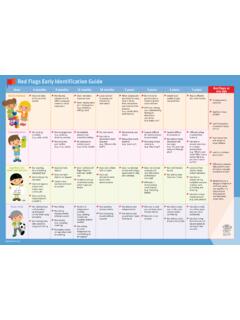
Red Flags Early Identification Guide
www.childrens.health.qld.gov.auStimulate your child’s development with PLAY! Partner: Updated: July 2016 be your child’s partner in play. Follow their lead and wait for them to take their turn. Look and listen: adjust play to your child’s level and follow their instructions. Add:introduce new ideas to guide, support and expand on the play your child is leading.
Employer's Guide to the Family and Medical Leave Act
www.dol.govfoster care, and to bond with the newborn or newly-placed child; • To care for a spouse, son, daughter, or parent who has a serious health condition, including incapacity due to pregnancy and for prenatal medical care; • For a serious health condition that makes the employee unable to perform the essential functions of

Class Observation Tool: All Ages NAEYC Site Visit
www.naeyc.orga child. This is a required assessment item. If a child is in immediate danger, assessors must immediately notify the program administrator and contact the NAEYC Accreditation of Early Learning Programs. Examples of physical punishment: Shaking, hitting, spanking, slapping, jerking, squeezing, kicking, biting, pinching,