
8 Things to Remember About Child Development
emotional development. And, while the regions of the brain dedicated to higher-order functions—which involve most social, emotional, and cognitive capacities, including multiple aspects of executive functioning—are also affected powerfully by early influences, they continue to develop well into adolescence and early adulthood. So,
Download 8 Things to Remember About Child Development

Information
Domain:
Source:
Link to this page:
Documents from same domain

The Foundations of Lifelong Health Are Built in Early ...
46y5eh11fhgw3ve3ytpwxt9r-wpengine.netdna-ssl.comHealth is more than merely the absence of disease—it is an evolving human resource that helps children and adults

Executive Function Activities for Adolescents
46y5eh11fhgw3ve3ytpwxt9r-wpengine.netdna-ssl.comdevelopingchild.harvard.edu 12 Executive Function Activities for Adolescents Goal setting, planning and monitoring Self-regulation is necessary in any goal-

InBrief-The Science of Resilience
46y5eh11fhgw3ve3ytpwxt9r-wpengine.netdna-ssl.com1 Resilience requires supportive relationships and opportunities for skill-building. No matter the source of hardship, the single most common factor for children who

Stress Disrupts the Architecture of the Developing Brain
46y5eh11fhgw3ve3ytpwxt9r-wpengine.netdna-ssl.com2 Excessive Stress Disrupts the Architecture of the Developing Brain WWW.DEVELOPINGCHILD.HARVARD.EDU NATIONAL SCIENTIFIC COUNCIL ON THE DEVELOPING CHILD supportive relationships, it also can become toxic to the body’s developing systems. Toxic stress refers to strong, frequent, or pro - longed activation of the body’s stress manage-

Early Experiences Can Alter Gene Expression and Affect ...
46y5eh11fhgw3ve3ytpwxt9r-wpengine.netdna-ssl.comearly experiences can alter gene expression and affect long-term Development. working paper. 10. 10

3 Principles to Improve Outcomes for Children and Families
46y5eh11fhgw3ve3ytpwxt9r-wpengine.netdna-ssl.comCore Principles of Development Can Help Us Redesign Policy and Practice www.developingchild.harvard.edu Three Principles to Improve Outcomes for Children and Families 1 Recent advances in the science of brain development offer us an unprecedented
Enhancing and Practicing Executive Function Skills with ...
46y5eh11fhgw3ve3ytpwxt9r-wpengine.netdna-ssl.comExecutive Function Activities for 18- to 36-month-olds During this stage of development, children are rapidly expanding their language skills. Language plays an important role in the development of executive function and self-regulation (EF/SR), as it helps children identify their thoughts and actions, reflect on them, and make plans that they
Connecting the Brain to the Rest of the Body: Early ...
46y5eh11fhgw3ve3ytpwxt9r-wpengine.netdna-ssl.comEstablished in 2003, the Council is committed to an evidence-based approach to building broad-based public will that transcends political partisanship and recognizes the complementary responsibilities of family, community, workplace, and government to promote the well-being of all young children. For more information, go to www.developingchild.net.
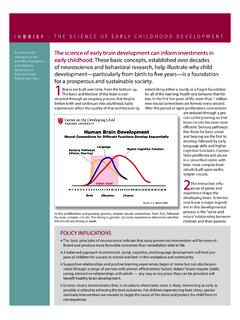
Brains are built over time, from the bottom up
46y5eh11fhgw3ve3ytpwxt9r-wpengine.netdna-ssl.comsummaries of the scientific presentations at the National Symposium on Early Childhood Science and Policy. The science of early brain development can inform investments in early childhood. These basic concepts, established over decades of neuroscience and behavioral research, help illustrate why child
Building the Brain’s “Air Traffic Control” System
46y5eh11fhgw3ve3ytpwxt9r-wpengine.netdna-ssl.comExecutive Brain, Elkhonon Goldberg, notes, “The ability to stay on track is an asset, but being ‘dead in the track’ is not.”4 Stated differently, self-control and persistence are assets, rigidity is not. Cognitive flexibility enables us to catch mistakes and fix them, to revise ways of doing things in light of new information, to
Related documents
ERIK ERIKSON'S THEORY OF IDENTITY DEVELOPMENT
childdevpsychology.yolasite.coman understanding of adolescence is bis ldentity: Youth and Crisis (1968). Erikson's more re-cent book, The Life Cycle Compteted (1982), encompasses an integration of much of bis ear-lier work, but with the explicit purpose of exploring development by beginning with old age and to make sense of the "completed life cycle."

Erik Erikson's Stages of Psychosocial Development
basics.nami.orgDuring adolescence, the transition from childhood to adulthood is most important. Children are becoming more independent, and begin to look at the future in terms of career, relationships, families, housing, etc. The individual wants to belong to a society and fit in.

Stages of Adolescent Development - ACT for Youth
www.actforyouth.netDevelopment by Sedra Spano Adolescence is a time of great change for young people. It is a time when physical changes are happening at an accelerated rate. But adolescence is not just marked by physical changes—young people are also experiencing cognitive, social/emotional and interpersonal changes as well.

DOMAINS OF DEVELOPMENT - National Institute of Open …
www.nios.ac.inDevelopment of children is a complex and a continuous process. It takes place in many areas or domains which together influences their holistic development. ... and it continues to grow in adolescence. At the level of conventional morality, children tend to believe that rules can be

The Adolescent Brain: A second window of opportunity
www.unicef-irc.orgdevelopment into adolescence. The advances and investments made in ECD must be continued for children in their second decade of life. Adolescence is a time of both opportunity and vulnerability. Many problematic and risky behaviours are activated in adolescence, including