A practical Time -Series Tutorial with MATLAB
Matlab introduction – I will try to convince you that Matlab is cool ... – Image, Statistics, Bioinformatics, etc Matlab. 5 Tutorial | Time-Series with Matlab 9 History of Matlab (MATrix LABoratory) ... “The most important thing in the programming language is the name.
Download A practical Time -Series Tutorial with MATLAB

Information
Domain:
Source:
Link to this page:
Documents from same domain

TCPDUMP filters - University of California, Riverside
alumni.cs.ucr.eduTCPDUMP filters expression selects which packets will be dumped. If no expression is given, all packets on the net will be dumped. Otherwise, only packets for which expres
Introduction to Socket Programming
alumni.cs.ucr.eduIntroduction to Socket Programming Part I : TCP Clients, Servers; Host information Keywords: sockets, client-server, network programming-socket functions, OSI layering, byte-ordering Outline: 1.) Introduction 2.) The Client / Server Model
Consumer RGB D Cameras and their Applications
alumni.cs.ucr.eduKrystof Litomisky Consumer RGB-D Cameras and their Applications 7 Khoshelham and Elberink looked at how the depth resolution of data from the Microsoft Kinect …

The Little Book of Semaphores - University of California ...
alumni.cs.ucr.eduWellesley College. I used the rst edition of The Little Book of Semaphores along with one of the standard textbooks, and I taught Synchronization as a concurrent thread for the duration of the course. Each week I gave the students a few pages from the book, ending with a …
Selective Bayesian Classifier: Feature Selection for the ...
alumni.cs.ucr.edudecision trees by using features to try and split the training ... decision trees in a top-down recursive divide-and-conquer manner. The algorithm starts with the entire set of tuples in the ... to class Ck and is estimated by sk / s. Let attribute A have v distinct values, ...
C++ Interview Questions Compiled by Dr. Fatih Kocan, Wael ...
alumni.cs.ucr.eduC++ Interview Questions Compiled by Dr. Fatih Kocan, Wael Kdouh, and Kathryn Patterson for the Data Structures in C++ course(CSE 3358) Spring 2008

Exact Discovery of Time Series Motifs - alumni.cs.ucr.edu
alumni.cs.ucr.eduExact Discovery of Time Series Motifs Abdullah Mueen Eamonn Keogh Qiang Zhu Sydney Cash1,2 Brandon Westover1,3 University of California – Riverside 1Massachusetts General Hospital, 2Harvard Medical School, 3Brigham and Women's Hospital {mueen, eamonn, qzhu}@cs.ucr.edu
Related documents

Copyright © 2013 Dr. Martin Jones
userpages.fu-berlin.dephilosophy that programming courses must be friendly, approachable, and practical. Martin has taught introductory programming as part of the Bioinformatics MSc course at Edinburgh University for the past five years, and is currently Lecturer in Bioinformatics.
Statistics Using R with Biological Examples
cran.r-project.orgtechnique in bioinformatics. Chapter 14 covers hypothesis testing and includes instructions on how to do most popular test using R. Regression and ANOVA are covered in Chapter 15 along with a brief introduction to general linear models. Advanced Topics (Ch 16-17)
2022 - PWr Rekrutacja
rekrutacja.pwr.edu.pl» Introduction to Programming » Metrology » Philosophy SEMESTER 2 » Mathematics Analysis 2 » Mathematics for Electronics » Object Oriented Programming » Electronic » Physics » Foreign Language SEMESTER 3 » Physics for Electronics » Scientific & Engineering Programming » Electronic Components & Sensors
Mathematics and Chemistry
www.maa.orgComputer Science: Introduction to computer science including programming, data structures, algorithms. Graduate school and career opportunities Students with solid backgrounds in both mathematics and chemistry have many good options. They would be strong candidates for graduate programs in mathematics, applied mathematics,
Introduction to Bioinformatics
www.cs.helsinki.fi20 A good biology course for computer scientists and mathematicians? p Biology for methodological scientists (8 credits, Meilahti) n Course organized by the Faculties of Bioscience and Medicine for the MBI programme n Introduction to basic concepts of microarrays, medical genetics and developmental biology n Study group + book exam in I period (2 cr) n Three …

Introduction to Pseudocode
bioinformaticsalgorithms.comA Introduction to Pseudocode What is Pseudocode? An algorithm is a sequence of instructions to solve a well-formulated computational problem specified in terms of its input and output.An algorithm uses the input to generate the output. For example, the algorithm PATTERN COUNTuses strings Text and Pattern as input to generate the number COUNT(Text,Pattern) …
EVALUATION OF DATABASE MANAGEMENT SYSTEMS
www.diva-portal.org1. INTRODUCTION 1.1. BACKGROUND The idea for this thesis project comes from a local software company called Medicwave [1]. The company provides bioinformatics tools for high dimensional mass spectrometry data analysis and is one of the leading bioinformatics solution providers in Europe.
Introduction to Bioinformatics - Lehigh University
www.lehigh.eduIntroduction to Bioinformatics Lopresti BioS 95 November 2008 Slide 8 Algorithms are Central •Conduct experimental evaluations (perhaps iterate above steps). An algorithm is a precisely-specified series of steps to solve a particular problem of interest. •Develop model(s) for task at hand. •Study inherent computational complexity:
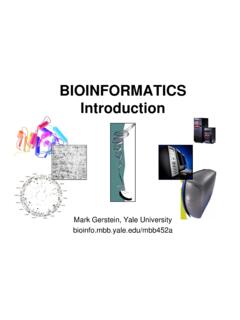
Introduction BIOINFORMATICS
bioinfo.mbb.yale.eduBioinformatics is conceptualizing biology in terms of molecules (in the sense of physical-chemistry) and then applying “ informatics ” techniques (derived from disciplines such as applied math, CS, and statistics) to understand and organize the information associated with these molecules, on a large-scale. • Bioinformatics is “MIS ...
Introduction to Linux - Boston University
www.bu.eduThe Unix Programming Environment, Kernighan and Pike … at its heart is the idea that the power of a system comes more from the relationships among programs than from the programs themselves. Many UNIX programs do quite trivial things in isolation, but, combined with other programs, become general and useful tools.