A TUTORIAL ON POINTERS AND ARRAYS IN C
CHAPTER 6: Some more on Strings, and Arrays of Strings 26 CHAPTER 7: More on Multi-Dimensional Arrays 30 CHAPTER 8: Pointers to Arrays 32 ... way, with the help of an ASCII text editor, you can copy a given block of code to a new file and compile it on your system. I recommend that readers do this as it will help in
Download A TUTORIAL ON POINTERS AND ARRAYS IN C

Information
Domain:
Source:
Link to this page:
Documents from same domain
A TUTORIAL ON POINTERS AND ARRAYS IN C
pdos.csail.mit.eduA TUTORIAL ON POINTERS AND ARRAYS IN C ... If you want to be proficient in the writing of code in the C programming language, ... of this tutorial is to provide an ...

Understanding the Linux Virtual Memory Manager
pdos.csail.mit.eduLibrary of Congress Cataloging-in-Publication Data Gorman, Mel. Understanding the Linux Virtual Memory Manager / Mel Gorman. p. cm.—(Bruce Perens’ Open source series)
PC Assembly Lanugage - Distributed operating system
pdos.csail.mit.eduOther PC assembly language books still teach how to program the 8086 processor that the original PC used in 1980! The 8086 processor only supported real mode. In this mode, any program may address any memory or device in the computer. This mode is not suitable for a secure, multitasking operating system. This book instead
PC Assembly Lanugage - Distributed operating system
pdos.csail.mit.eduOther PC assembly language books still teach how to program the 8086 processor that the original PC used in 1980! This book instead discusses how to program the 80386 and later processors in protected mode (the mode that Windows runs in). There are several reasons to do this: 1. It is easier to program in protected mode than in the 8086 real mode
xv6 - DRAFT as of September 4, 2018
pdos.csail.mit.eduContents 0 Operating system interfaces 7 1 Operating system organization 17 2 Page tables 29 3 Traps, interrupts, and drivers 39 4 Locking 51 5 Scheduling 61 6 File system 75 7 Summary 93 A PC hardware 95 B The boot loader 99 Index 105 DRAFT as of September 4, 2018 3 https://pdos.csail.mit.edu/6.828/xv6
Russ Cox Frans Kaashoek Robert Morris August 31, 2020
pdos.csail.mit.eduxv6 kernel provides a subset of the services and system calls that Unix kernels traditionally offer. Figure 1.2 lists all of xv6’s system calls. The rest of this chapter outlines xv6’s services—processes, memory, file descriptors, pipes, and a file system—and illustrates them with code snippets and discussions of how the shell, Unix’s
Russ Cox Frans Kaashoek Robert Morris September 6, 2021
pdos.csail.mit.eduderstanding xv6 is a good start toward understanding any of these systems and many others. As Figure 1.1 shows, xv6 takes the traditional form of a kernel, a special program that provides services to running programs.
In Search of an Understandable Consensus Algorithm ...
pdos.csail.mit.eduMay 20, 2014 · the algorithm to facilitate the development of intuitions that areessential forsystembuilders.It was importantnot justforthealgorithmtowork,butforittobeobviouswhy it works. The result of this work is a consensus algorithm called Raft. In designing Raft we applied specific techniques to improveunderstandability,includingdecomposition(Raft
The Google File System
pdos.csail.mit.educus of performance optimization and atomicity guarantees, while caching data blocks in the client loses its appeal. Fourth, co-designing the applications and the file system ... chronization overhead is essential. The file may be read later, or a consumer may be reading through the file simultaneously. • High sustained bandwidth is more ...
MapReduce: Simplified Data Processing on Large Clusters
pdos.csail.mit.eduhardware. (5) Users submit jobs to a scheduling system. Each job consists of a set of tasks, and is mapped by the scheduler to a set of available machines within a cluster. 3.1 Execution Overview The Map invocations are distributed across multiple machines by automatically partitioning the input data
Related documents

Working with Strings in S7-SCL
cache.industry.siemens.comwhere hh indicated the hexadecimal value of the corresponding ASCII-character. Example: 'Text1$0D$0AText2' 5 Existing standard functions STEP7 contains a Standard-Library with standard functions for the handling and comparaison of strings or for string conversions. These functions will be shortly explained here, with a synthax description.
Notes on Exploring Data - Princeton University
dss.princeton.edu# Reading ASCII record form, numbers represent the width of variables, negative sign excludes variables not wanted (you must include these). # To get the width of the variables you must have a codebook for the data set available (see an example below). # To get the widths for unwanted spaces use the formula: Start of var(t+1) – End of var(t) - 1

Logix 5000 Controllers ASCII Strings, 1756-PM013G-EN-P
literature.rockwellautomation.comThis manual shows how to manipulate ASCII strings in Logix 5000 controllers. This manual is one of a set of related manuals that show common procedures for programming and operating Logix 5000 controllers. For a complete list of common procedures manuals, refer to …
261-30: Manipulating Data with PROC SQL - SAS
support.sas.comThe CHARACTER or CHAR data typeallows ASCII or EBCDIC character sets and stores fixed-length character strings consisting of a maximum of 32K characters. The PROC SQL user has a vast array of functions and operators that can make the task of working with numeric and

Platform Management FRU Information Storage …
www.intel.comFeb 02, 2013 · character encoding and Strings in the “Type/Length Byte” section and in the Management Access Record (Record Type 0x03). Added “Extended DC Output” and “Extended DC Load” records, per Errata E447, to support larger maximum DC currents. Deleted Table 16 – System Enclosure or
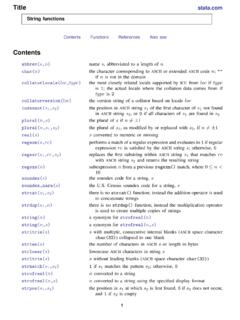
Title stata.com String functions
www.stata.comindexnot() is intended for use with onlyplain ASCII strings. For Unicode characters beyond the plain ASCII range, the position and character are given in bytes, not characters. Domain s 1: ASCII strings (to be searched) Domain s 2: ASCII strings (to search for) Range: integers 0 plural(n,s) Description: the plural of sif n6= 1