
ABC Problem Solving Worksheet - SMART Recovery
ispute - Dispute the Beliefs to find which are dysfunctional—What is the evidence that my belief is true? In what ways is my belief helpful or unhelpful? What helpful/self-enhancing belief can I use to replace each self-defeating or dysfunctional belief?
Download ABC Problem Solving Worksheet - SMART Recovery

Information
Domain:
Source:
Link to this page:
Documents from same domain
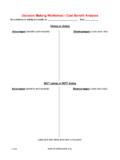
Decision Making Worksheet / Cost Benefit Analysis
smartrecovery.org5-24-06 www.smartrecovery.org Decision Making Worksheet / Cost Benefit Analysis The substance or activity to consider is: _____ Date:_____

Change-Plan Worksheet - SMART Recovery
smartrecovery.orgChange-Plan Worksheet Changes I want to make: How important is it to me to make these changes? (1-10 scale) How confident am I that I can make

Hierarchy of Values Worksheet - SMART Recovery
smartrecovery.orgVisit us at our website at: www.smartrecovery.org Make a donation to SMART Recovery at: www.smartrecovery.org/donate HIERARCHY OF VALUES From the work of Joe Gerstein, MD

ROLE PLAY/REHEARSAL - SMART Recovery
smartrecovery.orgorange juice, fruit juice, anything non-alcoholic, water (exotic - with ice and a twist), mineral water, with a twist – very exotic. SMART Recovery ® www.smartrecovery.org info@smartrecovery.org

ABCs- a crash course. - Self-Help Addiction Recovery
smartrecovery.orgThe "ABC's" are an exercise from REBT, which is a form of cognitive therapy that is simple enough and effective enough to be used by anybody and- it works. You can learn to do this straight out of a book, or off the computer screen. We use it to examine the beliefs we have (or the thinking we are doing) as some of this may be causing us problems.
Rational Emotive Behavior Therapy: The Basics
smartrecovery.orgemotions are affected by what happens to them and how they think about those events. B = Behavior Most people accept that what they do ... rationality, validity, helpfulness, etc. of your IB’s. What do you mean by ‘I can get away with it’? Where is the evidence you can just have
Related documents
The History of Group Therapy
adaa.orgdysfunctional beliefs ∙ These beliefs are formed from early childhood experiences •Changing your cognitions, the way you look at something, changes how you feel •The therapist is interactive and serves as a coach who teaches the skill set of identifying thoughts underneath feelings ...
Clinical Psychology and Psychotherapy Article reprinted ...
padesky.comto identify core beliefs. These include the Dysfunctional Attitude Scale (Weissman and Beck, 1978; Weissman, 1979), the schema checklist in Appendix A of the text on personality disorders written by Beck and colleagues (Beck et al., 1990), and the schema questionnaire developed by Young (Young, 1990). These
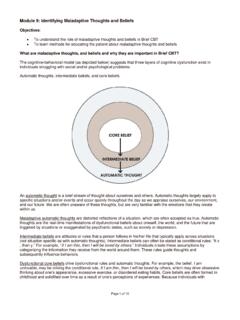
Module 9: Identifying Maladaptive Thoughts and Beliefs
athealth.comDysfunctional core beliefs drive dysfunctional rules and automatic thoughts. For example, the belief, I am unlovable, may be driving the conditional rule, If I am thin, then I will be loved by others, which may drive obsessive thinking about one’s appearance, excessive exercise, or disordered eating habits. Core beliefs are often formed in

DeTUR ˜(Desensitization of Triggers and Urge Reprocessing ...
emdrtherapyvolusia.comwith Addictions and Dysfunctional Behaviors ... gain, blocking beliefs, and negative internal dialog regarding their unsuccessful attempts) will reveal client patterns, communication styles and decision-making criteria. Listening for key words, phrases,

The ICD-10 Classification of Mental and Behavioural ...
www.who.intB. There must be dysfunctional behaviour or perceptual abnormalities, as evidenced by at least one of the following: (1) euphoria and sensation of increased energy; (2) hypervigilance; (3) grandiose beliefs or actions; (4) abusiveness or aggression;
Treating Adults from Dysfunctional Families
www.dhss.delaware.govDysfunctional Families Judith E. Pierson, Ed.D. 28 to 34 Million. Family Dynamics. Unpredictability Abuse Neglect Love is inconsistent Children parentified Feelings okay for dysfunctional parent only. ... Limiting and inaccurate beliefs “If you loved me, you’d know what I

SYMPTOMS OF ADULTS FROM DYSFUNCTIONAL FAMILIES
www.erikbohlin.net29. Adults from dysfunctional families have repetitive relationship patterns in their adult lives. Internal beliefs and filters lead them to pick spouses and friends that replicate the childhood interactions with parents. They frequently they find themselves recreating the painful experiences of their childhood. Why?