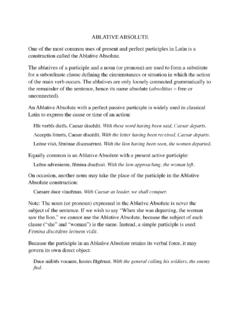
ABLATIVE ABSOLUTE
ABLATIVE ABSOLUTE One of the most common uses of present and perfect participles in Latin is a construction called the Ablative Absolute. The ablatives of a participle and a noun (or pronoun) are used to form a substitute
Download ABLATIVE ABSOLUTE

Information
Domain:
Source:
Link to this page:
Documents from same domain
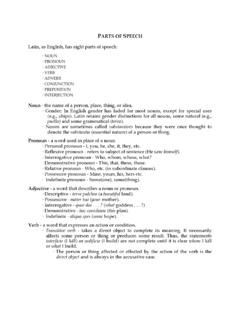
Parts of Speech - The Latin Library
www.thelatinlibrary.comPARTS OF SPEECH Latin, as English, has eight parts of speech: · NOUN · PRONOUN · ADJECTIVE · VERB · ADVERB · CONJUNCTION · PREPOSITION · INTERJECTION Noun - the name of a person, place, thing, or idea.
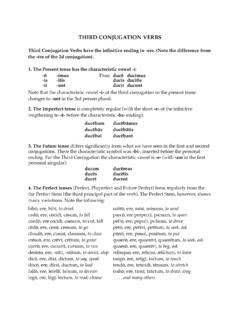
Third Conjugation Verbs - The Latin Library
www.thelatinlibrary.comTHIRD CONJUGATION VERBS Third Conjugation Verbs have the infinitive ending in -ere. (Note the difference from the -ēre of the 2d conjugation).
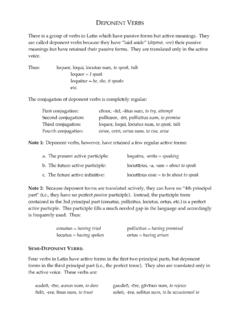
DEPONENT VERBS - The Latin Library
www.thelatinlibrary.comDEPONENT VERBS There is a group of verbs in Latin which have passive forms but active meanings. They are called deponent verbs because they have “laid aside” (dëpönö, -ere) their passive
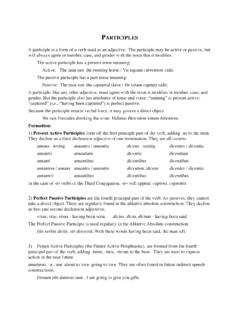
PARTICIPLES - The Latin Library
www.thelatinlibrary.comPARTICIPLES A participle is a form of a verb used as an adjective. The participle may be active or passive, but will always agree in number, case, and gender with the noun that it …
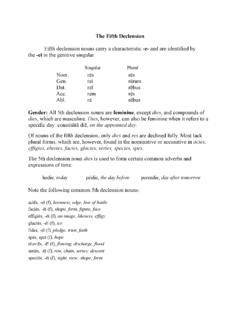
The Fifth Declension
www.thelatinlibrary.comThe Fifth Declension Fifth declension nouns carry a characteristic -e- and are identified by the -eī in the genitive singular. Singular Plural Nom. rēs rēs ...
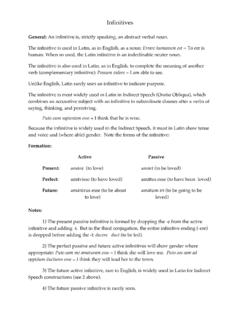
Infinitives - The Latin Library
www.thelatinlibrary.comInfinitives General: An infinitive is, strictly speaking, an abstract verbal noun. The infinitive is used in Latin, as in English, as a noun: Errare humanum est = To err is ...
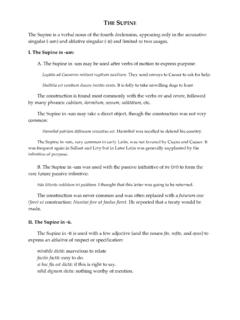
T SUPINE - The Latin Library
www.thelatinlibrary.comTHE SUPINE The Supine is a verbal noun of the fourth declension, appearing only in the accusative singular (-um) and ablative singular (-ü) and limited to two usages.
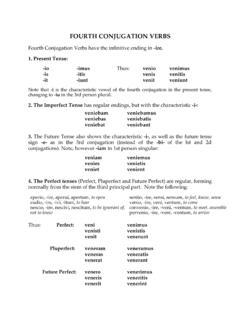
FOURTH CONJUGATION VERBS - The Latin Library
www.thelatinlibrary.comFOURTH CONJUGATION VERBS Fourth Conjugation Verbs have the infinitive ending in -ire. 1. Present Tense:-io-is-it-imus-itis-iunt Thus: venio venis venit venimus
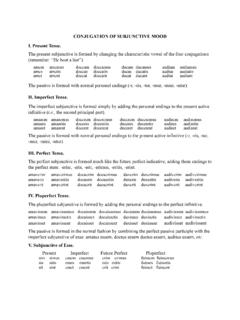
CONJUGATION OF SUBJUNCTIVE MOOD I. Present …
www.thelatinlibrary.comCONJUGATION OF SUBJUNCTIVE MOOD I. Present Tense. The present subjunctive is formed by changing the characteristic vowel of the four conjugations
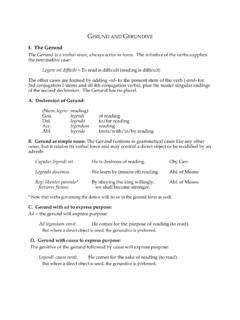
I. The Gerund - The Latin Library
www.thelatinlibrary.comGERUND AND GERUNDIVE I. The Gerund The Gerund is a verbal noun, always active in force. The infintive of the verbs supplies the nominative case: Legere est difficile = To read is difficult (reading is difficult)
Related documents
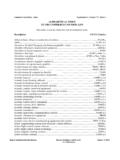
ALPHABETICAL INDEX TO THE COMMERCE CONTROL LIST ...
customs-assoc.orgCommerce Control List - Index Supplement No. 1 to part 774 - Index 3 Description ECCN Citation Export Administration Regulations Bureau of Industry and Security January 9, 2012

Society of Nuclear Medicine Procedure Guideline for ...
nucmedinfo.compatient or by counting a standard in a neck phan - tom, with correction for decay if necessary. H. Interpretation Criteria Reference values for thyroid uptake determina-
A Practical grammar of the pali language
www.buddhanet.netAppendix 1 Here is a collection of dictionary definitions of some of the terms that can be found in this book Ablative: Of, relating to, or being a grammatical case indicating separation, direction away from,
PARTICIPLES - The Latin Library
www.thelatinlibrary.comPARTICIPLES A participle is a form of a verb used as an adjective. The participle may be active or passive, but will always agree in number, case, and gender with the noun that it modifies.

Mark scheme A401/02 Latin Language 1 (Mythology and ...
ocr.org.ukOCR (Oxford Cambridge and RSA) is a leading UK awarding body, providing a wide range of qualifications to meet the needs of candidates of all ages and abilities.