Academic Standards for Mathematics
Mar 01, 2014 · division, fractions, and decimals. Taken together, these elements support a student’s ability to learn and apply more demanding math concepts and procedures. The middle school and high school standards call on students to practice applying mathematical ways of thinking to real world issues and
Download Academic Standards for Mathematics

Information
Domain:
Source:
Link to this page:
Documents from same domain

Academic Standards for English Language Arts
static.pdesas.orgAcademic Standards for English Language Arts Grades Pre K–5 March 1, 2014 Pennsylvania Department of Education
Child Abuse Recognition and Reporting Training …
static.pdesas.orgRevised February 2015 1 Child Abuse Recognition and Reporting Training (Section 1205.6 of the Public School Code of 1949) Frequently Asked Questions

Academic Standards for English Language Arts
static.pdesas.orgPENNSYLVANIA CORE STANDARDS English Language Arts Grade 6–12 March 1, 2014 2 INTRODUCTION These standards describe what students should know and be able to do with the English language, prekindergarten through Grade 12.
Academic Standards for Mathematics - pdesas.org
static.pdesas.orgPA CORE STANDARDS Mathematics | P a g e 4 March 1, 2014 The PA Core Standards for Mathematics detail four standard areas: Numbers and Operations, Algebraic Concepts, Geometry, and Measurement,
The Framework for Teaching Evaluation Instrument
static.pdesas.orgThe Framework for Teaching identifies those aspects of a teacher's responsibilities that have been documented through empirical studies and theoretical research as promoting
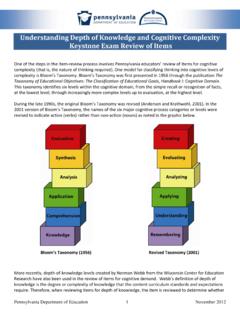
Understanding Depth of Knowledge and Cognitive …
static.pdesas.orgPennsylvania Department of Education 1 November 2012 Understanding Depth of Knowledge and Cognitive Complexity Keystone Exam Review of Items
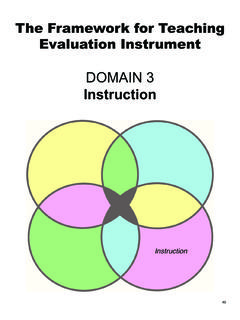
The Framework for Teaching Evaluation Instrument
static.pdesas.org51 3a Communicating with Students —Possible Examples Unsatisfactory Basic Proficient Distinguished A student asks: “What are we supposed to
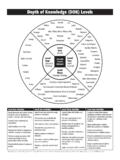
Depth of Knowledge (DOK) Levels - pdesas.org
static.pdesas.orgLevel One Activities Recall elements and details of story structure, such as sequence of events, character, plot and setting. Conduct basic mathematical
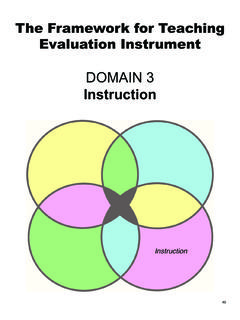
The Framework for Teaching Evaluation Instrument
static.pdesas.org59 3c Engaging Students in Learning —Possible Examples Unsatisfactory Basic Proficient Distinguished Students are able to fill out the lesson
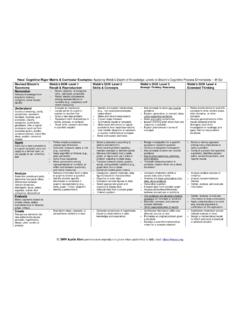
Hess’ Cognitive Rigor Matrix & Curricular Examples ...
static.pdesas.orgHess’ Cognitive Rigor Matrix & Curricular Examples: Applying Webb’s Depth-of-Knowledge Levels to Bloom’s Cognitive Process Dimensions – M-Sci © 2009 Karin ...
Related documents

Handouts on Percents………………………………………page 2 Percent …
www.cnm.eduChanging fractions to decimals: divide the bottom number into the top number .5.5 2 1 2 1 8.2.2 5 1 5 1 8 Changing decimals to fractions: place a one under the point and a zero under the number(s) 10.7 7.7 100 73 3.73 3.73 5 3 2 10 6 10.6 2.6 Changing Decimals to …
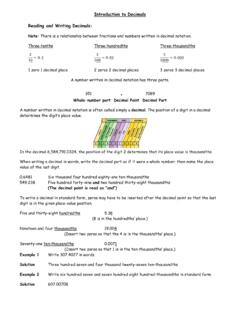
Decimals and Decimal Operations
www.mcckc.eduTo multiply decimals, multiply the numbers as in whole numbers. Write the decimal point in the product so that the number of decimal places in the product is the sum of the decimal places in the factors. Multiply: 9 > 5 Increase 7 by 1 and drop all digits to the right of 7. Given place value

2.3 Multiplying and Dividing Rational Numbers
www.bigideasmath.comSection 2.3 Multiplying and Dividing Rational Numbers 63 Work with a partner. Write a story that uses addition, subtraction, multiplication, or division of rational numbers. A t least one of the numbers in the story has to be negative and not an integer. Draw pictures to help illustrate what is happening in the story. Include the solution of the problem in the story.

GED Study Guide
www.ged.com1 Fractions and decimals in order Place fractions and decimals in order. For example, you can order the set of numbers: in order from smallest to largest: Example Questions Fractions and decimals in order Question: Between which pair of decimals should be placed on a number line? A 0.3 and 0.4 B 0.4 and 0.5 C 0.5 and 0.6 D 0.6 and 0.7 2
GRADE 5 SUPPLEMENT
www.mathlearningcenter.organd decimals and then discuss the relationships among those calculations to build greater computational fluency and a stronger number sense with decimals. Then they explore what happens, and why, when they multiply by powers of 10 (0.01, 0.1, 1, 10, etc.). Skills & Concepts. H multiply by powers of 10, including 0.01, 0.1, 1, 10, 100, and 1,000

Lesson Plan -- Adding and Subtracting Integers
902126595362575422.weebly.comsubtract, multiply, and divide with decimals; add with negative integers; subtract positive integers from negative integers; and verify the reasonableness of the results. Gr. 6 NS 2.3: Solve addition, subtraction, multiplication, and division problems, including those arising in concrete situations, that use positive and negative integers and

Percents - Metropolitan Community College
www.mcckc.eduCHANGING PERCENTS TO DECIMALS RULE: To change a percent to a decimal, drop the % symbol and move the decimal point two places to the left. ... The word is always translates to an = sign, the word of almost always means multiply, and the number we are looking for can be represented with a letter, such as n or x.
Math Definitions: Introduction to Numbers
www.usf.edunumber of times you multiply it is called the exponent or the power. Sometimes written as 2^5 2^5=25=2*2*2*2*2=32 . In this case, 5 is the exponent and 2 is the base. We would say 25 out loud as “two to the fifth power” (or sometimes just “two to the fifth”). Squared . To square a number is to multiply it by itself. A number x squared ...
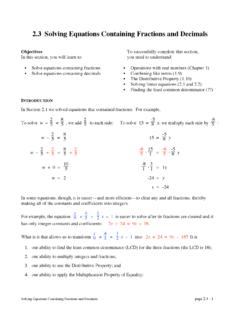
2.3 Solving Equations Containing Fractions and Decimals
bobprior.comSolving Equations Containing Fractions and Decimals page 2.3- The Multiplication Property of Equality We may multiply any non-zero number, c, to each side of an equation. If a = b, then c · a = c · b, c ≠ 0 Applying the Multiplication Property of Equality to an equation such as