
Acid-Base Extraction
An acid-base extraction, this week's experiment, is a modification of the second case above; that is, it is a solvent-solvent extraction. Before looking at what makes it an acid-base extraction, first consider solvent-solvent extractions in general. A requirement of a solvent-solvent extraction is that the two
Download Acid-Base Extraction

Information
Domain:
Source:
Link to this page:
Documents from same domain

Esters. An Introduction.
people.chem.umass.eduof mixtures, albeit not as complex as their natural counterparts. One example is an artificial pineapple mixture – 7 esters, 3 carboxylic acids, and 7 essential oils (other natural extracts). In some cases even an individual ester smells similar to a natural aroma. Some examples include O O O O O O O O chocolate vanilla honey caramel
Thin layer chromatography TLC
people.chem.umass.eduMost organic compounds will form a dark-colored complex with iodine. It is good practice to use at least two visualization techniques in case a compound does not show up with one particular method. The Rf value is used to quantify the movement of the materials along the plate. Rf is …

Distillation - BMB & Chemistry IT
people.chem.umass.eduFamiliar examples include the distillation of crude fermentation broths into alcoholic spirits such as gin and vodka, and the fractionation of crude oil into useful products such as gasoline and heating oil. ... It shows only the basic pieces that exemplify the process.) If we placed the 1:1 mixture of cyclohexane and toluene into the ...

The Synthesis of Phenacetin from Acetaminophen Introduction
people.chem.umass.eduScheme 2 shows the reaction that will be performed i n this experiment . Acetaminophen is treated ... via syringe followed by the football-shaped magnetic stir bar. 3. Turn the stirrer on to low. The stir bar should be allowed to spin at a rate to sufficiently mix ... Reaction Work Up: 1. Add 4 mL water to the RBF and allow the solid to ...
Thin layer chromatography TLC
people.chem.umass.eduThin Layer Chromatography. Thin layer chromatography, or TLC, is a method for analyzing mixtures by separating the compounds in the mixture. TLC can be used to help determine the number of components in a mixture, the identity of compounds, and the purity of a compound.
Identification of an Unknown – Alcohols, Aldehydes, and ...
people.chem.umass.edu2,4-Dinitrophenylhydrazine : Aldehydes and ketones react with 2,4-dinitrophenylhydrazine reagent to form yellow, orange, or reddish-orange precipitates, whereas alcohols do not react. Formation of a precipitate therefore indicates the presence of an aldehyde or ketone. The precipitate from this test also serves as a solid derivative.

Synthesis of Cyclohexene The Dehydration of Cyclohexanol
people.chem.umass.eduSet up a fractional distillation apparatus in the same way as in the distillation experiment (remember the boiling chips). Be sure to use the distillation column (in some rare cases a slightly longer narrower glass tube that looks a lot like the distillation column may have inadvertently gotten mixed in to some of the lockers. Be sure to
Melting Points - University of Massachusetts Amherst
people.chem.umass.eduMelting Points. The temperature at which a solid melts is known as the melting point (MP) of that substance. The melting point is a physical property of a solid and can be used to help identify a substance. In practice, a solid usually melts over a range of temperatures rather than at one specific temperature.

A Brief Discussion of Color - BMB & Chemistry IT
people.chem.umass.eduA Brief Discussion on Color. Because several tests in the Alcohol, Aldehyde, and Ketone experiment involve color changes or produce colored compounds, a modest understanding of color will be helpful in the interpretation of the test results. What causes a compound to appear as being colored? The answer to this
The 2-Step Synthesis of Lidocaine Review: Introduction
people.chem.umass.eduabove for the proper hook-up of a water-cooled condenser). Turn water on very slowly. Your water going to the drain should just trickle out, not flow like white-water rapids! Lower assembly close to the hot plate and reflux for 90 minutes (note any and all observations). Cool to room temperature, unaided. Transfer to a separatory funnel and ...
Related documents
9.11.1 Vegetable Oil Processing
www3.epa.govsoybeans for solvent extraction, solvent extraction and oil desolventizing, flake desolventizing, and oil refining. Oilseed Handling/Elevator Operations - Figure 9.11.1-1 is a schematic diagram of a typical soybean handling/elevator operation that precedes the preparation of soybeans for the solvent extraction process.
Extraction of Caffeine from Coffee and preparation of ...
www.ripublication.comA good extraction solvent needs five essential features: 1) Be immiscible with the other solvent (usually water). 2) Has a relatively low boiling point so as to be easily removed from the compound after extraction. 3) Extract little or none of the impurities and other compounds present in the mixture. ...

Method of Extraction - Philadelphia University
www.philadelphia.edu.joextraction so that less solvent is needed and evaporation requirements for concentrated products are reduced. ¾By reducing the cost of evaporation, it has the further advantage of minimizing the heat damage to thermo-labile constituents. 1.5: Modified Large Scale Maceration Processes 1.5.1: Circulatory Extraction

Isolation and Purification of Organic Compounds Extraction ...
chemistry.miamioh.eduOver time the extraction solvent is enriched in the desired compound. Extraction Procedures, Continued . Liquid-liquid extraction Used to separate a component from one liquid phase into another. For most extractions one phase is an aqueous solution, and the other is an immiscible

Liquid-Liquid Extraction Equipment
cresp.orgLiquid-liquid extraction (also called solvent extraction) was initially utilized in the petroleum industry beginning in the 1930’s. It has since been utilized in numerous applications including petroleum, hydrometallurgical, pharmaceutical, and nuclear industries. Liquid-liquid extraction

SOLVENT EXTRACTION - Savitribai Phule Pune University
soe.unipune.ac.in• Solvent extraction is the process in which a compound transfers from one solvent to another owing to the difference in solubility or distribution coefficient between these two immiscible (or slightly soluble) solvents. • It is a method of quantitative separation of compounds.
COLUMN CHROMATOGRAPHY EXTRACTION OF PIGMENTS …
users.stlcc.edu(a solvent system which gradually increases in polarity.) For example, a column may be developed first with a low-polarity solvent, such as hexane, and as fractions are collected the developing solvent is changed to 70:30 hexane: acetone, then 50:50 hexane: acetone. (The solvent is changed by adding more to the top of the column).

Review of Extraction Techniques
www.arcjournals.orgliquid extraction the feed solution is one phase and the solvent used for extraction is another phase. In solvent extraction both the liquids i.e. the feed and solvent forms a homogenous mixture and are separated by contacting it with one another which separates out one of the two liquids preferentially [15]. Fig2.
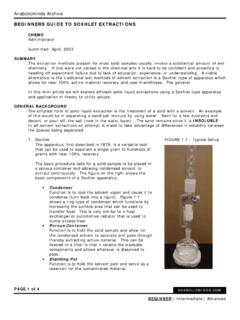
Beginners Guide to Soxhlet Extractions
www.erowid.orgSOLVENT EXTRACTION A solvent extraction is any technique that is used to separate or isolate a species from a mixture of compounds or impurities. This method of separation relies on the solubility characteristics of the particular species involved. A rather general statement of solute/solvent solubilities can be stated by like dissolves like. In