AN EXPERIMENT USING MOLECULAR MODELS
The idea of a correlation between molecular geometry and number of valence electrons (both shared and unshared) was first presented in 1940 by Sidgwick and Powell.
Download AN EXPERIMENT USING MOLECULAR MODELS

Information
Domain:
Source:
Link to this page:
Documents from same domain
Chem and physics of soap bubbles part 1 - …
www.chymist.com3 Introduction I have been playing with soap bubbles for most of my life. My studies turned from simple amusement to semi-serious study in about 1978, when I started investigating the chemistry of
Chem and physics of soap bubbles part 2 - …
www.chymist.com16 The Behavior of Soap Bubbles One reason a bubble breaks is that it hits something dry. The other reason is a result of the water in the walls of the bubble draining to the bottom of the bubble.
FORMULA WRITING AND NOMENCLATURE OF …
www.chymist.com2 Table 1. Names, Symbols, and Oxidation Numbers of Common Elements and Polyatomic Ions +1 Oxidation No. +2 Oxidation No. +3 Oxidation No.
A BRIEF HISTORY OF MEASUREMENT - chymist.com
www.chymist.comTable 2. The SI prefixes These prefixes multiply base units for larger measurements These prefixes are decimal fractions that multiply base units
POLYMERS - chymist.com
www.chymist.comPolymer name Monomer(s) Polymer Use Polyethylene CH 2=CH2 (ethene) −CH2 −CH − Most common polymer. Used in bags, wire insulation, and squeeze bottles ...
Names and symbols PCC - chymist.com
www.chymist.com5 2. MODERN CHEMICAL SYMBOLS Listed below are the atomic numbers, names, and symbols of the most common elements. The atomic number is used to determine the place of the element in the periodic table, it also has other meaning as you
CHEMICAL FORMULAS AND FORMULA WEIGHT …
www.chymist.comCHEMICAL FORMULAS AND FORMULA WEIGHT CALCULATIONS 1. THE MEANING OF A CHEMICAL FORMULA A chemical formula is a shorthand method of representing the elements in a compound.
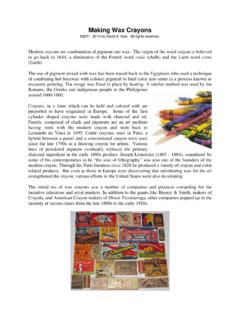
Making Wax Crayons - chymist.com
www.chymist.comAdd 0.25 g of pigment to the melted wax. Stir to obtain a uniform color. If the color is too light, additional pigment can be added. Remove the aluminum pan from the heat.
MASS-VOLUME EQUIVALENTS OF COMMON …
www.chymist.comMASS-VOLUME EQUIVALENTS OF COMMON CHEMICAL SOLIDS Edited by David A. Katz Pima Community College 2202 W. Anklam Rd. Tucson, AZ Original Mass …
OBJECTIVE: APPARATUS AND CHEMICALS - …
www.chymist.comIngredient Mixture 1 Mixture 2 Mixture 3 Mixture 4 Strearic acid 10 g 10 g 10 g — Lanolin 7 g 7 g 7 g 7 g Mineral oil 10 g 10 g — 10 g
Related documents
Table of Contents - keytomes.com
keytomes.comPreface vii Table of Contents Introduction i A1.1 (a) Shell number and number of subshells 1 A1.1 (b) Orbitals 2 A1.1 (c ) Orbital shapes (s, p & d) 2
Cumberland High School General Chemistry Syllabus
www.cumberlandschools.org3/23 Covalent Bonding Molecular Geometry Drawing Lewis Structures 3/24 Names & Formulas – Covalent Distinguishing Ionic from Resonance
Chapter 10 Chemical Bonding - Millersburg Area …
www.mlbgsd.k12.pa.us3 Lewis Theory • Uses dots to represent valence electrons. • Arranges bonding between atoms to attain certain sets of stable valence electron
CATALYST FOR CHEMISTRY - Pearson
www.pearsoncustom.comLaboratory Safety and Common Techniques 10 BCCAT0526 Taking Measurements 8 BCCAT0527 Physical and Chemical Properties and Changes 8 BCCAT0528 Percent Water in Popcorn ...

Lesson 3 Chemical Bonding Molecular Orbital Theory
www.uniroma2.it4 The Quantum Mechanics of H 2 + To get a better understanding of bonding, it’s best to start with the simplest possible molecule, H 2 +. What forces do we need to consider? This is a three-body problem, so there is no exact solution. The nuclei are much more massive than the electrons (1 u for a proton; 0.0005u for an electron).

Mechanics of Soft PSAs (Pressure Sensitive Adhesives)
benthamopen.comMechanics of Soft PSAs (Pressure Sensitive Adhesives) The Open Materials Science Journal, 2013, Volume 7 25 RESULTS AND DISCUSSION The PSAs under study contain a dispersed crosslinked

Course Syllabus CHEM 108 - General Lab Chemistry …
www.portagelearning.comCourse Syllabus CHEM 108 - General Lab Chemistry for Health Professions 4 credits Prerequisites: High school chemistry (recommended, but not required) Instructor: Kenneth Hartman, PhD Facilitator: H. Elaine Frey, MHA Contact Info: Faculty may be contacted through the Portage messaging system Course web site address: …
Related search queries
Table of Contents, Cumberland High School General Chemistry Syllabus, Bonding Molecular Geometry, Chemical Bonding, Theory, Bonding, CATALYST FOR CHEMISTRY, Pearson, And Chemical, Chemical Bonding Molecular Orbital Theory, Mechanics of Soft PSAs, CHEM 108 - General Lab Chemistry, CHEM 108 - General Lab Chemistry for Health