
and Incheon Declaration Framework for Action - UNESCO
Incheon Declaration and Framework for Action for the implementation of Sustainable Development Goal 4 Ensure inclusive and equitable quality education and promote lifelong learning opportunities for all Education 2030 Incheon Declaration and Framework for Action 1380_FfA_Cover_8a.indd 1-3 30/08/2016 10:39
Download and Incheon Declaration Framework for Action - UNESCO

Information
Domain:
Source:
Link to this page:
Documents from same domain
One in Five Children, Adolescents and Youth is Out of School
uis.unesco.orgchildren and youth has declined by little more than 1 million per year since 2012. Some 63 million, or 24% of the total, are children of primary school age (about 6 to 11 years old); 61 million, or 23% of the total, are adolescents of lower secondary

Provisional Agenda - UNESCO UIS
uis.unesco.orgProvisional Agenda Day 1 – Sunday, 4 December 2016 Bilateral meetings The meetings will be held with the representatives of each country to review the outcomes of UIS education surveys. Specifically, the objectives of bilateral meetings are to: ... Advanced charts in Excel

Communications and Stakeholder Engagement Guide
uis.unesco.org2 Communications and Stakeholder Engagement Guide . Introduction . The Global Alliance to Monitor Learning (GAML) is an institutional platform to coordinate efforts

Principles of Good Practice in Learning Assessment
uis.unesco.orgThe ACER Centre for Global Education Monitoring Principles of Good Practice in Learning Assessment 3 At the national level, this involves the development of national strategies for large-scale
Literacy Rates Continue to Rise from One Generation to the ...
uis.unesco.orgFact Sheet No. 45 September 2017 FS/2017/LIT/45 Literacy Rates Continue to Rise from One Generation to the Next To celebrate International Literacy Day on 8 September, this fact sheet
Information and Communication Technology ICT in Education ...
uis.unesco.orgof ICT in education and how it is integrated across national education systems must be a priority for all countries. 1. Why do we measure ICT in education? The UNESCO Institute for Statistics (UIS) is mandated to administer international data collections on the availability, use and impact of ICT in education. Through the establishment of

INFORMATION AND COMMUNICATION TECHNOLOGY …
uis.unesco.org1. Why do we measure ICT in education? The UNESCO Institute for Statistics (UIS), which is the United Nation’s repository for statistics on education, science and technology, and culture and communication, is mandated to administer international data collections on the availability, use and impact of ICT in education.

Introduction to financing Education - s financial flows
uis.unesco.orgs Typical Sources of Education Financing – multiple actors • Government/Public – often the largest contributor to the education sector and/or most sectors of the economy; • Income generated by schools; • External (grants or loans channelled …
Children Out of School - UNESCO
uis.unesco.orgout of school are counted, but they are also needed to provide a more detailed picture of these children. The global count is important for monitoring progress. Yet at the same time, it is essential to view the child and household as units of analysis in order to reassess or
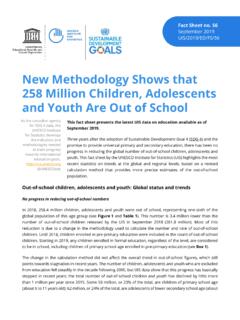
New Methodology Shows that 258 Million Children ...
uis.unesco.org2008, reaching 8% in 2018, and the lower secondary out-of-school rate has been at 16% since 2012. The upper secondary out-of-school rate, which was initially at much higher levels than the primary and lower secondary out-of-school rates, has …
Related documents
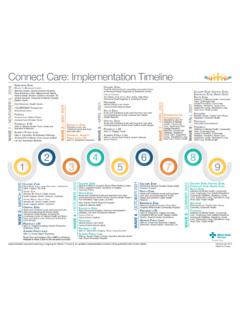
Connect Care: Implementation Timeline
albertahealthservices.caImplementation sequence planning for Waves 4, 5 and 6 is subject to change due to external factors, including COVID-19. Implementation sequence planning is ongoing for sites in Waves 7, 8 and 9. As our knowledge improves future waves may be modified. An updated implementation timeline will be published with further details. EDMONTON ZONE
The Nature of Policy Change and Implementation: A Review ...
www.oecd.orgthere is a growing body of literature on policy change and implementation, this review can only engage with a few selected theories which were deemed the most applicable to education policy. The review proceeds in the following way: Section 2 presents a selection of the main theories and

COVID-19 Lab Data Reporting Implementation Specifications
www.hhs.govCOVID-19 Lab Data Reporting Implementation Specifications . HHS Laboratory Data Reporting Guidance for COVID-19 Testing Under CARES: Specifications CDC / HHS EHR .

Implementation Guidance for FIPS 140-2 - NIST
csrc.nist.govImplementation Guidance for FIPS 140-2 and the Cryptographic Module Validation Program . National Institute of Standards and Technology . Canadian Centre for Cyber Security . Initial Release: March 28, 2003 . Last Update: March 14, 2022
PHASE 8: IMPLEMENTATION PHASE
doit.maryland.govThe Implementation Phase has one key activity: deploying the new system in its target environment. Supporting actions include training end-users and preparing to turn the system over to maintenance personnel. After this phase, the system enters the Operations and

Questions & Answers for applicants, marketing ...
www.ema.europa.euimplementation of the medical devices and the in vitro diagnostic medical devices regulations. This document has been produced to provide guidance to Applicants, Marketing Authorisations Holders (MAH) and notified bodies (NB) as regards aspects falling within the scope of the Agency’s activities and

Jurisdiction’s name: New Zealand Information on Tax ...
www.oecd.orgAdditional information on the mandatory issuance of Tax Identification Numbers (TINs) Question 1 – Does your jurisdiction automatically issue TINs to all residents for tax purposes? Individuals Yes Entities Yes No No Question 2a – If you answered no to Question 1 with respect to individuals, describe those instances where individuals are not being automatically issued a TIN.

External Guidance on the implementation of Policy 0070
www.ema.europa.euExternal guidance on the implementation of the European Medicines Agency policy on the publication of clinical data for medicinal products for human use EMA/90915/2016 Page 7/105 of 24 November 20085 - and line extension applications relating to existing centrally authorised

Department of Budget and Management
www.dbm.gov.phDepartment of Budget and Management