Angular Momentum and Central Forces
central field) has conserved physical observables such as energy, angular momentum, etc. – In a central force problem there is no external torque acting on the system • “The law of conservation of angular momentum is a statement about the rotational symmetry of a …
Download Angular Momentum and Central Forces

Information
Domain:
Source:
Link to this page:
Documents from same domain
ECE3080-L-4-Density of states fermi energi
alan.ece.gatech.eduDerivation of Density of States Concept We can use this idea of a set of states in a confined space ( 1D well region) to derive the number of states in a given volume (volume of our crystal).
Density of States - Georgia Institute of Technology
alan.ece.gatech.eduDerivation of Density of States (2D) We can model a semiconductor as an infinite quantum well (2D) with sides of length L. Electrons of mass m* are confined in the well.

Lecture 1 Introduction to Semiconductor Devices Reading ...
alan.ece.gatech.eduElement Atomic Radius/Lattice Constant Bandgap (How closely spaced are the atoms?) C 0.91/3.56 Angstroms 5.47 eV Si 1.46/5.43 Angstroms 1.12 eV Ge 1.52/5.65 Angstroms 0.66 eV α-Sn 1.72/6.49 Angstroms ~0.08 eV* Pb 1.81/** Angstroms Metal *Only has a measurable bandgap near 0K **Different bonding/Crystal Structure due to unfilled higher orbital ...

Lecture 1 Introduction to Semiconductors and …
alan.ece.gatech.eduQuantum Mechanics allows us to Understand and Design Complex Semiconductors and Devices •The goal of this course is to teach the fundamentals of Quantum Mechanics, a modern approach to physics on the nano scale. Understanding of this important concept leads to the ability to: •Understand and design custom semiconductor materials with optical

Lecture 5 Ion Implantation Reading: Chapter 5
alan.ece.gatech.eduThick or dense materials can be used to “protect” regions from being implanted. The choice of materials ... the crystal from an amorphous layer via a process known as solid phase epitaxy (activation energy ~2.3 eV in Silicon) than it is to anneal out defects. Thus, two schemes for implants are used:

Lecture 7 Drift and Diffusion Currents Reading: Notes and ...
alan.ece.gatech.eduThus, the drift velocity increases with increasing applied electric field. More generally, for Silicon and Similar Materials the drift velocity can be empirically given as: Drift ⎩ ⎨ ⎧ →∞ → ≅ ⎥ ⎥ ⎦ ⎤ ⎢ ⎢ ⎣ ⎡ ⎟⎟ ⎠ ⎞ ⎜⎜ ⎝ ⎛ + = v when E E when E v E E v sat o sat o o d 0 1 1 µ µ µ β β where vsat ...
Lecture 24 MOSFET Basics (Understanding with no math ...
alan.ece.gatech.edu“stripping” or “collecting” carriers from the channel. Georgia Tech ECE 3040 - Dr. Alan Doolittle MOS Transistor Qualitative Description Inversion case, V GS > V T(continued): If L<<L, the voltage at the end of the channel will be constant (V sat) for all V DS >V sat. I

Lecture 25 MOSFET Basics (Understanding with Math) …
alan.ece.gatech.eduGeorgia Tech ECE 3040 - Dr. Alan Doolittle Lecture 25 MOSFET Basics (Understanding with Math) Reading: Pierret 17.1-17.2 and Jaeger 4.1-4.10 and Notes

Lecture 12 Physical Vapor Deposition: Evaporation and ...
alan.ece.gatech.edumetal deposition can be used to deposit other materials as well. Several methods are currently used for deposition of metal layers. Physical Vapor Deposition techniques (PVD) 1.) Evaporation 2.) Sputtering 3.) Chemical Vapor Deposition (CVD) 4.) Electrochemical techniques 1.) Evaporation: Advantages: Highest purity (Good for Schottky

Lecture 20 Bipolar Junction Transistors (BJT): Part 4 ...
alan.ece.gatech.eduselected so PSPICE results in V. BE =0.7V @ I. C =1.66mA . Georgia Tech . ECE 3040 - Dr. Alan Doolittle . Step 1: Determine DC Operating Point . Remove the Capacitors . Because the impedance of a capacitor is Z = 1/(jωC), capacitors have infinite impedance or …
Related documents
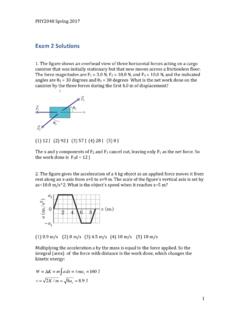
Exam 2 Solutions - Department of Physics
www.phys.ufl.edu11. A disk rotates about its central axis starting from rest and accelerates with constant angular acceleration. At one time it is rotating at 10 rev/s; 50 revolutions later, its angular speed is 25 rev/s. Calculate the angular acceleration in rev/s^2. (1) 5.25 (2) 1.0 (3) 6.25 (4) 15.0 (5) 0.15 ω 2 2−ω 1 2=2αΔθ α= ω 2 2−ω 1 2 2Δθ =
Lecture Notes on Classical Mechanics (A Work in Progress)
courses.physics.ucsd.eduLecture Notes on Classical Mechanics (A Work in Progress) Daniel Arovas Department of Physics University of California, San Diego May 8, 2013

8.09(F14) Chapter 1: A Review of ... - MIT OpenCourseWare
ocw.mit.edumotion and central force scattering, and the basic ideas of canonical transformations. This ... Often when using Lwe can avoid discussing forces of constraint (for example, the force normal to the surface). ... which is equivalent to the relation between angular momentum and torque perpendicular to
AP Physics 1 and 2 Exam Questions - College Board
secure-media.collegeboard.orgLearning Objective (5.E.2.1): The student is able to describe or calculate the angular momentum and rotational inertia of a system in terms of the locations and velocities of objects that make up the system. Students are expected to do qualitative …
4. Central Forces - University of Cambridge
www.damtp.cam.ac.ukWe already saw in Section 2.2.2 that angular momentum is conserved in a central potential. The proof is straightforward: dL dt = mx⇥x¨ = x⇥rV =0 where the final equality follows because rV is parallel to x. The conservation of angular momentum has an important consequence: all motion takes place in a plane.

Classical Mechanics: A Critical Introduction
www.physics.upenn.eduthe forces which act on a given object. Most people require a considerable amount of practice before they can make a correct list. One must learn to distinguish between the forces acting on a thing and the forces which it exerts on other things, and one must learn the di …