AnIntroductionto StatisticalSignalProcessing
A.2 Examples of proofs 418 A.3 Mappings and functions 422 A.4 Linear algebra 423 A.5 Linear system fundamentals 427 A.6 Problems 431 Appendix B Sums and integrals 436 B.1 Summation 436 B.2 ⋆Double sums 439 B.3 Integration 441 B.4 ⋆The Lebesgue integral 443 Appendix C Common univariate distributions 446 Appendix D Supplementary reading 448 ...
Download AnIntroductionto StatisticalSignalProcessing

Information
Domain:
Source:
Link to this page:
Documents from same domain
Probability, Random Processes, and Ergodic Properties
ee.stanford.eduof random processes. These in turn provide the means of proving the ergodic decomposition of certain functionals of random processes and of characterizing how close or di erent the long term behavior of distinct random processes can be expected to be. Of particular interest are

Realism and Morality in Politics - ee.stanford.edu
ee.stanford.eduRealism and Morality in Politics Andrei V. Kortunov ... attendant political relations would wipe out historical modes of interactions, nationalism, cultural differences, and ideologies. Instead, it has become ... Over the Years International Relations Are Becoming More Complex.

Optical Physics of Quantum Wells - Stanford EE
ee.stanford.eduOptical Physics of Quantum Wells David A. B. Miller Rm. 4B-401, AT&T Bell Laboratories Holmdel, NJ07733-3030 ... All of the physics and devices that will be discussed here are based on properties of direct gap semiconductors near the center of the Brillouin zone. For all of the semiconductors of interest ... 3 Linear Optical Properties of ...
Entropy and Information Theory - Stanford EE
ee.stanford.eduinformation theory text include asymptotic mean stationary sources, one-sided sources as well as two-sided sources, nonergodic sources, d -continuous channels, and sliding block or stationary codes .

The Evolution of Cooperation* - Stanford EE
ee.stanford.eduThe Evolution of Cooperation** Robert Axelrod Professor of Political Science and Public Policy, University of Michigan, Ann Arbor. Dr. Axelrod is a member of the American National Academy of Sciences and the American Academy of Arts and Sciences. His honors include a MacArthur Foundation Fellowship for the period 1987 through 1992.

The Physics of Nuclear Weapons
ee.stanford.eduNatural uranium, with only 0.7% U-235, is not useful as either bomb or power plant primary fuel, with an important exception. That is the Magnox reactor, which is a gas-cooled, graphite-moderated reactor. Magnox reactors can run on natural, unenriched uranium and produce bomb-
NOVEMBER New Directions in Cryptography
ee.stanford.edu644 IEEE TRANSACTIONS ON INFORMATION THEORY, VOL. IT-22, NO. 6, NOVEMBER 1976 New Directions in Cryptography Invited Paper WHITFIELD DIFFIE AND MARTIN E. HELLMAN, MEMBER, IEEE Abstract-Two kinds of contemporary developments in cryp-
Related documents
Theory of Statistics
mason.gmu.eduPreface: Mathematical Statistics After teaching mathematical statistics for several years using chalk on a black-board (and, later, smelly “dry erase markers” on a whiteboard) mostly doing proofs of theorems, I decided to lecture from computer slides that provide an outline of the “big picture”. Rather than spend class time “doing ...
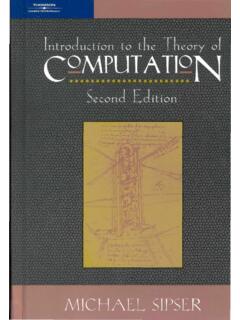
INTRODUCTION TO THE
www.cs.virginia.eduate text in computer science theory. It contains a mathematical treatment of the subject, designed around theorems and proofs. I have made some effort to accommodate students with little prior experience in proving theorems, though more experienced students will …

A First Course in Linear Algebra
linear.ups.eduas a rigorous mathematical subject. Besides computational pro ciency, there is an emphasis on understanding de nitions and theorems, as well as reading, understand-ing and creating proofs. A strictly logical organization, complete and exceedingly detailed proofs of every theorem, advice on techniques for reading and writing proofs,

A ProblemText in Advanced Calculus
web.pdx.eduground in all sorts of things: quanti ers, logical connectives, set operations, writing proofs, the arithmetic and order properties of the real numbers, mathematical induction, least upper bounds, functions, composition of functions, images and inverse images of sets under functions, nite and in nite sets, countable and uncountable sets.
Discrete Structures Lecture Notes
web.stanford.edu2 shortly. The proofs for π and e require mathematical analysis and are outside our scope.) On being formal. Were the above definitions formal enough? The answer is: it depends. For example, defining the natural numbers is an important and non-trivial accomplishment of mathematics. After all, what do these symbols “1”, “2”, “3 ...

A GUIDE TO PROOFS IN LINEAR ALGEBRA
www.vcccd.eduLogical deduction was the fourth element in our list of ingredients for writing proofs. Much of our logical structure is buried in the development of axiomatic structure and set theory. From this we get the theorems we’ve previously developed in mathematics such as Euclidean geometry, algebra, trigonometry, and calculus.
Mathematical Writing CS209. Mathematical Writing—
jmlr.csail.mit.eduMathematical Writing by Donald E. Knuth, Tracy Larrabee, and Paul M. Roberts This report is based on a course of the same name given at Stanford University during autumn quarter, 1987. Here’s the catalog description: CS209. Mathematical Writing—Issues of technical writing and the ef-fective presentation of mathematics and computer science.
Mathematical induction & Recursion
people.cs.pitt.eduMathematical induction • Used to prove statements of the form x P(x) where x Z+ Mathematical induction proofs consists of two steps: 1) Basis: The proposition P(1) is true. 2) Inductive Step: The implication P(n) P(n+1), is true for all positive n. • Therefore we conclude x P(x).
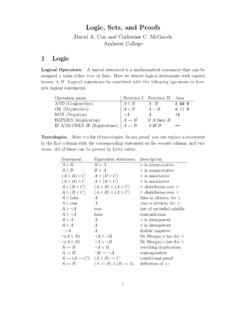
Logic, Sets, and Proofs
www.amherst.eduLogic, Sets, and Proofs David A. Cox and Catherine C. McGeoch Amherst College 1 Logic Logical Operators. A logical statement is a mathematical statement that can be assigned a value either true or false. Here we denote logical statements with capital letters A,B. Logical statements be combined with the following operators to form new logical ...