
ANSYS Workbench Tutorial – Flow Over an Airfoil
Workbench Tutorial – Flow Over an Airfoil, Page 3. on the circle next to “Meter”, then OK. If this prompt does not appear, your version of DM was set to always use a certain unit of length. If this is the case, Tools-Options-Units, and set . Display Units Pop-up Window. to “Yes”. 3. Concept-3D Curve. In . Details View, Not Selected
Download ANSYS Workbench Tutorial – Flow Over an Airfoil

Information
Domain:
Source:
Link to this page:
Documents from same domain

Activated Carbon (Charcoal) Filters
www.me.psu.eduCharcoal filters are used in air conditioning units and exhaust fans to rid air of unwanted odors (smoke, fumes, and animal odor). Some forms of alcohol, …

Stress, Strain, and Strain Gages
www.me.psu.eduStress, Strain, and Strain Gages, Page 2 Strain gage The principle discussed above, namely that a wire’s resistance increases with strain, is key to understanding how a strain gage works. The strain gage was invented by Ed Simmons at Caltech in 1936. A strain gage consists of a small diameter wire (actually an etched metal foil) that is attached to a backing material (usually …

Compressible Flow in a Converging-Diverging Nozzle
www.me.psu.educhromel-alumel. 4. microphones, amplifier, and speaker system 5. Heise absolute pressure gauge (psi units) 6. Omega Engineering thermocouple-based digital thermometer, model 871 7. schlieren flow visualization system: a. two 70-mm diameter 500-mm focal length lenses b. LED light source with condenser lens and slit

Drag on Spheres
www.me.psu.eduDrag on Spheres Prepared by Professor J. M. Cimbala, Penn State University Latest revision: 11 January 2012 Nomenclature a speed of sound A projected frontal area (for a sphere, A = d2/4) CD drag coefficient: CD = 2FD/( V 2A) CL lift coefficient: CL = 2FL/( V 2A) d diameter of a cylinder, sphere, or other object FD drag force FL lift force g gravitational constant (9.81 m/s2)
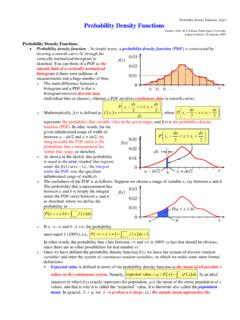
Probability Density Functions
www.me.psu.eduProbability Density Functions, Page 2 expected value when n is large. x and μ are often used interchangeably, but this should be done only if n is large. Standard deviation is defined in terms of the PDF as standard deviation σμ()()x 2 fxdx ∞ −∞ == −∫.In an ideal situation in which f(x) exactly represents the population, σ is the standard deviation of the entire population.

939-956 cengel app1 - Pennsylvania State University
www.me.psu.edu948 PROPERTY TABLES AND CHARTS TABLE A–9 Properties of air at 1 atm pressure Specific Thermal Thermal Dynamic Kinematic Prandtl Temp. Density Heat c p Conductivity Diffusivity Viscosity Viscosity Number T, 8C r, kg/m3 J/kg·K k, W/m·K a, m2/s m, kg/m·s n, m2/s Pr 2 150 2.866 983 0.01171 4.158 3 1026 8.636 3 1026 3.013 3 1026 0.7246 2 100 2.038 966 0.01582 …

The Ideal Gas Constant
www.me.psu.eduFor air in English units, air ft lbf 1545.4 lbmol R ft lbf 53.34 lbm lbm R 28.97 lbmol R Ru M . As a check, one can convert from S. I. to English units, i.e., kJ 1 Btu 5 K 778.17 ft lbf 0.4536 kg ft lbf 0.2870 53.35 air kg K 1.055 kJ 9 R Btu lbm lbm R R The disagreement in the last digit is due to round-off errors in the conversion factors.

Parts of a micrometer - Pennsylvania State University
www.me.psu.eduPlease use the information below to help you read our .001" and .0001" outside micrometers. Parts of a micrometer Figure 1: The parts of a micrometer Sleeve: The Micrometer sleeve is divided into 10 equal parts, each of these parts is equal to .100" (1 tenth of an inch). Each of these 10 parts is divided into 4 equal parts.

Dynamic System Response - Pennsylvania State University
www.me.psu.eduDynamic System Response, Page 3 o For nonhomogeneous ODEs (those with non-zero right hand sides) like the above, the solution is the sum of a general (homogeneous) part and a particular (nonhomogeneous) part in which the right hand side takes the actual form of the forcing function, x(t) times K, namely y t ygeneral particular t y t .

Flat plate turbulent BL - Pennsylvania State University
www.me.psu.eduThe turbulent flat plate boundary layer velocity profile: The time-averaged turbulent flat plate (zero pressure gradient) boundary layer velocity profile is much fuller than the laminar flat plate boundary layer profile, and therefore has a larger slope u/ y at the wall, leading to greater skin friction drag along the wall.
Related documents

Chapter 2: Parametric Analysis in ANSYS Workbench Using ...
alfaproject.irFigure 2.4:The Project Loaded into ANSYS Workbench The project (fluent-workbench-param.wbpj) already has a Fluent-based fluid flow analysis system that includes the geometry and mesh, as well as some predefined parameters.You will first examine and edit parameters within Workbench, then later proceed to define the fluid flow model in ANSYS ...

Industry Workbench/Common Data Model
cloudblogs.microsoft.comIndustry Workbench/Common Data Model CDM driven Analytics Vision at Microsoft Payal Tiwana| Principal Group PM | Azure Global. Volume Variety Velocity. report struggling to become mature users of data* report data silos and data management difficulties as roadblocks*

Reporting Workbench Ref Guide - University of Virginia
hit.healthsystem.virginia.eduWorkbench after the saved results have expired, a window appears where you can delete or resave the results. 1. From a report's results, click Options. 2. Select Save Results. The Save Results window opens. 3. Enter a name and an expiration date for the results. 4. Click Accept. The report results appear in the Saved Results section. 5.

Connected Components Workbench™ Software Guide for …
literature.rockwellautomation.comThe Connected Components Workbench software term for going online with a controller is Connect. 1. With the offline project open, check if there is a project (‘connection’) path displayed for the controller.

Lecture 1 Introduction to ANSYS Workbench
www.clear.rice.eduANSYS Workbench is a convenient way of managing your simulation projects. Workbench is used to launch the individual software components, and used to transfer data between them. It is easy to see at-a-glace how a model has been built, and determine which files were used for a particular simulation (pairing geometry files to solver runs)

Chapter 1: Introduction to Using ANSYS Fluent in ANSYS ...
www.fm.energy.lth.seANSYS Workbench saves the project with a .wbpj extension and also saves supporting files for the project. Note that the fluid flow analysis system is composed of various cells (Geometry, Mesh, etc.) that represent the workflow for performing the analysis. ANSYS Workbench is composed of multiple

ANSYS Workbench – a short guideline
www.kth.seANSYS Workbench – a short guideline This document is a guidline on how to use ANSYS Workbench 2.0 as a tool to solve the second computer workshop in the course SE1025 FEM for engineering applications. You are supposed to have read the problem descriptions before proceeding with this document.