
APPENDIX D MODEL EXPOSURE CONTROL PLAN
provided to eliminate or minimize occupational exposure to bloodborne pathogens in accordance with OSHA standard 29 CFR 1910.1030, "Occupational Exposure to Bloodborne Pathogens." The ECP is a key document to assist our firm in implementing and ensuring compliance with the
Download APPENDIX D MODEL EXPOSURE CONTROL PLAN

Information
Domain:
Source:
Link to this page:
Documents from same domain

Motor Vehicles Safe Driving Practices for Employees
www.osha.govMotor Vehicles Safe Driving Practices for Employees You are your employer’s most valuable asset! The way that you drive says everything about you and your
U. S. Department of Labor Occupational Safety and …
www.osha.govU. S. Department of Labor Occupational Safety and Health Administration Notice of Alleged Safety or Health Hazards . For the General Public: This form is provided for the assistance of any complainant and is not intended to constitute the exclusive means by
Controlling Hazardous Fume and - osha.gov
www.osha.govFactSheet Controlling Hazardous Fume and Gases during Welding Welding joins materials together by melting a metal work piece along with a …
OSHA 3220-10N 2004
www.osha.govWORKER SAFETY SERIES WAREHOUSING 11 Hazards & Solutions Warehouse operations can present a wide variety of potential hazards for the worker. For warehousing establishments, the
Job Safety and Health - osha.gov
www.osha.govJob Safety and Health. IT’S THE LAW! All workers have the right to: A safe workplace. Raise a safety or health concern with your employer or OSHA, or report a work-
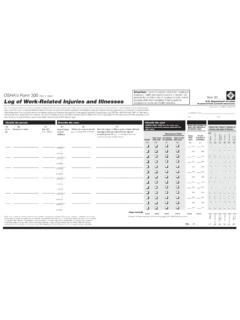
Year 20 Log of Work-Related Injuries and Illnesses
www.osha.govU.S. Department of Labor Occupational Safety and Health Administration OSHA’s Form 300 (Rev. 01/2004) Year 20__ __ Log of Work-Related Injuries and Illnesses You must record information about every work-related death and about every work-related injury or illness that involves loss of consciousness, restricted work activity or job transfer,
DEPARTMENT OF LABOR 29 CFR Part 1904
www.osha.gov2 The final rule also revises the requirements for reporting work-related fatality, injury, and illness information to OSHA. The current regulation requires employers to report …
CRANES AND DERRICKS IN CONSTRUCTION FINAL …
www.osha.govOSHA is making this document, the regulatory text, available for informational purposes only. This action does not affect the effective date of the final rule on Cranes and Derricks in Construction, which will be 90
Preventing Mold-Related Problems in the Indoor …
www.osha.govIntroduction This guide provides basic information about mold, mold sources, and building-related illnesses. Brief discussions are included on building design considerations for healthy indoor air,
HazardCommunicationGuidancefor CombustibleDusts
www.osha.govU.S.DepartmentofLabor OccupationalSafetyandHealthAdministration OSHA3371-08 2009 HazardCommunicationGuidancefor CombustibleDusts Occupational Safety and Health Act of 1970
Related documents

Bloodborne Pathogens Exposure Control Plan
ehs.weill.cornell.eduThis Exposure Control Plan (ECP) has been developed to minimize or eliminate employee occupational exposure. Occupational exposure is any "reasonably anticipated skin, eye, mucous membrane or parenteral contact with blood or other potentially infectious
Occupational Hygiene and Risk Management - HSSE WORLD
hsseworld.comChapter 1 Fundamentals of occupational hygiene and risk management 1 Occupational hygiene 1 Risk management 2 Risk perception 3 States of matter 4 Toxicology 8 Routes of entry 9 Distribution, metabolism and excretion 10 Dose 11 Carcinogenicity 13 Chronic versus acute exposure 15 National exposure standards 16 Sampling and measurement 18
The modern diagnosis and management of pleural effusions …
www.bmj.comStandard blood tests for the investigation of an effusion include a full blood count; looking for evidence of infection, ... • Previous exposure to tuberculosis • Full occupational history, with names and dates of employers if known* • Exposure …
Blood/Body Fluid Exposure Option
www.cdc.govJan 01, 2013 · Blood/Body Fluid Exposure Option Last Updated January 1, 2013 3-2 healthcare facility to record information about the exposure and its management. This option can be used in any healthcare setting where there is potential for occupational exposure to blood and body fluids among HCP. This option requires that data be entered into NHSN when exposures

EXPOSURE TO STRESS - Centers for Disease Control and ...
www.cdc.gov1 Exposure to Stress Introduction Occupational stress has been a long-standing concern of the health care industry. Studies indicate that health care workers have higher rates of substance abuse and suicide than other professions and elevated rates of

Health and Safety G409 Exposure measurement: Air sampling
www.hse.gov.ukThe results obtained are not exposure measurements and so should not be compared against workplace exposure limits (WELs). Sometimes you may also need to carry out biological monitoring of a worker’s breath, blood or urine. This will detect exposure via inhalation, through skin contact, and by ingestion. It may also indicate
American Nurses Association’s Needlestick Prevention Guide
www.who.int4 International Health Care Worker Safety Center, “Estimated Annual Number of U.S. Occupational Percutaneous Injuries and Mucocutaneous Exposures to Blood or Potentially At-Risk Biological Substances,” Advances in Exposure Prevention4, 1 (1998):3.
Guidelines for the Management of Occupational Exposures …
www.who.int• Seroconversion infrequent following occupational exposure to HIV-infected blood • Study of converters vs nonconverters showed use of zidovudine (ZDV) was associated with an 81% decrease in the risk for HIV infection –limitations include a small number of cases, and that cases and controls came from different