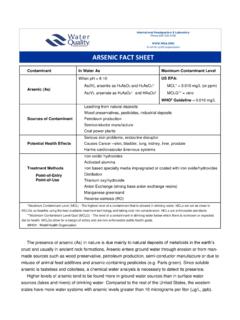
ARSENIC FACT SHEET
Environmental Protection Agency (US EPA) in drinking water in 25 states over a period of 18 years. You can also get information on the presence of arsenic in your drinking water from your local Utility or state EPA. You can also call USEPA’s drinking water hotline (1-800-426-4791) for more information.
Download ARSENIC FACT SHEET

Information
Domain:
Source:
Link to this page:
Documents from same domain
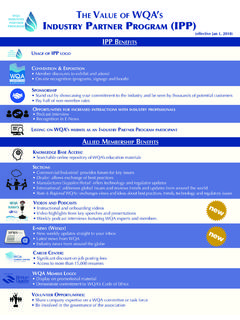
WQA HE ALUE OF WQA’ S I P (IPP)
www.wqa.orgTHE VALUE OF WQA’ S INDUSTRY PARTNER PROGRAM (IPP) ALLIED MEMBERSHIP BENEFITS CAREER CENTER: • Significant discount on job posting fees • Access to more than 15,000 resumes VOLUNTEER OPPORTUNITIES: • Share company expertise on a WQA committee or task force

LAS VEGAS CONVENTION EXPOSITION L A S V E G A S , N E V …
www.wqa.orgTOP 5 REASONS FOR EXHIBITING PURCHASING POWER W Q A C O N V E N T I O N & E X P O S I T I O N EXHIBITOR PROSPECTUS Display new products, services or
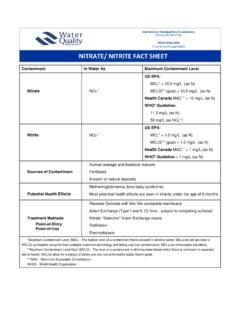
NITRATE/ NITRITE FACT SHEET
www.wqa.org11.3 mg/L (as N) 50 mg/L (as NO 3-1) Nitrite NO 2-1 ... tanks – that was found at ... Brine reclaim should be avoided because excess nitrates in the recycled brine can lead to excessive nitrate leakage in the subsequent run. Anion resins are lower in density than softener resins and are
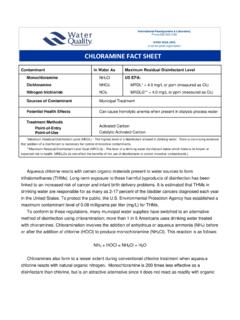
CHLORAMINE FACT SHEET - Water Quality Association
www.wqa.org) for public water systems under the Safe Drinking Water Act, and the level below which there is no known or expected risk to health. Chloramines do pose a risk for hemodialysis patients and fish. Chloramines easily enter the bloodstream through dialysis membranes and the gills of fish. Once in the blood stream, chloramines
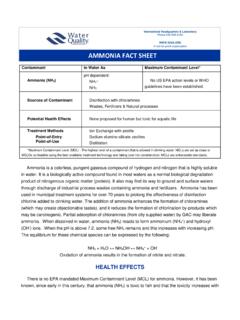
AMMONIA FACT SHEET - Water Quality Association
www.wqa.orgThe concentration of ammonia that exists in drinking water has been determined by the US EPA and WHO not to be of a health risk. WHO does recognize odor effects at a concentration of 1.5 mg/L and taste effects at 35 mg/L. In 2013, the US EPA has recommended water quality criteria for aquatic life expressed as Total ...
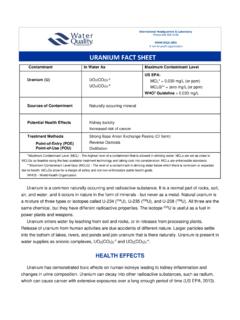
URANIUM FACT SHEET - Water Quality Association
www.wqa.orgWQA Technical Fact Sheet: Uranium The US EPA has issued a Maximum Contaminant Level Goal of zero and a Maximum Contaminant Level (MCL) of 0.030 mg/L for uranium. The 0.030 mg/L is based on increased risk of kidney toxicity and is equivalent to about 27 picocuries per liter (pCi/L) of radioactivity, which also presents an
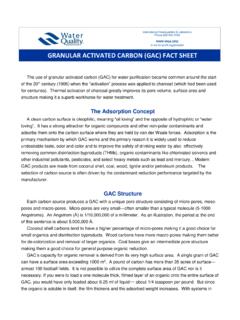
GRANULAR ACTIVATED CARBON (GAC) FACT SHEET
www.wqa.orgWQA Technical Fact Sheet Activated Carbon for Radon Removal Radon (Symbol Rn) is a radioactive gas that does not impart taste or odor to water. It stems from the natural decay of uranium to radium and radium to radon (radon is known to increase the risk of lung cancer when inhaled). Radon is the second leading cause of lung cancer in the US today.
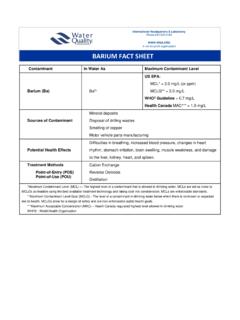
BARIUM FACT SHEET - Water Quality Association
www.wqa.orgAnimal studies have found increased blood pressure and changes in the heart from ingesting barium over a long time. Based on such studies, the United States Environmental Protection Agency (US EPA) has set a Maximum Contaminant Level Goal (MCLG) at 2.0 mg/L (or ppm) in water. The federal Safe
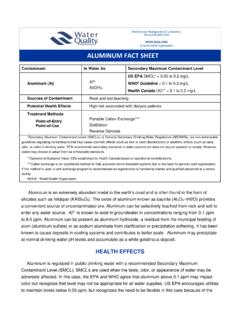
ALUMINUM FACT SHEET - Water Quality Association
www.wqa.orgenter any water source. Al3+ is known to exist in groundwater in concentrations ranging from 0.1 ppm to 8.0 ppm. Aluminum can be present as aluminum hydroxide, a residual from the municipal feeding of alum (aluminum sulfate) or as sodium aluminate from clarification or precipitation softening. It has been
Related documents

Vessel Safety Manual - US EPA
www.epa.govrequired by the U.S. Environmental Protection Agency’s (EPA’s) Vessel Safety Manual. The manual has been developed with the goal of minimizing risk to all individuals who embark on EPA vessels. Policy: It is EPA policy that the operation of all EPA vessels will be governed in accordance with the requirements set forth in this manual.

MATERIAL SAFETY DATA SHEET - Amazon S3
s3-us-west-1.amazonaws.comRESPIRATORY PROTECTION: Where dust or fumes are generated and cannot be controlled to within acceptable levels by engineering means, use appropriate NIOSH approved respiratory protection equipment (a 42CFR84 Class N -95 particulate filter cartridge or better). EYE PROTECTION: Wear safety glasses or splash goggles to prevent contact with this ...
School Chemistry Laboratory Safety Guide
www.cdc.govby private and public school systems in States that have occupational safety and health plans accepted by the Occupational Safety and Health Administration (OSHA) of the U.S. Department of Labor (DOL). OSHA rules and regulations are provided to …

Art and Craft Safety Guide - CPSC.gov
www.cpsc.govGood health and safety habits can be formed at any point in life, including childhood. Adults should model safety procedures, the use of appropriate safety gear, and careful reading of labels and cautionary statements. Children need regular and consistent reminders of safety rules, and there is no substitute for direct supervision.

Hydrochloric Acid (Hydrogen Chloride)
www.epa.gov9. Occupational Safety and Health Administration (OSHA). Occupational Safety and Health Standards, Toxic and Hazardous Substances. Code of Federal Regulations. 29 CFR 1910.1000. 1998. 10. American Industrial Hygiene Association (AIHA). The AIHA 1998 Emergency Response Planning Guidelines

EPA Guidelines for Responsible Pesticide Use
www.epa.sa.gov.auFacsimile: (08) 8204 9393 ; Freecall: 1800 623 445 (non-metro callers) E-mail: epainfo@epa.sa.gov.au . Web site: www.epa.sa.gov.au . ISBN 1 921125 05 5

Wastewater Technology Fact Sheet: Ozone Disinfection
www3.epa.gov• Maintain ambient levels of ozone below the limits of applicable safety regulations. COSTS The cost of ozone disinfection systems is dependent on the manufacturer, the site, the capacity of the plant, and the characteristics of the wastewater to be disinfected. Ozonation costs are generally high in comparison with other disinfection techniques.