
Balancing Chemical Equations
KEY Chemistry: Balancing Chemical Equations Directions: First, balance each of the chemical equations below. Then, classify each reaction as synthesis, decomposition, single-replacement, or double-replacement.To earn full credit, write the words out
Download Balancing Chemical Equations

Information
Domain:
Source:
Link to this page:
Documents from same domain
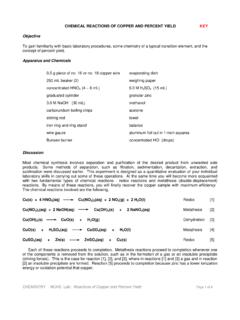
Chemical Reactions of Copper and Percent Yield
teachnlearnchem.com5. Give criteria in terms of temperature changes for exothermic and endothermic reactions. Exothermic reactions - release heat and feel “hot” to the touch Endothermic reaction - gain heat and feel “cold” to the touch 6. If 1.65 g of Cu(NO 3) 2 are obtained from allowing 0.93 g of Cu to react with excess HNO 3, what is the percent

Chemistry: Chemical Word Equations
teachnlearnchem.comChemistry: Chemical Word Equations Directions: Write a balanced chemical equation for each of the word equations below. 1. aqueous sodium chloride reacts with aqueous lead (II) nitrate to yield a lead (II) chloride precipitate and aqueous sodium nitrate ... solid calcium carbonate reacts with hydrochloric acid [HCl(aq)] to yield aqueous calcium ...

Periodic Table questions
teachnlearnchem.comHour: _____ Date: _____ Chemistry: The Periodic Table and Periodicity Directions: Answer each of the following questions. You need not use complete sentences. 1. Who first published the classification of the elements that is the basis of our periodic table today? 2. By what property did Mendeleev arrange the elements? 3.
Related documents
Fluid Mechanics - Chemical Engineering documents 2012 - …
chemicalengineeringdocuments.weebly.com4 Rate Equation It describes the transformation of conserved quantity. Transformation of conserved quantity is based on specified unit of time (Rate). Components of Rate Equation Input Output Generation Consumption Accumulation Basic Concepts

CHAPTER 4:The Material Balance for Chemical Reactors
sites.engineering.ucsb.edubalance for the packed-bed reactor. 3/152 Rate expressions To solve the reactor material balance, we require an expression for the production rates, R j R j = X i ijri Therefore we require ri as a function of c j This is the subject of chemical kinetics, Chapter 5 Here we use common reaction-rate expressions without derivation 4/152

CHAPTER 6:The Energy Balance for Chemical Reactors
sites.engineering.ucsb.eduThe temperature is determined by the energy balance for the reactor. We derive the energy balance by considering an arbitrary reactor volume element, shown in Figure 6.1 1/149 General Energy Balance m 1 E^ 1 c j1 m 0 E^ 0 c j0 V Q_ W _ The statement of conservation of energy for this system takes the form, rate of energy accumulation = 8 ...

EXERCISE 13: CHEMICAL EXAMINATION OF URINE
pkdiet.comName 10 routine chemical tests performed on urine and List and describe a condition that will cause an abnormal 2. Properly use and interpret the reactions of the reagent strip with patient urine samples and control solutions. 3. Define the following terms: proteinuria, glycosuria, ketonuria, ... and acid-base balance of the patient.

Chapter 10 Chemical Reactions
web.gccaz.eduGiven a chemical equation with any hydrocarbon and oxygen gas as reactants, predict the products for the reaction ( H 2 O (g) + CO 2 (g) ) Balance combustion reactions (Tip: balance oxygen last) 10.7 Acid Base Neutralization Reactions HX + MOH → H 2 O(l) + MX Water is formed in some acid base reactions.

Chapter 4 Stoichiometry of Chemical Reactions
web.ung.edu4.1Writing and Balancing Chemical Equations By the end of this section, you will be able to: • Derive chemical equations from narrative descriptions of chemical reactions. • Write and balance chemical equations in molecular, total ionic, and net ionic formats.

Calculating the Capacity of Chemical Plants
www.aiche.orgContinuous and batch chemical processing plants can be modeled as a serial production system. The primary difference between the capacity analysis of a continu-ous operation and that of a batch operation is the form of the mass balance. This article only considers continuous production systems. (References 2–4 discuss production

Chapter 3 Chemical Reactions - Texas A&M University
www.chem.tamu.eduChapter 3 Chemical Reactions 40 5. Balance and name the reactants and products: (a) Fe2O3(s) + 3 Mg(s) 3 MgO(s) + 2 Fe(s) 1. Note the need for at least 2 Fe and 3 O atoms. 2. 2 Fe atoms would provide the proper iron atom inventory. 3. 3 MgO would give 3 O atoms on both sides of the equation. 4.
Notes CHEMICAL REACTION AND EQUATIONS
www.nios.ac.inchemical equation is called the Hit and Trial method . Let us consider another reaction for writing and balancing of a chemical reaction. When steam is passed over red hot iron, hydrogen gas (H 2 ) is evolved and magnetic