
Balancing Chemical Equations
KEY Chemistry: Balancing Chemical Equations Directions: First, balance each of the chemical equations below. Then, classify each reaction as synthesis, decomposition, single-replacement, or double-replacement.To earn full credit, write the words out
Download Balancing Chemical Equations

Information
Domain:
Source:
Link to this page:
Documents from same domain
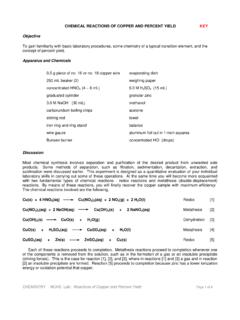
Chemical Reactions of Copper and Percent Yield
teachnlearnchem.com5. Give criteria in terms of temperature changes for exothermic and endothermic reactions. Exothermic reactions - release heat and feel “hot” to the touch Endothermic reaction - gain heat and feel “cold” to the touch 6. If 1.65 g of Cu(NO 3) 2 are obtained from allowing 0.93 g of Cu to react with excess HNO 3, what is the percent

Chemistry: Chemical Word Equations
teachnlearnchem.comChemistry: Chemical Word Equations Directions: Write a balanced chemical equation for each of the word equations below. 1. aqueous sodium chloride reacts with aqueous lead (II) nitrate to yield a lead (II) chloride precipitate and aqueous sodium nitrate ... solid calcium carbonate reacts with hydrochloric acid [HCl(aq)] to yield aqueous calcium ...

Periodic Table questions
teachnlearnchem.comHour: _____ Date: _____ Chemistry: The Periodic Table and Periodicity Directions: Answer each of the following questions. You need not use complete sentences. 1. Who first published the classification of the elements that is the basis of our periodic table today? 2. By what property did Mendeleev arrange the elements? 3.
Related documents
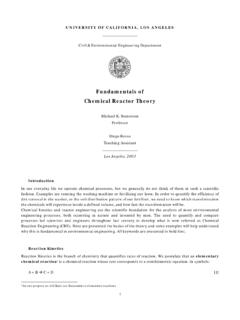
Fundamentals of Chemical Reactor Theory1
www.seas.ucla.eduStenstrom, M.K. & Rosso, D. (2003) Fundamentals of Chemical Reactor Theory 2 and the reaction rate will be defined as: -r = k · (cA) · (cB) where k is referred as the specific reaction rate (constant). The overall order of reaction III is defined as: n = [3] The temperature dependency of k is described by the Arrhenius equation:

4.1Writing and Balancing Chemical Equations
web.ung.edu4.1Writing and Balancing Chemical Equations By the end of this section, you will be able to: • Derive chemical equations from narrative descriptions of chemical reactions. • Write and balance chemical equations in molecular, total ionic, and net ionic formats.

Chapter 4 Stoichiometry of Chemical Reactions
web.ung.edu• Derive chemical equations from narrative descriptions of chemical reactions. • Write and balance chemical equations in molecular, total ionic, and net ionic formats. ... represented by a chemical equation using formulas (top). ... immediately to the left of each formula). A coefficient of 1 is typically omitted.
Steps to Predicting the Products of Chemical Reactions
www.oakparkusd.orgOF CHEMICAL REACTIONS!Here are a few important things to remember when predicting products: !The compounds form must be neutral ionic compounds (which means you’ll be paying attention to their charges) !You do NOT carry subscripts from the reactants to the products. !You always balance your equation LAST
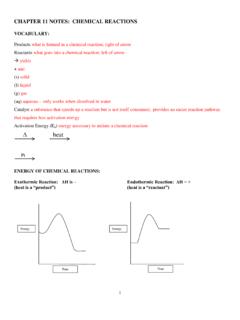
NOTES: CHEMICAL REACTIONS
www.livingston.org2 BALANCED CHEMICAL REACTIONS Law of Conservation of Matter: matter cannot be created or destroyed in a chemical reaction WORD FORMULA BALANCED EQUATIONS 1. word equation: Hydrogen gas reacts with oxygen gas to form water formula equation: ____ H

Chapter 10 Chemical Reactions
web.gccaz.eduBe able to identify combustion reactions Given a chemical equation with any hydrocarbon and oxygen gas as reactants, predict the products for the reaction ( H 2 O (g) + CO 2 (g) ) Balance combustion reactions (Tip: balance oxygen last) 10.7 Acid Base Neutralization Reactions HX + MOH → H 2 O(l) + MX

Chapter 3 Chemical Reactions - Texas A&M University
www.chem.tamu.eduChapter 3 Chemical Reactions 40 5. Balance and name the reactants and products: (a) Fe2O3(s) + 3 Mg(s) 3 MgO(s) + 2 Fe(s) 1. Note the need for at least 2 Fe and 3 O atoms. 2. 2 Fe atoms would provide the proper iron atom inventory. 3. 3 MgO would give 3 O atoms on both sides of the equation. 4.
“Facts are not science — as the dictionary is not ...
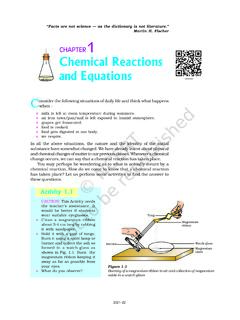
ncert.nic.inChemical Reactions and Equations CHAPTER1 Consider the following situations of daily life and think what happens when – n milk is left at room temperature during summers. n an iron tawa/pan/nail is left exposed to humid atmosphere. n grapes get fermented. n food is cooked. n food gets digested in our body. n we respire. In all the above situations, the nature and the …