BASIC COMMUNICATION MODEL
BASIC COMMUNICATION MODEL According to Adler and Towne (1978), all that ever has been accomplished by humans and all that ever will be accomplished involves communication with others. Many social and organizational problems derive from unsatisfactory relationships brought about by inadequate communication between people.
Download BASIC COMMUNICATION MODEL

Information
Domain:
Source:
Link to this page:
Documents from same domain
THREE APPROACHES TO ORGANIZATIONAL …
home.snu.eduThe Pfeiffer Library Volume 16, 2nd Edition. Copyright © 1998 Jossey-Bass/Pfeiffer 1 THREE APPROACHES TO ORGANIZATIONAL LEARNING Anthony J. Reilly

General Introduction to the Pfeiffer Library
home.snu.eduMain Menu Introduction Credits Help About Jossey-Bass/Pfeiffer Since 1968, Jossey-Bass/Pfeiffer (formerly University Associates, Inc., and now an imprint
CONDITIONS THAT HINDER EFFECTIVE …
home.snu.eduThe Pfeiffer Library Volume 6, 2nd Edition. Copyright © 1998 Jossey-Bass/Pfeiffer 1 CONDITIONS THAT HINDER EFFECTIVE COMMUNICATION J. William Pfeiffer
Presentation and Discussion Resources: …
home.snu.eduii The Pfeiffer Library Volume 6, 2nd Edition. Copyright © 1998 Jossey-Bass/Pfeiffer Jargon: Rediscovering a Powerful Tool..... 87
STRUCTURED EXPERIENCES, ROLE PLAYS, CASE STUDIES ...
home.snu.edudeveloping individuals’ behavioral skills. We will discuss five of them in this volume: structured experiences, role plays, case studies, simulations, and games.

MISSIONS GIVING THROUGH FAITH PROMISE
home.snu.edu5.5% with Faith Promise, don’t simply make up the difference by dipping into tithe money. • Do give people opportunity to reach your Word l Evangesmil Fund goal through offerings at Thanksgiving and Easter (and Christmas and whatever other times may be necessary!)
THE COGNITIVE-STYLE INVENTORY
home.snu.eduStyle Model, these two styles had not previously been shown to reflect the entire spectrum of people’s behavior with regard to thinking, learning, and especially problem solving and decision making.
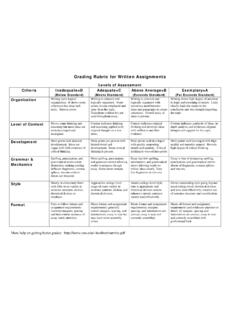
Written Communication Rubric - Southern Nazarene …
home.snu.eduGrading Rubric for Written Assignments Levels of Assessment Criteria Inadequate=D (Below Standard) Adequate=C (Meets Standard) Above Average=B
THREE APPROACHES TO ORGANIZATIONAL LEARNING
home.snu.eduskill areas—data processing, budget and accounting techniques, salary administration— are other examples of applications of management training. Originally published in The 1973 Annual Handbook for Group Facilitators by John E. Jones and J. William Pfeiffer (Eds.), San Diego, CA: Pfeiffer & Company.
MANAGEMENT BY OBJECTIVES
home.snu.eduMay 22, 1973 · organizational vitality and creativity. As a term, “Management by Objectives” was first used by Peter Drucker in 1954. As a management approach, it has been further developed by many management theoreticians, among them Douglas McGregor, George Odiorne, and John Humble. Essentially, MBO is a process or system designed for
Related documents

THEORIES OF BASIC HUMAN NEEDS - Yola
fahmidulhaque.yolasite.comBasic needs theory elaborates the concept of basic needs and its relation to psychological health and well-being; Basic psychological needs are a natural aspect of human beings that apply to all people, regardless of

Module code: LUBS3305 Electric Cars - University of Leeds
resources.library.leeds.ac.ukMaslow (1943) presents a specific basis of needs that need to be met for an individual to achieve a certain level of motivation. Although later revised, the 1943 paper provides a solid basis to the psychological needs of any party, in this instance; a consumer. The 5 basic groups identified by Maslow; physiological (the most basic
The Need to Belong: Desire for Interpersonal Attachments ...
scholar.harvard.eduneeds, the difference being in the scope of ill effects that follow from nonsatisfaction: Unsatisfied needs should lead to pathol-ogy (medical, psychological, or behavioral), unlike unsatisfied wants. Thus, if belongingness is a need rather than simply a want, then people who lack belongingness should exhibit patho-
TARGET ARTICLE The “What” and “Why” of Goal Pursuits ...
selfdeterminationtheory.orgthe psychological rather than physiological level. Thus, in SDT, needs specify innate psychological nu-triments that are essential for ongoing psychological growth, integrity, and well-being. As noted, we identi-fied three, the needs for competence, relatedness, and autonomy. This definition can be considered in organismic and functional terms.

ETHNIC AND RACIAL MINORITIES & SOCIOECONOMIC …
www.apa.orgPsychological Health Socioeconomic deprivation and racial discrimination have been implicated in higher psychological distress. • At each level of income or education, African Americans have worse outcomes than Whites. This could be due to adverse health effects of …

The Human: Basic Psychological Principles
www.ohsbok.org.auThe Human: Basic Psychological Principles April, 2012 1 Introduction This chapter examines basic elements of psychological science that are most relevant for Occupational Health and Safety (OHS) professionals. It is the second in a series of three1 that examine the human as an individual from biological, psychological and social
Methods for Changing Behaviors - Psychological Self-Help
www.psychologicalselfhelp.org6. Meet basic needs (so they won't get in the way) 1093 7. Recognize your motives and defense mechanisms 1095 Techniques Used During-the-Behavior: 1097 8. Record behavior--self-monitor and check your progress 1097 9. Record antecedents & consequences; behavioral analysis 1101 10. Disrupt the unwanted habit; thought stopping 1105 11.