Basic Management Principles - Mercer University
Basic Management Principles Author: Jack E. Fincham, PhD, RPh Dean & Professor University of Kansas School of Pharmacy. Learning Objectives • Understand basic management principles applying to individuals, small and large organizations • …
Download Basic Management Principles - Mercer University

Information
Domain:
Source:
Link to this page:
Documents from same domain

Behaviorism Theory - Mercer University
faculty.mercer.eduBehaviorism Theory And Its Relation to Instructional Design . Bryan Danley . Nakita James . Cameron Mims . Andrew Simms
Time Response of Second Order Systems - Mercer …
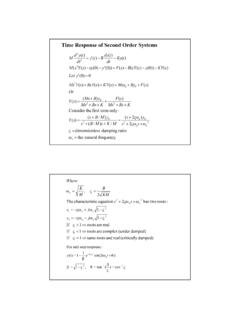
faculty.mercer.eduImpulse response of the second order system: Laplace transform of the unit impulse is R(s)=1 Impulse response: Transient response for the impulse function, which is simply is the derivative of the response to the unit step: ( 2) 2 2 2 n n n s s Y s ζω ω ω + + = y(t) e sin(n t)n n t ω β β = ω −ζω Responses and pole locations Time Responses and Pole …

MAE 322 Machine Design Lecture 5 Fatigue - Mercer University
faculty.mercer.eduStages of Fatigue Failure Stage I – Initiation of micro- crack due to cyclic plastic deformation Stage II – Progresses to macro-crack that repeatedly opens and closes, creating bands called beach marks Stage III – Crack has propagated far enough that
Basic Management Principles - Mercer University
faculty.mercer.eduBasic Management Principles Author: Jack E. Fincham, PhD, RPh Dean & Professor University of Kansas ... • Excessive medical costs for employee healthcare, which increase the final cost of goods and services • Excessive cost of warranty, fueled by ... processes • Knowledge of development models • Knowledge of organization of
Engineering Standards What They are,
faculty.mercer.eduprocess, material, product, or service for use primarily in procurement and manufacturing. Standards may be referenced or included in specifications. Technical Regulation: A mandatory government requirement that defines the characteristics and/or the performance requirements of a product, service or process (see also Regulation).

Stresses in Pressure Vessels - Mercer University
faculty.mercer.eduThin Walled Vessels (spherical) ... Press and Shrink Fits •Two cylindrical parts are assembled with radial interference d •Pressure at interface •If both cylinders are of the same material Fig. 3−33 Eqn. (3−57) Press and Shrink Fits •Eq. (3-49) for pressure cylinders applies •For the inner member, p o = p and p i = 0 •For the ...

Extension & Torsion Springs (Chapter 10)
faculty.mercer.eduStress in Torsion Springs The coil of a torsion spring experiences bending stress (despite the name of the spring). Including a stress-correction factor, the stress in the coil can be represented by The stress-correction factor at inner and outer fibers has been found analytically for round wire to be K i is always larger, giving the highest stress at the inner fiber.
Basic Dimensioning and Tolerancing - Mercer University
faculty.mercer.eduBasic Dimensioning and Tolerancing Dr. Hodge Jenkins MAE 205 . Important Elements of Dimensioning . Dimension locations Dimensions and all text are ALWAYS horizontal . Size and Location of Features Dimension features in the view best seen. Dimension Examples . Slotted holes may be dimensioned

Tuning for PID Controllers - Mercer University
faculty.mercer.eduPID Controllers • PID Controllers are everywhere! Due to its simplicity and excellent, if not optimal, performance in many applications, • PID controllers are used in more than 95% of closed-loop industrial processes. • Can be tuned by operators without extensive background in Controls, unlike many other modern controllers (Full State

Stability, Gain Margins, Phase Margins - Mercer University
faculty.mercer.edufor the SISO open-loop model SYS (continuous or discrete). The gain margin Gm is defined as 1/G where G is the gain at the -180 phase crossing. The gain margin in dB is derived by Gm_dB = 20*log10(Gm) The phase margin Pm is in degrees. The loop gain at Wcg can increase or decrease by this many dBs before losing stability.
Related documents

Classroom Management Scenarios - University of South …
www.usf.eduClassroom Management Five Golden Rules 1. Be friendly but firm (andragogy, not pedagogy) 2. Be an ally… for their learning (not grade) 3. De-escale rather than De-fensive (listen first. Speak softly) 4. Revise syllabus policies to be realistic 5. When in doubt, ^fairness rules Spectrum of response: 1. Do nothing (hope for extinction) 2. Stand ...

Early Childhood Classroom Management Using Research and ...
www.nj.govEarly Childhood Classroom Management. Using Research and Evidenced-Based Strategies . Teaching children social and emotional skills during the early childhood years is critical for later success in school and in life. Research substantiates that healthy social emotional development is an essential ingredient for future academic success.
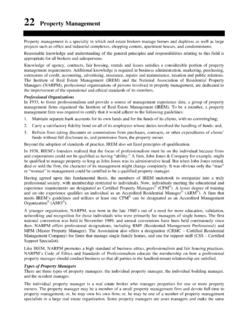
22. Property Management - California Department of Real …
www.dre.ca.gov22 Property Management. Property management is a specialty in which real estate brokers manage homes and duplexes as well as large projects such as office and industrial complexes, shopping centers, apartment houses, and condominiums. Reasonable knowledge and understanding of the general principles and responsibilities relating to this field is

Procurement and management of supplies and equipment
www.who.intProcurement and management of supplies and equipment This section provides practical guidelines for all stages of procurement and management of medical supplies and equipment. It is divided into the following sub-sections: • Section 2.1covers ordering and procurement. • Section 2.2 covers storage and stock control.
Management Plan Handbook - IREM
www.irem.orgWHAT IS A MANAGEMENT PLAN? A real estate management plan is an operating plan developed to maximize a property’s potential and support ownership objectives. The plan is created by you, the real estate manager, based on data and stated assumptions. Just as with any other business plan, it outlines measures to maximize the return to investors.