
Bipolar disorder - Mind
Bipolar disorder This resource explains what bipolar disorder is, what kinds of treatment are available, and how you can help yourself cope. It also provides guidance on what friends and family can do to help. If you require this information in Word document format for compatibility with screen readers, please email: publications@mind.org.uk
Download Bipolar disorder - Mind

Information
Domain:
Source:
Link to this page:
Documents from same domain
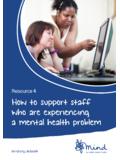
Resource 4 How to support staff who are ... - Mind
www.mind.org.ukResource 4 How to support staff who are experiencing a mental health problem mind.org.uk/work

Understanding depression understanding - Mind
www.mind.org.ukUnderstanding depression If you are depressed, you may feel that nothing can help. But this is untrue. Most people recover from bouts of depression, and some even look
Making sense of dialectical behaviour therapy …
www.mind.org.ukMaking sense of dialectical behaviour therapy This booklet is for anyone who is considering dialectical behaviour therapy (DBT), and would like
Making sense of dialectical behaviour therapy …
www.mind.org.ukMaking sense of dialectical behaviour therapy making sense dialectical behaviour therapy
Understanding borderline personality disorder ... - …
www.mind.org.ukUnderstanding borderline personality disorder This booklet is for anyone experiencing borderline personality disorder (BPD). It explains what the
Understanding self-harm understanding - Mind
www.mind.org.uk2 Understanding self-harm This booklet is for anyone who self-harms, and their friends and family. It explains what self-harm is, the reasons for …
How to manage stress how to - Mind
www.mind.org.ukHow to manage stress This booklet is for anyone who wants to learn how to manage stress. It explains what stress is, what might cause it and how it can affect you.
Sectioning - Mind, the mental health charity
www.mind.org.uk1 Sectioning Explains the rights that you have if you are sectioned and detained in hospital under the Mental Health Act 1983. Applies to England and Wales.
How to be mentally healthy at work how to - Mind
www.mind.org.ukHow to be mentally healthy at work This booklet is for anyone who is managing their mental health at work. It covers the relationship between work and mental health, managing stress
Open tin of fish, drain liquid, stir into Rinse dried ...
www.mind.org.ukGet professional support Sometimes the best way to improve your diet is with the help of a health professional. • Dietitians can help you work
Related documents

Effects of Marijuana on Mental Health: Bipolar Disorder
adai.uw.edubipolar disorder not otherwise specified (BD-NOS, clinically significant symptoms of BD that do not meet criteria for other BD diagnoses).8. Overview of Complexities in Specifying Marijuana Effects. Any summarization of the effects of marijuana on mental health would be …
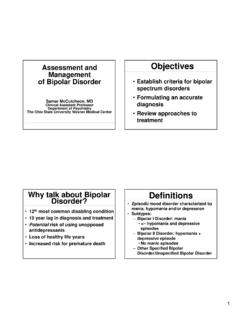
Assessment and Objectives Management of Bipolar Disorder
ccme.osu.edu‒Bipolar I disorder, most recent episode depressed, severe, without psychotic features Bipolar Disorder and Suicide • 10-15% of patients with bipolar disorder die by suicide • 2 major risk factors ‒History of attempted suicide ‒Hopelessness • Up to 27% of patients with bipolar disorder have attempted suicide at least once Hawton 2009

Bipolar Disorder in Children and Teens: A Parent's Guide
education.ucsb.eduBipolar Disorder Not Otherwise Specifi ed (BP-NOS) is diagnosed when a person has symptoms of the illness that do not meet diagnostic criteria for either bipolar I or II. The symptoms may not last long enough, or the person may have too few symptoms, to be diagnosed with bipolar I or II. However, the
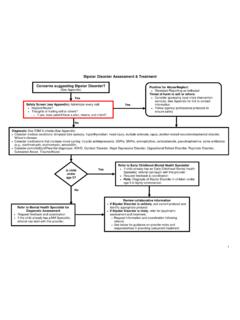
Bipolar Disorder Assessment and Treatment Protocol
mn.govBipolar I Disorder A. Criteria have been met for at least one manic episode (Criteria A-D under “Manic Episode” below). B. The occurrence of the manic and major depressive episode(s) is not better explained by schizoaffective disorder, schizophrenia, schizophreniform disorder, delusional disorder, or other specified or unspecified ...

An Introduction to Bipolar Disorder and Co-Occurring ...
store.samhsa.govHowever, treatment for bipolar disorder and SUDs is available, and remission and recovery are possible—especially with early intervention. 9,10, 11 . This . Advisory. provides behavioral health professionals with information on the symptoms of bipolar disorder and the potential complications of co-occurring bipolar disorder and SUDs.

Bipolar Disorder - American Academy of Child and ...
www.aacap.orgBipolar disorder in children and adolescents is not an easy or certain diagnosis. This diagnosis is usually made by a mental health clinician who has evaluated and treated many, many children. It requires that the clinician take a detailed medical …

Facts about Bipolar II Disorder - Veterans Affairs
www.mirecc.va.govBipolar disorder II is a major psychiatric disorder in which the person experiences occasional episodes of hypomania. Persons with this disorder also experience episodes of extremely low mood (depression). In between these extremes, the person's mood may be normal.