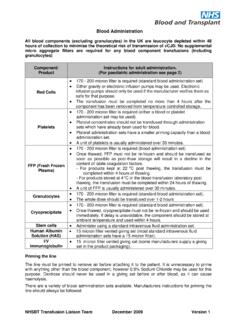
Blood admin sets -TLN document - Transfusion Guidelines
transfusion of blood at 4ºC can lower the patients core temperature by several degrees. Cold blood infused faster than 100 ml/minute has been reported to cause cardiac arrest in adults. Rapid infusion devices may be used when large volumes have …
Download Blood admin sets -TLN document - Transfusion Guidelines

Information
Domain:
Source:
Link to this page:
Documents from same domain

PHSS Guidance Document for Cold Storage Temperature ...
www.transfusionguidelines.orgbe allowed time to run in order for all storage areas to reach the required temperature. In addition the mapping must be performed with the equipment running at the temperature it is expected to operate at and with the equipment classed as empty. 6.1.5 Quality Assurance must approve each mapping before the next stage can take ...
Blood Transfusion Policy and Procedures
www.transfusionguidelines.orgBlood Transfusion Policy Version 4.0 - June 2012 Page 1 of 32 Blood Transfusion Policy and Procedures Category: Policy and Procedures Summary: A blood transfusion is a potentially hazardous procedure. Stringent procedures must be followed to ensure that the correct blood is given and that any adverse reactions are dealt with
Handbook of Transfusion Medicine
www.transfusionguidelines.org5 Adverse effects of transfusion 41 5.1 Haemovigilance 43 5.2 Non-infectious hazards of transfusion 44 5.2.1 Acute transfusion reactions 44 5.2.2 Severe and life-threatening reactions 45 5.2.3 Less severe acute transfusion reactions 53 …

Protocol for the use of Intravenous Iron Sucrose (Venofer
www.transfusionguidelines.orgpatients. Non-serious anaphylactoid reactions occurred rarely. 3.1 Management of adverse events In the event of a serious anaphylactic or allergic reaction stop the infusion/ IM adrenaline should be administered and appropriate resuscitation measures initiated. Mild allergic reactions should be managed by stopping the infusion and administering

Good Manufacturing Practice (GMP) -What
www.transfusionguidelines.orgzGood Manufacturing Practice (GMP) ensures that quality is built into the organisation and processes involved in manufacture zGMP covers all aspects of “manufacture” including collection, transportation, processing, storage, quality control and delivery of the finished product

Crossmatching and Issuing blood components
www.transfusionguidelines.orgMicrosoft PowerPoint - Crossmatching and Issuing blood components.ppt Author: Robe0052 Created Date: 2/23/2016 12:59:24 PM ...

Transfusion reactions - Transfusion Guidelines
www.transfusionguidelines.org2. Common causes of an acute transfusion reactions include febrile non-haemolytic transfusion reactions and allergy T/F 3. ATR causing hypotension with anaphylaxis must not be treated with IM adrenaline if the patient has platelets less than 50. T/F
Red Cell Immunohaematology - Transfusion Guidelines
www.transfusionguidelines.org– LISS Tube IAT – Saline (direct agglutination) – Capture-R ( Immucor ) – BioVue IAT ( Ortho ) • Vary temperature, incubation times, etc. Adsorptions & Elutions • DAT performed if auto control positive – Monospecific anti-IgG, -IgM, -IgA, -C3d, -C3c • Autoantibodies can be removed by

Platelet Transfusion Guidelines
www.transfusionguidelines.org2003 19,259 11 2 1 in 1,751 2004 20,323 9 0 1 in 2,258 2006 15,388 8 1 1 in 1,924 2013 9,295 9 6 1 in 1,033 Total 47 12 Bain BJ. Bone marrow biopsy morbidity and mortality: 2002 data. Clin …

Protocol for the use of Intravenous Iron Dextran (CosmoFer
www.transfusionguidelines.orgIf calculating the dose for an obstetric patient, use the pre-pregnancy weight. For obese patients use ideal body weight. 2.2 How to select the correct dose of CosmoFer® In the left hand column, find the body weight closest to the patients body weight, read across this row to the column headed by the patients current haemoglobin value,
Related documents

Cryoprecipitate Transfusion- Guideline for practice
pch-pathlab.comrate of transfusion is 10-20ml/kg/hr. 2.6 Inform the patient of possible complications of transfusion, and the importance of reporting any adverse effects. A number of reactions may follow cryoprecipitate transfusions. They are the same as those which can occur after the transfusion of red cell concentrates including:- Febrile Reactions
Fresh Frozen Plasma Transfusion- Guideline for practice
www.pch-pathlab.comthe transfusion of red cell concentrates including:- Febrile Reactions Urticarial Reactions Anaphylactic Reactions Reaction to a bacterially contaminated unit. Follow the same baseline, 15 minute and post transfusion observation checks as for red cell transfusions. If a reaction is suspected, STOP THE TRANSFUSION, and inform medical
Transfusion of Blood and Blood Products: Indications and ...
www.aafp.orgMar 15, 2011 · transfusion triggers in patients who do not have cardiac disease.6 A similar study was carried out in critically ill chil-dren.2 The restrictive transfusion trigger was a hemoglo-
Transfusion Blood Administration - Children's Minnesota
www.childrensmn.orgTransfusion Service personnel will notify patient unit personnel by telephone when ordered blood is ready for transfusion. The risks of transfusion, including adverse symptoms and alternatives to homologous (allogeneic) transfusion, must be discussed with the patient well before transfusion. This discussion should be
Exchange Transfusion: Neonatal - Royal Children's Hospital
www.rch.org.auExchange transfusion should be performed slowly over approximately 2 hours to avoid major fluctuations in blood pressure. Anticipate the need for increased oxygen requirement during procedure (administer oxygen via nasal cannula in self ventilating babies if required).

NATIONAL STANDARDS FOR BLOOD TRANSFUSION …
www.who.intBlood transfusion is a life saving intervention that has an essential role in the total patient management within health care delivery. It is therefore important that the health authority takes appropriate and adequate measures to ensure that the blood banks in the country

Clinical Transfusion Practice - WHO
www.who.intii Foreword Blood transfusion is an important part of day‐to‐day clinical practice. Blood and blood products provide unique and life‐saving therapeutic benefits to patients.