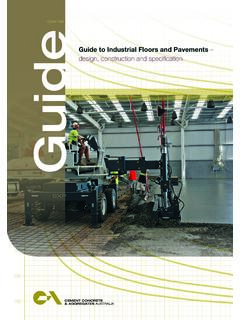
CCAA T48 Guide
not cover prestressed or post-tensioned concrete pavements. For pavement thickness greater than 400 mm, specialised software design tools should be used to determine the optimum pavement thickness. The principles and details provided are applicable to pavements found in a wide range of commercial and industrial buildings including:
Download CCAA T48 Guide

Information
Domain:
Source:
Link to this page:
Documents from same domain
Joints in Concrete Buildings - CCAA
www.ccaa.com.auUnplanned construction joints These are joints that are forced upon the concrete-placing crew because of an interruption in supply of a duration long enough for the concrete to take its initial set.
Joints in Concrete Buildings - ccaa.com.au
www.ccaa.com.auDEFINITION The word ‘joint’ is used in building parlance to cover elements which have to perform quite different functions, eg beam-column joints and isolation
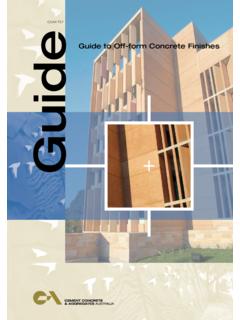
CCAA T57 Guide
www.ccaa.com.au4 Guide to off-form ConCrete finishes 2.3 INSITU v PRECAST While the more-appropriate approach will vary from project to project, precast has some advantages over insitu work in terms of the range and quality

Durability of Masonry Mortar - CCAA
www.ccaa.com.auDurability of Masonry Mortar Page 3 Typical cement:lime:sand mortar compositions were chosen with one exception of an M3 mix of cement and sand without lime.
CCAA T57 Guide
www.ccaa.com.auConcrete is the most commonly used construction material for loadbearing and non-loadbearing elements. its ability to be shaped and reflect the

RESIDENTIAL Concrete Driveways and Paths
www.ccaa.com.auby weight of cement to be used will need to be specified. Aggregates. Any information necessary to identify the coarse aggregate required – size, type, texture, colour (e.g. nominal 10-mm aggregate consisting of 90% brown rounded river gravel and 10% crushed white quartz). Cement colour. Normal grey, off-white or white.
Guide
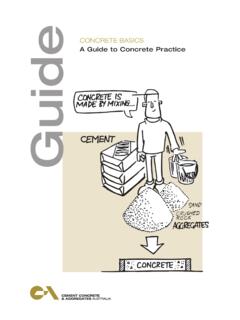
www.ccaa.com.auConcrete Basics provides a clear, concise explanation of all aspects of making quality concrete; from the Materials and Properties involved through Planning, Preparation, Finishing and Curing. Concrete Basics addresses the needs of unskilled and semi-skilled persons undertaking general concreting projects including home and handyman projects.

Curing of Concrete
www.ccaa.com.auPage of 7 > curing of ncreteco n Curing by preventing excessive loss of moisture from the concrete: either by > leaving formwork in place > 20covering the concrete with an impermeable membrane after the formwork has been removed > by the application of a suitable chemical curing agent (wax etc) > or by a combination of such methods n Curing by continuously …
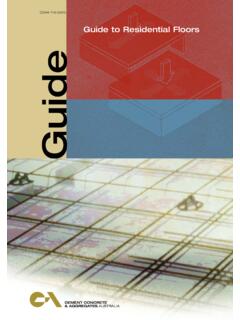
Guide to Residential Floors Guide
www.ccaa.com.aufloors suitable for residential buildings ranging from single, detached houses to medium density buildings of apartments and flats. For slab-on-ground floors it provides an understanding of the footing/slab selection, design, detailing and construction requirements contained in AS 2870 and the Housing Provisions of the BCA. The requirements of

Residential Concrete Driveways and Paths
www.ccaa.com.au5.3 Assessment of Cracks 10 6 SPECIFICATION CHECKLIST 10 7 REFERENCES 12 july 2006 Data sheet > > ResidentiAl Concrete driveways and Paths the bAsiC funCtion of residential pavements such as driveways, paths and patios is to provide safe, easy access onto or around a property. > 1 INTRODUCTION 2 2 PLANNING otpath2.1 fo Area 2 2.2 Pavement Grades 2
Related documents

Seismic Design Updates for the California Building Code
www.asceoc.org–Nonductile concrete buildings –Soft or weak ground floor level Before 1998 CBC (1997 UBC) –Steel moment frame connections –Precast, prestressed or post-tensioned concrete. Performance-Based Design. Continued Function Resilient communities –Occupiable buildings, including limited non-
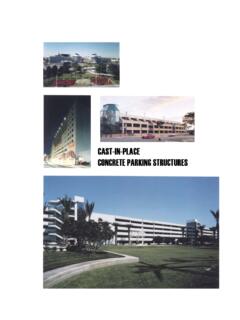
Cast-In-Place Concrete Parking Structures - CRSI
crsi.orgUnbonded Post-Tensioned Buildings, S anF rcis o E thqu ke - 1989” Post-Tensioning Institute, Phoenix, Arizona, 1990. (4) Hawkins, Neil M., and Ishizuka, Takayuki, “Concrete Ductile Moment Resistant Frames with Unbonded Post-Tensioned Beams.” Proceedings, Seminar on Precast Concrete Construction in Seismic Zones,
General Overview of Post-Tensioned Concrete Design
pdhonline.comGeneral Overview of Post-Tensioned Concrete Design Instructor: D. Matthew Stuart, P.E., S.E., F.ASCE, F.SEI, SECB, MgtEng ... Originally post-tensioned, two-way slab framing systems were constructed with column and ... serviceability of the many buildings that have been erected to date with this method of
Guidelines for the Design of Post-Tensioned Floors
ptstructures.comPOST-TENSIONING SYSTEMS In the U.S. and Canada, post-tensioned buildings and parking garages are typically constructed with seven-wire, 0.5-in.-diameter (12.7 mm), unbonded single-strand (monostrand) tendons. These tendons, with a typical strength of 270 ksi (1860 MPa), are also greased and sheathed. One reason for the widespread use of the
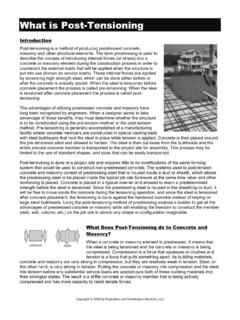
Post-Tensioned Concrete in Residential Construction
www.buildersshow.compost-tensioned reinforcing is installed in a draped profile instead of running in a straight line. A typical draped profile in an elevated concrete slab would route the post-tensioned reinforcing through a high point over the slab’s supports, and through …
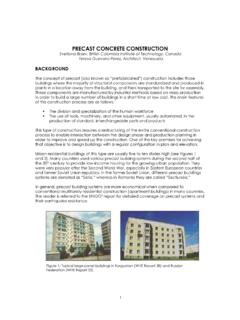
PRECAST CONCRETE CONSTRUCTION - World Housing
www.world-housing.netPrecast Concrete Construction Figure 12: Post-tensioned slab-column connection (WHE Report 68, Serbia and Montenegro) poured on the ground in forms, one on top of the other, as shown in Figure 11. Precast concrete floor slabs are lifted from the …