CHAPTER 1
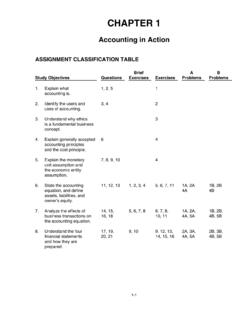
CHAPTER 1 Accounting in Action ASSIGNMENT CLASSIFICATION TABLE Study Objectives Questions Brief Exercises Exercises A Problems B Problems 1. Explain what accounting is. 1, 2, 5 1 2. Identify the users and uses of accounting. 3, 4 2 3. Understand why ethics is a fundamental business concept. 3 4. Explain generally accepted
Download CHAPTER 1

Information
Domain:
Source:
Link to this page:
Documents from same domain

CHAPTER 8
godgiften.weebly.com8-6 Questions Chapter 8 (Continued) 20. The lack of agreement between the balances may be due to either: (1) Time lags—a check written in …
CHAPTER 10
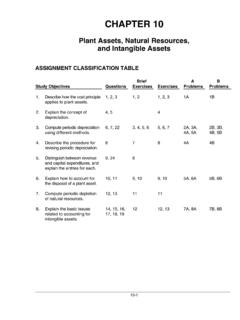
godgiften.weebly.com10-1 CHAPTER 10 Plant Assets, Natural Resources, ... Study Objectives and End-of-Chapter Exercises and Problems Study ObjectiveKnowledge Comprehension Application Analysis Synthesis Evaluation 1. Describe how the cost principle applies to plant assets. ... fair market value of its net assets. 18.
CHAPTER 3
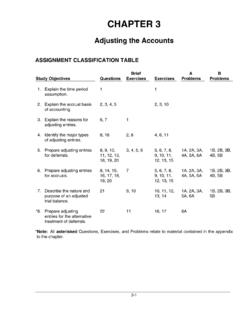
godgiften.weebly.comThe two generally accepted accounting principles that relate to adjusting the accounts are: The revenue recognition principle, which states that revenue should be recognized in the accounting period in which it is earned.
CHAPTER 4
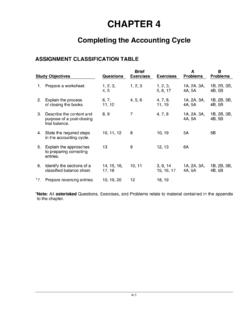
godgiften.weebly.comand is made at the beginning of the new accounting period. Reversing entries are an optional step in the accounting cycle. 11. The steps that involve journalizing are: (1) journalize the transactions, (2) journalize the adjusting entries, and (3) journalize the closing entries. 12.
Related documents
Communication Chapter 1 - cu
www.pathways.cu.edu.eg1.1 Introductory Note This chapter presents the communication process. It describes the basic elements of the communication process and defines concepts. It also sheds light on forms of communication and basic characteristics of each form.
CHAPTER 1 : INTRODUCTION TO PROCESS CONTROL
www.pc-education.mcmaster.caCHAPTER 1: SUGGESTIONS FOR SELF-STUDY 1. Write down the rules (algorithm) that you use when you drive an automobile or bicycle. 2. Formulate questions with answers and trade with members of your study group. 3. Find a P&I drawing in one of the textbook references (or recent volume of Chemical Engineering Progress),

CHAPTER 1 The Economic Way of Thinking - Weebly
dawnquarles.weebly.comCHAPTER 1 KEY CONCEPT Scarcity is the situation that exists because wants are unlimited and resources are limited. WHY THE CONCEPT MATTERS You confront the issue of scarcity constantly in everyday life. Look again at the caption on page 2. …

Tuck Everlasting Chapter Discussion Questions
www.lakewoodcityschools.orgWhy does the author state that only the first house, the road, and the wood were important? Does a person own property all of the way down to the center of the earth? Why or why not? Why would the discovery of the spring in the middle of the woods be an immense disaster? Chapter 2: Why do you think that Tuck only smiled when he was asleep?
CHAPTER Defining Culture 1 and Identities
www.sagepub.comCHAPTER 1 Defining Culture and Identities 7 • The process of social transmission of these thoughts and behaviors from birth in the family and schools over the course of generations. • Members who consciously identify themselves with that group. Collier and Thomas (1988)

Chapter 1: What is Economics? Section 1
www.stbarnabashigh.comMar 13, 2018 · 1. Explain why scarcity and choice are the basis of economics. 2. Describe what entrepreneurs do. 3. Define the three factors of production and the differences between physical and human capital. 4. Explain how scarcity affects the factors of production.

Chapter 1: Ten Principles of Economics Principles of ...
www.unm.eduChapter 1: Ten Principles of Economics Principles of Economics, 8th Edition N. Gregory Mankiw Page 6 a. Productivity is the quantity of goods and services produced from each hour of a worker’s time. P. 13 3. We recognize that productivity (and the institutions that encourage it) is far more important than natural resources, for ...

Chapter 1 Structure and Bonding - Michigan State University
www2.chemistry.msu.eduOrganic chemistry is study of carbon compounds. Why is it so special? 90% of more than 30 million chemical compounds contain carbon. Examination of carbon in periodic chart answers some of these questions. Carbon is group 4A element, it can share 4 valence electrons and form 4 covalent bonds. Origins of Organic Chemistry Review ideas from general chemistry: atoms, …