
Chapter 1 Character Functions - SAS Support
Miscellaneous String Functions 113 MISSING 113 RANK 115 REPEAT 117 REVERSE 119 . Chapter 1: Character Functions 3 Introduction A major strength of SAS is its ability to work with character data. The SAS character functions are essential to this. The collection of functions and call routines in this chapter
Download Chapter 1 Character Functions - SAS Support

Information
Domain:
Source:
Link to this page:
Documents from same domain
027-2009: Tips and Tricks for Creating the Reports …
support.sas.comPaper 027-2009 TIPS AND TRICKS FOR CREATING THE REPORTS YOUR CLIENTS NEED TO SEE Michael J Molter, INC Research, Raleigh, NC ABSTRACT Advanced reporting tools such as PROC REPORT have progressed by leaps and …
Step-by-Step Programming with Base SAS Software
support.sas.comThe correct bibliographic citation for this manual is as follows: SAS Institute Inc. 2001. Step-by-Step Programming with Base SAS® Software.Cary, NC: SAS Institute Inc.
227-2012: Executing a PROC from a DATA Step - …
support.sas.com2 Using RUN_MACRO to execute a PROC from a DATA step requires writing three blocks of code, described in the Introduction: a macro to execute a PROC, a user-written function to execute the macro, and a DATA step to call the
149-2012: Queries, Joins, and WHERE Clauses, Oh …
support.sas.comPaper 149-2012 Queries, Joins, and WHERE Clauses, Oh My!! Demystifying PROC SQL Christianna S. Williams, Chapel Hill, NC ABSTRACT Subqueries, inner joins, outer joins, HAVING expressions, set operators…just the terminology of PROC SQL might
158-2010: How to Use Arrays and DO Loops: Do I …
support.sas.com1 Paper 158-2010 How to Use ARRAYs and DO Loops: Do I DO OVER or Do I DO i? Jennifer L Waller, Medical College of Georgia, Augusta, GA ABSTRACT
248-2009: Learning When to Be Discrete: …
support.sas.com1 Paper 248–2009 Learning When to Be Discrete: Continuous vs. Categorical Predictors David J. Pasta, ICON Clinical Research, San Francisco, CA ABSTRACT
338-2011: An Introduction to Survival Analysis …
support.sas.com2 (Censored) Study Ends (From Applied Survey Data Analysis, p. 306) Figure 1. Prospective View of Event History Survey Data Time can be regarded as continuous or discrete and this basic distinction affects the analytic approach selected.
Dongsheng Yang and Jarrod E. Dalton - SAS
support.sas.com1 Paper 335-2012 A unified approach to measuring the effect size between two groups using SAS® Dongsheng Yang and Jarrod E. Dalton Departments of Quantitative Health Sciences and Outcomes Research
SAS/STAT 9.2 User's Guide: Introduction to Power …
support.sas.comSAS/STAT ® 9.2 User’s Guide Introduction to Power and Sample Size Analysis (Book Excerpt) SAS® Documentation
249-2012: A Tutorial on the SAS® Macro Language
support.sas.com1 Paper 249-2012 A Tutorial on the SAS® Macro Language John J. Cohen, Advanced Data Concepts LLC, Newark, DE ABSTRACT The SAS macro language is another language layering on top of regular SAS code.
Related documents
1 Kernel Functions - Princeton University
www.cs.princeton.edustring we would like to match. Then, just as in the bag-of-words scenario, a basis function ˚(x) will map a string x to a vector of length jAj, where each element jis the number of times we observe substring A j in string x, where j= 1 : jAj. 1 1Superscripts here are regular expression operators.

Matlab Cheat Sheet Built in functions/constants Tables ...
sites.nd.edudocsearch string search documentation web google.com opens webadress inputdlg Input dialog box methods(A) list class methods for A Statistical commands ... For functions on matrices, see bsxfun,arrayfun or repmat *if arrayfun/bsxfun is passed a gpuArray, it runs on GPU. *Standard operations: rank,rref,kron,chol ...
Title stata.com String functions
www.stata.comcome from if typeis 2; or an empty string is returned for any other type wordcount(s) the number of words in s Functions In the display below, sindicates a string subexpression (a string literal, a string variable, or another string expression) and nindicates a numeric subexpression (a number, a numeric variable, or another numeric expression).

SAS Functions by Example
www.sas.comCharacter Functions CATS(string-1, string-2 …) Joins strings, stripping both leading and trailing blanks CATX(string-1, string-2 …) Joins strings, stripping both leading and trailing blanks, and add a space in between them ExampleExample A = ““StarStar”” B = ““WarsWars”” CATS(A, B) = ““StarWarsStarWars””
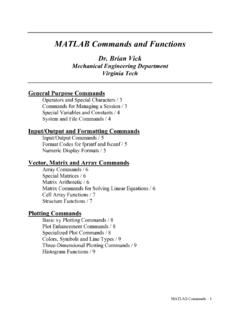
MATLAB Commands and Functions
www.hkn.umn.eduString Functions findstr Finds occurrences of a string. strcmp Compares strings. char Creates character string array. MATLAB Commands – 14 Numerical Methods Polynomial and Regression Functions conv Computes product of two polynomials deconv Computes ratio of polynomials.

Green’s Functions in Physics Version 1
faculty.washington.eduContents 1 The Vibrating String 1 1.1 The String . . . . . . . . . . . . . . . . . . . . . . . . . . 2 1.1.1 Forces on the String . . . . . . . . . . . . . . . . 2
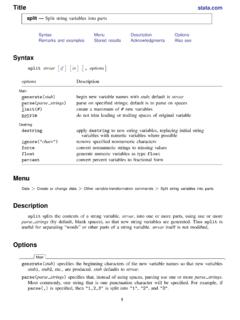
split — Split string variables into parts
www.stata.comThe key string functions for subdividing string variables and, indeed, strings in general, are strpos(), which finds the position of separators, and substr(), which extracts parts of the string. (See[D] functions.) split is based on the use of those functions.