Chapter 1 Infrared Detector Characterization
Over the past several hundreds of years, optical systems (telescopes, microscopes, eyeglasses, cameras, etc.) have formed their optical image on the human retina, photographic plate, or film. The birth of photodetectors dates back to 1873 when Smith discovered photoconductivity in selenium. Progress was
Download Chapter 1 Infrared Detector Characterization

Information
Domain:
Source:
Link to this page:
Documents from same domain

Chapter 1 Introduction to Radiometry - SPIE
spie.org1 Chapter 1 Introduction to Radiometry 1.1 Definitions Consider the following definitions a starting point for our study of radiometry: radio- [<L.radius] a combining form meaning ray, raylike -metry [Gr. -metria < metron] a terminal combining form meaning the process, art, or science of measuring

AND REMOTE SENSING• - SPIE - the international society ...
spie.orgConf . 9998: Remote Sensing for Agriculture, Ecosystems, and Hydrology (Neale, Maltese) p.48 Conf . 9999: Remote Sensing of the Ocean, Sea Ice, Coastal Waters, and Large Water Regions 2011

2012 Remote Sensing - SPIE
spie.orgRemote Sensing Technologies - -Atmospheric Sensing - -Sensors, Systems, and Next-Generation Satellites - Environmental Monitoring and Applications - Earth Surface Sensing Infrared Systems Optical Materials and Technologies - Unmanned/Unattended Sensors - Biological and Chemical Sensing

MARC TRAIN, AMTRAK & METRO SUBWAY ON METRORAIL …
spie.orgMARC is not the recommended method of transportation from Baltimore Washington Airport (BWI) to Baltimore Convention Center – Light Rail is recommended • The MARC …

The Keynote Guide to Planning a Successful Conference
spie.orgAbout Conference Manager: Conference ManagerTM is an online application that will help you take care of the details as such as: usetting conference goals usetting up your registration process usending invitations ubooking transportation ucollecting abstracts and papers
Chapter 4 Airy Functions - SPIE
spie.orgChapter 4 Airy Functions 4.1 Introduction Airy functions are named after the English astronomer George Biddell Airy (1801–1892). Airy’s first mathematical work was on the diffraction phenom-enon, namely, the Airy disk—the image of a point object by a telescope— which is familiar to all of us in optics. The name Airy is connected with many
The concept of modes in optics and photonics
spie.orgThe shape of modes may be changed by passive optical elements (lenses, mirrors, filters), however, the number N of photons per mode cannot by increased. The energy throughput of an optical systems depends on the number of supported modes and the adaptation of the modes between the different sections of the system.

TRANSFER OF COPYRIGHT TO THE SOCIETY OF PHOTO …
spie.orgThis form must be signed by (1) at least one author who is not a U.S. Government employee and (2) the author's employer if the Paper was prepared within the scope of the author’s employment or was commissioned by the employer.

How to Write a Good Scientific Paper - SPIE
spie.orgin general, good science writing does not require creative writing. In particular, writing for a peer-reviewed science or engineering journal requires learning and executing a specific formula for presenting scientific work. This book is all about teaching the style and conventions of writing for a peer-reviewed science journal.
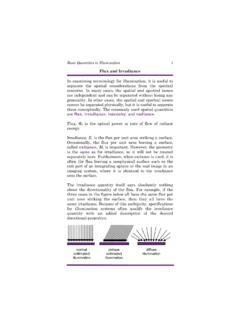
Flux and Irradiance flux irradiance intensity radiance
spie.orgare flux, irradiance, intensity, and radiance. Flux, Φ, is the optical power or rate of flow of radiant energy. Irradiance, E, is the flux per unit area striking a surface. Occasionally, the flux per unit area leaving a surface, called exitance, M, is important. However, the geometry is the same as for irradiance, so it will not be treated
Related documents

Space Based Astronomy Educator Guide pdf
www.nasa.govuniverse. By lofting telescopes and other scientif-Space-Based Astronomy Activity Guide for Science, Mathematics, and Technology Education1 INTRODUCTION If you go to the country,far from city lights,you can see about 3,000 stars on a clear night. If your eyes were bigger, you could see many more stars.With a pair of binoc-

Applications of Newton’s Laws - Pearson
www.pearson.comin the future. example 5.1 One-dimensional equilibrium Now let’s apply the problem-solving strategy outlined above to a simple one-dimensional equilibrium prob-lem. A gymnast hangs from the lower end of a rope connected to an O-ring that is bolted to the ceiling. The