
Chapter 1 Organic Compounds: Alkanes
Chapter 1 Alkanes 6 11 What’s So Great About Carbon? • Carbon atoms can form stable bonds to many other elements (H, F, Cl, Br, I, O, N, S, P, etc.). Most organic compounds contain a few hydrogens, and sometimes oxygen, nitrogen, sulfur, phosphorus, etc.
Download Chapter 1 Organic Compounds: Alkanes

Information
Domain:
Source:
Link to this page:
Documents from same domain

MGMT 3304 - Organizational Behavior
www.angelo.eduAn experiential and theoretical approach to human behavior in an organizational setting, by analysis of individual, group, and organizational processes, with a goal of understanding, predicting, and improving the performance of organizational elements.

MGMT 3304.010 Organizational Behavior
www.angelo.eduBehavior Course Description An experiential and theoretical approach to human behavior in an organizational setting, by analysis of individual, group, and organizational processes, with a goal of understanding, predicting, and improving the performance of organizational elements.

CURRICULUM VITAE Bruce E. Bechtol Jr. Ph.D. …
www.angelo.eduCURRICULUM VITAE Bruce E. Bechtol Jr. Ph.D. Angelo State University ASU Station #10896 San Angelo, Texas 76909-0896 Cell Phone (540) 538-4273
Constance L. Plocinski Kelley, DMA
www.angelo.eduKelley, C. 2 lessons; weekly studio class; organized visiting flutists’ master classes and recitals; coached undergraduate chamber ensemble; organized and coadjudicated flute section for fall and spring -

Dr. Katherine Toy Miller, Instructor Department of English ...
www.angelo.eduFall 2010-Spring 2014 Lecturer, Core Writing Program, Department of English University of Nevada, Reno, Reno, NV Faculty mentor to new instructors fall 2010-spring 2014.

Solids, Liquids, and Gases - Angelo State University
www.angelo.eduGases vs. Liquids and Solids • In gases, the particles in the sample are widely separated, because the attractive forces between the particles are very weak. • In liquids, there are strong intermolecular forces between the particles, which hold them in close

GUIDELINES ANNUAL FACULTY PERFORMANCE EVALUATION
www.angelo.eduAngelo State University GUIDELINES ANNUAL FACULTY PERFORMANCE EVALUATION Description and Purpose The evaluation is an annual requirement for all tenured and tenure-track faculty members
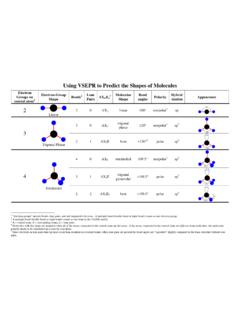
Using VSEPR to Predict the Shapes of Molecules
www.angelo.eduUsing VSEPR to Predict the Shapes of Molecules Electron Groups on central atom1 Electron-Group Shape Bonds2 Lone Pairs AX mE n 3 Molecular Shape Bond angles Polarity

Chapter 3 Alcohols, Phenols, and Ethers
www.angelo.eduChapter 3 Alcohols, Phenols, and Ethers 13 25 Reactions of Alcohols 26 Dehydration of Alcohols to Produce Alkenes • Heating alcohols in concentrated sulfuric acid (H2SO4) at 180°C removes the OH group and a H from an adjacent carbon to produce an alkene, with water as a by-product. Since water is “removed”
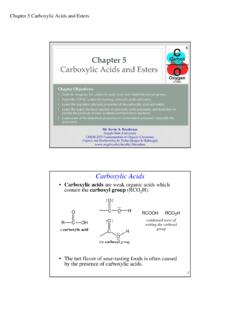
Ch 05 Carboxylic Acids and Esters
www.angelo.eduChapter 5 Carboxylic Acids and Esters 15 Physical Properties of Carboxylic Acids • Since carboxylic acids can form more than one set of hydrogen bonds, their boiling points are usually higher than those of other molecules of the same molecular weight (MW). • Low-MW carboxylic acids are generally liquids at room temp.
Related documents

from Organic Chemistry - Department of Chemistry
chem.ucr.edu1.1 Organic Molecules All organic molecules contain carbon (C), virtually all of them contain hydrogen (H), and most contain oxygen (O) and/or nitrogen (N) atoms. Many organic molecules also have halogen atoms such as fluorine (F), chlorine (Cl), …
CHAPTER 1 INTRODUCTION TO ORGANIC CHEMISTRY 1.1 …
www.siue.edu1.1 Historical Background of Organic Chemistry Organic chemistry is the area of chemistry that involves the study of carbon and its compounds. Carbon is now known to form a seemingly unlimited number of compounds. The uses of organic compounds impact our lives daily in medicine, agriculture, and general life. In theory (Oparin, 1923) organic ...
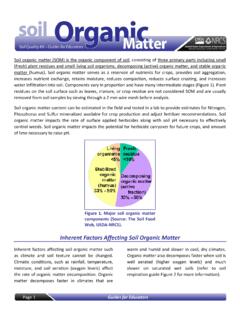
Figure 1. Major soil organic matter components (Source ...
www.nrcs.usda.govPage 1 Guides for Educators Soil organic matter (SOM) is the organic component of soil, consisting of three primary parts including small (fresh) plant residues and small living soil organisms, decomposing (active) organic matter, and stable organic
Some Arrow-Pushing Guidelines (Section 1.14)
web.mnstate.eduOrganic Chemistry I Review: Highlights of Key Reactions, Mechanisms, and Principles 1 Some Arrow-Pushing Guidelines (Section 1.14) 1. Arrows follow electron movement. 2. Some rules for the appearance of arrows • The arrow must begin from the electron source. There are two sources: a. An atom (which must have a lone pair to give) b.

ACS Examination guide (Selected Questions) Organic ...
www.mdc.eduOrganic Chemistry Nomenclature 1. What is the IUPAC names for this compound? a) 1-tert-butyl-2-butanol b) 5,5-dimethyl-3-hexanol c) 2,2-dimethyl-4-hexanol d) 1,1,1-trimethy-3-pentanol 4.What is the IUPAC name for this structure? a) 3-bromo-4-methylheptanone b) 5-bromo-4-methylheptanone c) 5-bromo-4-methyl-3-heptanone d) 3-bromo-4-methyl-5 ...
NAME REACTIONS AND REAGENTS IN ORGANIC SYNTHESIS
stromindia.weebly.com1,2-Dirnethoxyethane Glyme Dimethylisopropylsilyl Dimethylformamide Dimethylpyrazole N,N'-Dimethylpropyleneurea Dimethylsulfide Dimethylsulfoxide 1,2-Bis(diphenyIphosphino)ethane (DIPHOS) enantiomeric excess = % major enantiomer - % minor enantiomer 9-Fluoren ylmethoxycarbonyl xi Me 'N re Me0 5 OMe Me Me .. Me -S-Me 1: A Ph-P p-ph Ph pi I n
Organic Poultry Production for Meat and Eggs
www.ams.usda.govorganic when they use organic feed, preventative health care, and avoid prohibited materials. House-based systems are also permitted for organic production, provided they allow for access to the outdoors and direct sunlight, and oth - erwise fulfill all other regulatory requirements described below in Living Conditions.