
CHAPTER 1. SOIL PHYSICAL PROPERTIES
Structural stability or resistance of soil to disintegrative forces (rain, cultivation, soil swelling), depends on type of organic matter and its changing from low to high C/N as a result of microbial breakdown of OM: green manure Structural stability buried straw highly decomposed manure weeks months years Time since incorporation
Download CHAPTER 1. SOIL PHYSICAL PROPERTIES

Information
Domain:
Source:
Link to this page:
Documents from same domain
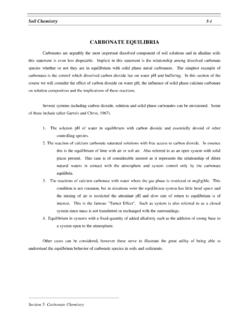
CARBONATE EQUILIBRIA - UC Davis
lawr.ucdavis.eduSoil Chemistry 5-1 Section 5- Carbonate Chemistry CARBONATE EQUILIBRIA Carbonates are arguably the most important dissolved component of …
CHAPTER 1. SOIL PHYSICAL PROPERTIES - UC Davis
lawr.ucdavis.eduSSC107-Fall 2000 Chapter 1, Page - 2 - Soils are extremely complex, hence we often simplify to study and understand soil physical
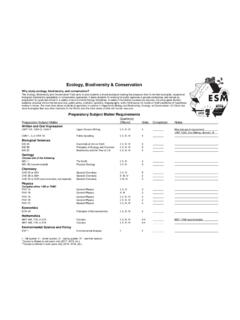
Ecology, Biodiversity & Conservation
lawr.ucdavis.eduBIS 2A Essentials of Life on Earth I, II, III, IV 5 BIS 2B Principles of Ecology and Evolution I, II, III, IV 5 BIS 2C Biodiversity and the Tree of Life I, II, III, IV 5 ... ESP 170* Conservation Biology Policy ESP 1, ECN 1A; ECN 100 or ARE 100A recommended III 4
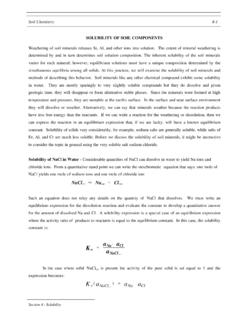
a a a - Department of Land, Air and Water Resources
lawr.ucdavis.eduSoil Chemistry 4-6 Section 4 - Solubility The Gibbsite case is a simple graphical representation of equilibrium over several values of pH. Application of this technique to any other chemical reaction is carried out in the same way.
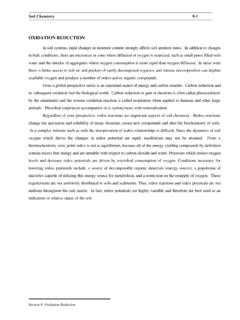
OXIDATION REDUCTION - University of California, Davis
lawr.ucdavis.eduSoil Chemistry 9-2 Section 9- Oxidation Reduction Eh -pH RELATIONSHIPS Thermochemistry background The Gibbs free energy (G) may be defined in differential form as: dG = - Sd T - V dP - w ′ (1) where w' is defined as the useful work in a chemical system ( non-pressure, volume work) in our case this will be the electrical work of the system.
CHAPTER 1. SOIL PHYSICAL PROPERTIES
lawr.ucdavis.eduForces acting on soil particle are gravitation, buoyancy and drag forces, and all depend on particle size; The larger particles settle first à Stokes law Since soils are a mixture of different size particles, soil’s are classified using the so-called soil textural triangle.
CARBONATE EQUILIBRIA
lawr.ucdavis.eduCalcium carbonate in water with a fixed partial pressure of carbon dioxide. For the case of a fixed partial pressure of carbon dioxide and calcium carbonate dissolved in the aqueous phase one more equation is need to describe the system. This is the solubility product of calcium carbonate: = K ( CaCO ) ( Ca ) ( CO ) o CaCO 3 2 - 3 2 + 3 (19)
Related documents
2.6.12. MICROBIOLOGICAL EXAMINATION OF NON-STERILE ...
uk.vwr-cmd.comfor the cultivation of bacteria (such as medium B) or a liquefied agar medium suitable for the cultivation of fungi (such as medium C) at about 45 °C to each Petri dish and allow to solidify. If larger Petri dishes are used, the volume of the agar is increased accordingly. Dry the plates, for example in a laminar-air-flow cabinet or an incubator.
5.1.3. EFFICACY OF ANTIMICROBIAL PRESERVATION
www.drugfuture.combean digest agar (2.6.12) for bacteria or Sabouraud-dextrose agar without the addition of antibiotics (2.6.12) for fungi, with the recently grown stock culture of each of the specified micro-organisms. Incubate the bacterial cultures at 30-35 °C for 18-24 h, the culture of C. albicansat 20-25 °C for 48 h, and
LAB 4. Cultivation of Bacteria
science.umd.eduTo grow bacteria in the lab, environmental conditions, as well as nutrients, must be considered. Bacteria may be isolated from a variety of environments. For cultivation of bacteria in the lab, the conditions of the environments must be mimicked. Prokaryotes that live in extreme environments are generally in the Domain: Archeae.
PURE CULTURE TECHNIQUES I. OBJECTIVES
www.sas.upenn.eduBacteria are found in all parts of the laboratory environment--on the workbench, in the air, on your hands, etc. The precise methods for handling sterile materials, for ... These media are general cultivation and maintenance media used for many environmental organisms that do not have special growth requirements, such as E. coli, Staphylococcus ...
The Columbian Exchange: A History of Disease, Food, and Ideas
www.kellogg.northwestern.eduEuropeans brought deadly viruses and bacteria, such as smallpox, measles, urope. Europeans brought deadly viruses and bacteria, such as smallpox, measles, ... tthe cultivation of fihe cultivation of fi nancially lucrative crops in the Americas, along with the devas-nancially lucrative crops in the Americas, along with the devas- ...
GROUNDNUT PRODUCTION A CONCISE GUIDE
www.arc.agric.zaroot bacteria. For this reason this crop is not dependent on nitrogen fertilisation. Root nodules which fix nitrogen effectively have a pink coloured appearance when dissected. Groundnuts with effective root bacteria do not need additional nitrogen. It has often had been accepted that groundnuts prefer residual phosphorus to freshly applied P.

Bioreactors and Fermentors— Powerful Tools for Resolving ...
www.eppendorf.combacteria, yeasts, and fungi), as well as plant cells and algae. Bioreactor and fermentor are two words for basically the same thing. Scientists who cultivate bacteria, yeast, or fungi often use the term fermentor. The term bioreactor often relates to the cultivation of mammalian cells but is also generically used. If we talk about bioreactors ...

Isolation &Characterization of Bacteria
www.gbiosciences.comtechniques and cultivation of bacteria. Using theses bacterial culture techniques students discover and isolate the bacteria present around us. Following isolation of bacteria, students characterize the bacteria with household disinfectant products and antibiotics. Students learn and understand the significance of bacterial isolation in ...

PACKAGE OF PRACTICES FOR CULTIVATION OF FRUITS
www.pau.edufor cultivation of strawberry in Punjab including varieties, propagation, time of planting, irrigation, fertigation, harvesting and marketing have been standardized. 1 ... acid bacteria @ 5.0% (w/v)) by incubating at 37ºC for 24 hrs. Indian Gooseberry/Amla pickle: The bioprocess for