Chapter 13: The Five Forces Behind Human Evolution
Chapter 13: The Five Forces Behind Human Evolution Introduction Five different forces have influenced human evolution: natural selection, random genetic drift, mutation, population mating structure, and culture. All evolutionary biologists agree on the first three of these forces, although there have been disputes at times about the
Download Chapter 13: The Five Forces Behind Human Evolution

Information
Domain:
Source:
Link to this page:
Documents from same domain

•Nature and nurture combine forces in prenatal …
psych.colorado.edu1 Prenatal Development •Nature and nurture combine forces in prenatal development. •Much of development is generated by the fetus itself. Conception

SAS Output for Repeated Measures - University of …
psych.colorado.eduQMIN SAS Output for Repeated Measures - 3 Next we want to do a repeated measures analysis of variance. Here, drug is the independent variable (often called a “between subjects factor” in repeated measures) and

Psychology 3102: Introduction to Behavioral …
psych.colorado.eduPsychology 3102: Introduction to Behavioral Genetics (Carey) Problem Set: Heritability and Environmentability Two basic equations are required to calculate heritability and environmentability. The first equation is h2 + e2 = 1 where h2 is the heritability and e2 is the environmentability. This equation simply states that the total …

Chapter 18: Quantitative Genetics I – Important …
psych.colorado.eduChapter 18: Quantitative Genetics I – Important Concepts Introduction In the chapter on Mendel and Morgan, we saw how the transmission of genes from one generation to another follows a precise mathematical formula. The traits discussed in that chapter, however, were discrete traits—peas are either yellow or green, someone either has a …

Functional magnetic resonance imaging: Basic …
psych.colorado.eduFunctional magnetic resonance imaging (fMRI) has quickly become the preferred technique for imaging normal brain activity, especially in the typically developing child. This technique takes advantage of specific magnetic properties and physiological

Piaget’s Theory - University of Colorado Boulder
psych.colorado.edu1 Piaget’s Theory •The first “cognitive” theory, developed by Jean Piaget beginning about 1920. •Piaget observed and described children at
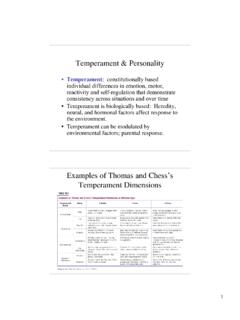
Temperament & Personality
psych.colorado.edu1 Temperament & Personality •Temperament: constitutionally based individual differences in emotion, motor, reactivity and self-regulation that demonstrate consistency across situations and over time

Positive and N egative Affectivity and T heir R elation to ...
psych.colorado.eduPositive and N egative Affectivity and T heir R elation ... (N A ) and Positive A ffectivity (PA ). N egative A ffect is a general factor of subjective distress, and subsum es a broad range of negative m ood states, including fear, anxiety, hostility, scorn, and disgust. M ood states related to de-
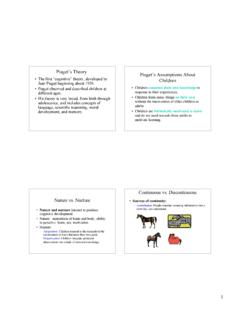
Piaget’s Theory Piaget’s Assumptions About Children
psych.colorado.edu3 Piaget’s Stages • Sensorimotor stage (birth to 2 years) •Preoperational stage (2 to 7 years) –Knowledge is represented by language, mental imagery,

Making Working Memory Work: A Computational Model of ...
psych.colorado.eduLETTER Communicated by Peter Dayan Making Working Memory Work: A Computational Model of Learning in the Prefrontal Cortex and Basal Ganglia Randall C. O Reilly
Related documents
THEORIES OF BASIC HUMAN NEEDS - Yola
fahmidulhaque.yolasite.comThe human needs approach supports collaborative and multifaceted problem-solving models and related techniques, such as an analytical problem-solving process. These models take into account the complexity of human life and the insistent nature of human needs. Problem-solving approaches also analyze the fundamental
Human resource management and human resource …
files.eric.ed.govThe evolution of HRD from its roots in human knowledge transference to HRM and present day HRD activities reveals that environmental, social, and political influences have escalated the need for organizations to focus employee development in the areas of flexibility,
A Time Line of the Evolution of School Bullying in ...
files.eric.ed.govA Time Line of the Evolution of School Bullying in Differing Social Contexts 109 possible to speak of a common reaction. As the definitions emphasise, a mob usually is composed of a relatively large group of people joining in some kind of common performance. Regarding the differentiation between bullying and mobbing,