
Chapter 15: EXPLOSIVES DEFINITIONS
Chapter 15: EXPLOSIVES DEFINITIONS 1. An explosive substance is a solid or liquid substance (or mixture of substances) which is in itself capable by chemical reaction of producing gas at such a temperature and pressure and at such a speed as to cause damage to the surroundings. Pyrotechnic substances are included even when they do not evolve gases.
Download Chapter 15: EXPLOSIVES DEFINITIONS

Information
Domain:
Source:
Link to this page:
Documents from same domain

Social security: Issues, challenges and prospects
www.ilo.orgII Social security: Issues, challenges and prospects ISBN 92-2-111961-0 ISSN 0074-6681 First published 2001 The designations employed in ILO publications, which are in conformity with United Nations practice, and

SOUTH AFRICA Country Profile Decent Work
www.ilo.orgThe Decent Work Country Profile for South Africa analyses progress and challenges across the ten internationally agreed thematic areas of decent

EMPLOYMENT Working Paper No. 194
www.ilo.orgDevelopment and Investment Branch Employment Intensive Investment Programme EMPLOYMENT Working Paper No. 194 Employment Policy Department 2015 Nite Tanzarn, Maria Teresa Gutierrez

Código de Trabajo de la República de El Salvador
www.ilo.orgCódigo de Trabajo de la República de El Salvador Edición rubricada y concordada con las Normas Internacionales del Trabajo Versión actualizada

Guidelines for a just transition - copyrighted
www.ilo.orgGuidelines for a just transition towards environmentally sustainable economies and societies for all

PROJECT DESIGN - International Labour Organization
www.ilo.orgIII Project Design Manual A Step-by-Step Tool to Support the Development of Cooperatives and Other Forms of Self-Help Organization 2010 COOPAFRICA
7. PROJECT EVALUATION - International Labour …
www.ilo.org7. PROJECT EVALUATION ♦ Project monitoring focusing on activities and outputs and their contribution to outcomes. Monitoring is the continuous observation of a project’s progress by systematically gathering key performance data for …
Workplace policy on HIV/AIDS - what it should cover
www.ilo.orgThe purpose of this policy is to ensure a consistent and equitable approach to the prevention of HIV/AIDS among employees and their families, and to …

labour-based road works - International Labour …
www.ilo.orgContractor’s Handbook for Labour-Based Road Works Republic of Zambia Ministry of Works and Supply Roads Department Roads Department Training School
Inequality in Southern Africa
www.ilo.orgIntroduction and Background The Southern African region is characterised by unacceptable high levels of unemployment, poverty and inequality. In …
Related documents

Chapter 14 Sterile Filtration, Filling, and Lyophilization ...
biomanufacturing.org4 Chapter 14 – Sterile Filtration, Filling, and Lyophilization of Product Eutectic: two or more crystalline species in such close contact that they melt as a single, pure substance Eutectic melt: the characteristic temperature where a eutectic solid melts Flexible IV (intravenous) bags: a sterile bag used to hold fluids that are administered to a ...
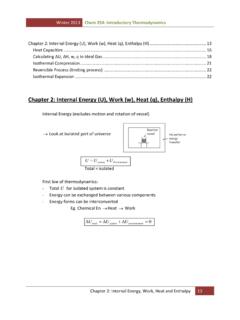
Chapter 2: Internal Energy (U), Work (w), Heat (q ...
scienide2.uwaterloo.caChapter 2: Internal Energy, Work, Heat and Enthalpy 13 ... The amount of energy (heat) required to raise the temperature of 1 gram of substance by 1 oC. Heat capacity of water is 4.18 J/g K = 1 calorie 1) Heat capacity is dependent on heat Eg. 10 oC o 11 oC and 80 oC o

STEADY HEAT CONDUCTION
www.cecs.wright.eduarea, and the temperature difference, but is inversely proportional to the wall thickness.Also, once the rate of heat conduction is available, the tem-perature T(x) at any location x can be determined by replacing T 2 in Eq. 3–3 by T, and L by x. Thermal Resistance Concept Equation 3–3 for heat conduction through a plane wall can be ...
Chapter 10 Refrigeration & Heat Pump Cycles (Systems)
www.descoenergy.comChapter 10 Refrigeration & Heat Pump Cycles (Systems) - 2 - Refrigeration & Heat Pump Systems • To maintain a region of space at a temperature blow that of ... the condenser of a low-temperature cycle provides the heat input to the evaporator of a …

Chapter 17 SOLAR ENERGY - Pennsylvania State University
personal.ems.psu.edudefinition of heat (Chapter 3): Heat = [Mass] [Heat capacity] [Temperature difference] Here the mass is that of the storage medium, water, which needs to be determined. The heat capacity of water is 1 kcal/kg/°C (see Table 3-2), and the temperature difference is that between the hot fluid in the secondary loop and the cold water going into the ...
Chapter 10 VAPOR AND COMBINED POWER CYCLES
staff.emu.edu.trThe first part of the heat-addition process in the boiler takes place at relatively low temperatures. Heat is transferred to the working fluid during process 2-2’ at a relatively low temperature. This lowers the average heat-addition temperature and thus the cycle efficiency. In steam power plants, steam is extracted

Chapter 2 Measurement of Temperature
www.jma.go.jpChapter 2 Measurement of Temperature 2.1 Definition and units Heat balance difference of atmosphere between regions creates temperature distribution. This temperature distribution generates wind current along with cloud and rainfall phenomena. Thus, atmospheric temperature is one of the most important meteorological elements as well as wind and

Chapter 5: Microbial Metabolism
www.lamission.edu2) Changes in temperature, pH or [salt] 3) Availability of any necessary cofactors 4) Effect of inhibitors • more enzyme &/or more substrate = more product! • can effect enzyme structure, hence its activity • some enzymes don’t work w/o a non-protein cofactor • molecules that bind to enzymes & reduce their activity