Chapter 15 Mixed Models - CMU Statistics
often more interpretable than classical repeated measures. Finally, mixed models can also be extended (as generalized mixed models) to non-Normal outcomes. The term mixed model refers to the use of both xed and random e ects in the same analysis. As explained in section14.1, xed e ects have levels that are
Download Chapter 15 Mixed Models - CMU Statistics

Information
Domain:
Source:
Link to this page:
Documents from same domain
Chapter 14 Within-Subjects Designs - CMU Statistics
www.stat.cmu.eduChapter 14 Within-Subjects Designs ... although often the term repeated measures analysis is used in a narrower sense to indicate the speci c set of analyses discussed
Chapter 9 Simple Linear Regression
www.stat.cmu.eduChapter 9 Simple Linear Regression An analysis appropriate for a quantitative outcome and a single quantitative ex-planatory variable. 9.1 …
Lecture Notes 9 Asymptotic Theory (Chapter 9)
www.stat.cmu.eduLecture Notes 9 Asymptotic Theory (Chapter 9) In these notes we look at the large sample properties of estimators, especially the maxi-mum likelihood estimator.
2 Probability Theory and Classical Statistics
www.stat.cmu.edu2 Probability Theory and Classical Statistics Statistical inference rests on probability theory, and so an in-depth under-standing of the basics of probability theory is necessary for acquiring a con-
Ryan Tibshirani Data Mining: 36-462/36-662 January 22 2013
www.stat.cmu.eduRyan Tibshirani Data Mining: 36-462/36-662 January 22 2013 Optional reading: ESL 14.10 1. Information retrieval with the web Last time:information retrieval, learned how to compute similarity scores (distances) of documents to a given query string But what if …
Ryan Tibshirani Data Mining: 36-462/36-662 April 25 2013
www.stat.cmu.eduBoosting Boosting1 is similar to bagging in that we combine the results of several classi cation trees. However, boosting does something fundamentally di erent, and can work a lot better As usual, we start with training data (x
Chapter 8 Threats to Your Experiment - CMU Statistics
www.stat.cmu.eduThis chapter discusses possible complaints about internal validity, external validity, construct validity, Type 1 error, and power. We are using \threats" to mean things that will reduce the impact of
Advanced Data Analysis from an Elementary Point of View
www.stat.cmu.eduAdvanced Data Analysis from an Elementary Point of View Cosma Rohilla Shalizi
Finding Informative Features - CMU Statistics
www.stat.cmu.eduSimilarly, our uncertainty about the class C, in the absence of any other information, is just the entropy of C: H[C] = X c Pr(C= c)log 2 Pr(C= c) Now suppose we observe the value of the feature X.
Degrees of Freedom and Model Search - CMU Statistics
www.stat.cmu.eduDegrees of Freedom and Model Search Ryan J. Tibshirani Abstract Degrees of freedom is a fundamental concept in statistical modeling, as it provides a quan-titative description of the amount of tting performed by a given procedure. But, despite this
Related documents

Profile Analysis - San Francisco State University
userwww.sfsu.eduProfile Analysis . Introduction . Profile analysis is the multivariate equivalent of repeated measures or mixed ANOVA. Profile analysis is most commonly used in two cases: 1) Comparing the same dependent variables between groups over several time-points. 2) When there are several measures of the same dependent variable (Ex.

Repeated Measures ANOVA and Mixed Model ANOVA
www.cogsci.bme.huRepeated Measures ANOVA and Mixed Model ANOVA Comparing more than two measurements of the same or matched participants. ... Steps in the Analysis. Descriptives Minutes of Exercise Balance Errors sd 3 8.5 4.5 6 11.4 7.96 9 16.4 10.8 12 31.1 12.56 15 …
Analysis of Covariance (ANCOVA) - Discovering Statistics
www.discoveringstatistics.comMain Analysis Most of the General Linear Model (GLM) procedures in SPSS contain the facility to include one or more covariates. For designs that don’t involve repeated measures it is easiest to conduct ANCOVA via the GLM Univariate procedure. To

Fatigue Analysis - UTEP
me.utep.eduFatigue Loading •R= -1 and R= 0 are two common reference test conditions used for obtaining fatigue properties. •R= -1 is called the fully reversed condition since Smin= -Smax •R = 0, where Smin = 0, is called pulsating tension. •One cycle is the smallest segment of the stress versus time history which is repeated periodically.

Lecture Notes #7: Residual Analysis and Multiple ...
www-personal.umich.edurelax the independence assumption, as we saw in the repeated measures section of the course. (b)Identically distributed As stated above, we assume that the residuals are distributed N(0, σ2 ϵ). That is, we assume that each residual is sampled from the same normal distribution with a mean of zero and the same variance throughout.
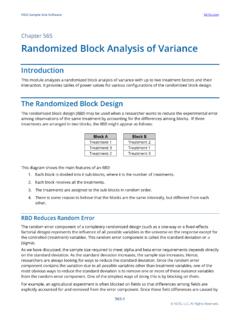
Randomized Block Analysis of Variance - NCSS
ncss-wpengine.netdna-ssl.comThe randomized block design is often confused with a single-factor repeated measures design because the analysis of each is similar. However, the randomization pattern is different. In a randomized block design, the treatments are applied in random order within each block. In a repeated measures design, however, the treatments are usually

2x2 Mixed Groups Factorial ANOVA - University of Nebraska ...
psych.unl.edu2x2 Mixed Groups Factorial ANOVA Application: Examination of the main effects and the interaction relating two independent variables to a single quantitative dependent variable when one of the independent variables involves a between-groups comparison and the other independent variable involves a within-groups comparison.
198-30: Guidelines for Selecting the Covariance Structure ...
support.sas.complots, repeated measures, multi-site clinical trials, hierar chical linear models, random coefficients, analysis of covariance are all special cases of the mixed model. The question of selecting the covariance structure changes with each case, as it does when you throw in missing values or missing treatment combinations. For this paper we will ...