
Chapter 16: Composite Materials
Composite Survey: Structural Particle-reinforced Fiber-reinforced Structural • Sandwich panels A structural composite is normally composed of both homogeneous and composite materials. Chapter 16 -24-- low density, honeycomb core-- benefit: small weight, large bending stiffness honeycomb adhesive layer face sheet Adapted from Fig. 16.18 ...
Download Chapter 16: Composite Materials

Information
Domain:
Source:
Link to this page:
Documents from same domain

Chapter 2. Atomic Structure and Interatomic Bonding
web.eng.fiu.eduChapter 2. Atomic Structure and Interatomic Bonding Interatomic Bonding –Bonding forces and energies –Primary interatomic bonds –Secondary bonding –Molecules Bonding Forces and Energies • Considering the interaction between two isolated atoms as they are brought into close proximity from an infinite separation. • At larger distances ...
Chapter 4 : ERP Implementation Methodologies and Strategies
web.eng.fiu.eduimplementation, and are kept at the forefront of the strategy. It is crucial that management executives and project stakehold-ers establish expectations for the project. Their role is to ensure ... • Budget • Funding CHAPTER 4 Dunaway – ERP …

Mechanical Vibrations FUNDAMENTALS OF VIBRATION
web.eng.fiu.edu• Joseph Sauveur (1653–1716) coined the word “acoustics” for the science of sound. • Sir Isaac Newton (1642–1727) his law of motion is routinely used to derive the equations of motion of a vibrating body. • Brook Taylor (1685–1731), obtained the natural frequency of vibration observed by Galilei and Mersenne.

Chapter 9: Phase Diagrams
web.eng.fiu.eduPhase Diagrams • Indicate phases as function of T, Co, and P. • For this course:-binary systems: just 2 components.-independent variables: T and Co (P = 1 atm is almost always used). • Phase Diagram for Cu-Ni system Adapted from Fig. 9.3(a), Callister 7e. (Fig. 9.3(a) is adapted from Phase Diagrams of Binary Nickel Alloys , P. Nash

Practice Problems for FE Fluid Mechanics
web.eng.fiu.eduExample 30 Inthepipesystemdepictedbelow,thedischargeinpipeABis100 m3/sec. Branch 1 is 500 m long, and it has a diameter of 2 m and a friction factor of 0.018. Branch 2 has a length of 400 m, diameter of 3 m, and a friction factor of 0.02.

OVERVIEW OF HEURISTIC OPTIMIZATION
web.eng.fiu.eduOPTIMIZATION (Eberhart Kennedy -1995) A robust stochastic optimization technique inspired by the social behavior of swarms of insects or flocks of birds –maximize “food”. Apply the concept of social interaction to problem solving. Developed in 1995 by James Kennedy (social-psychologist) and Russell Eberhart (electrical engineer).

Experiment One (1) Tensile Stress Testing
web.eng.fiu.eduor Pa). In Equation (3.3-2), å is the strain measured in in/in (m/m) in the direction of the applied load. Since strain is dimensionless, the elastic modulus is measured in units of psi (Pa). It is important to realize that Equations above is valid only for uniaxial tension and is a special case of a generalized set of relations known as Hooke ...

Milliequivalents, Millimoles, and Milliosmoles
web.eng.fiu.eduStep 2: Calculate equivalent weight Equiv weight = molecular weight KCl divided by valence Since valence of KCl = 1, Equiv weight = 74.5/ 1 Step 3: 1 mEq KCl = 1/1000 x 74.5 g = 0.0745 g = 74.5 mg Step 4: 4 mEq KCl = 74.5mg x 4 = 298 mg/ml OR using the equation listed before: mg/ml = mEq/ml * atomic, molecular or formula weight valence ...

Experiment Two (2) Torsional testing of Circular Shafts
web.eng.fiu.eduDetermination of Modulus of Rigidity, Shear Modulus G and Torsional Stress for Steel and Aluminum. A. Using the reading of above to calculate the shear modulus and torsional stress for Steel, Aluminum and Brass, by using the following formulas. Compare the experimental results with theoretical values. Θ = [180*T*L/(π*J*G)] (eq. 1) τ= T*C/J ...
Related documents
4350.1 REV-1 CHG-3 CHAPTER 35: SMOKE DETECTORS
www.hud.govOther structural variations may exist, such as a structure with a vestibule on the lower level, instead of a basement, where people enter, in which case a smoke ... easily attached via an adhesive strip. Merely providing the device to the resident does not ensure actual physical installation and does not fulfill an

Scotch-Weld Epoxy Adhesive
multimedia.3m.comStructural Adhesive Primer EC-3901 to the glass surfaces to be bonded and allow the primer to dry a minimum of 30 minutes @ 75°F (24°C) before bonding. *When using solvents, extinguish all ignition sources, including pilot lights, and follow the manufacturer’s precautions and directions for use. Use solvents in accordance with local ...
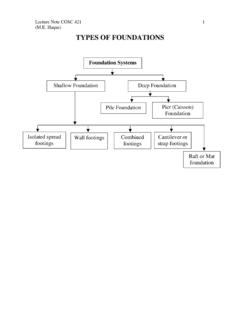
TYPES OF FOUNDATIONS
people.tamu.eduFootings are structural elements, which transfer loads to the soil from columns, walls or lateral loads from earth retaining structures. In order to transfer these loads properly to ... surface tension caused by cohesion within the liquid and adhesive forces between the liquid and the tube act to lift the liquid (Figure). The capillary action ...

Scotch-Weld TM Structural Adhesive Film AF 163-2
multimedia.3m.com3M™ Scotch-Weld™ Structural Adhesive Film AF 163-2 Technical Datasheet - 6 - H. Metal to Metal Climbing Drum Peel Strength (in•lb/in) – 3M Test Method C-2222 Cure Cycle: 235°F, 90 minutes, 35 psig, 5°F/min. rise rate Primer: 3M™ Scotch-Weld™ Structural Adhesive Primer EC-3960 Metal: 2024 T-3 Clad aluminum .020" to .040" FPL etched Peel Rate: 3"/min. (cross …

DuPont Tyvek Water-Resistive and Air Barriers Residing …
www.dupont.comDuPont™ Adhesive/Primer DuPont™ Window and Door Foam ... 65 mph equivalent structural load and 15 mph equivalent wind-driven rain water infiltration for buildings less than 5 stories, it is recommended to install a high pressure skirt to help prevent
PRODUCT DATA SHEET Sikadur®-32 Hi-Mod
usa.sika.comStructural adhesive for concrete, masonry, metal, wood, etc Chemical Base CHARACTERISTICS / ADVANTAGES High-strength bonding/grouting adhesive. Tolerant to moisture before, during and after cure. Excellent adhesion to most structural materials. Convenient easy-to-mix ratio A:B = 1:1 by volume.