
Chapter 18: Quantitative Genetics I – Important Concepts
Chapter 18: Quantitative Genetics I – Important Concepts Introduction In the chapter on Mendel and Morgan, we saw how the transmission of genes from one generation to another follows a precise mathematical formula. The traits discussed in that chapter, …
Download Chapter 18: Quantitative Genetics I – Important Concepts

Information
Domain:
Source:
Link to this page:
Documents from same domain

•Nature and nurture combine forces in prenatal …
psych.colorado.edu1 Prenatal Development •Nature and nurture combine forces in prenatal development. •Much of development is generated by the fetus itself. Conception

SAS Output for Repeated Measures - University of …
psych.colorado.eduQMIN SAS Output for Repeated Measures - 3 Next we want to do a repeated measures analysis of variance. Here, drug is the independent variable (often called a “between subjects factor” in repeated measures) and

Psychology 3102: Introduction to Behavioral …
psych.colorado.eduPsychology 3102: Introduction to Behavioral Genetics (Carey) Problem Set: Heritability and Environmentability Two basic equations are required to calculate heritability and environmentability. The first equation is h2 + e2 = 1 where h2 is the heritability and e2 is the environmentability. This equation simply states that the total …
Chapter 13: The Five Forces Behind Human Evolution
psych.colorado.eduChapter 13: The Five Forces Behind Human Evolution Introduction ... relative importance of each force. The fourth and fifth forces are new in the sense that they

Functional magnetic resonance imaging: Basic …
psych.colorado.eduFunctional magnetic resonance imaging (fMRI) has quickly become the preferred technique for imaging normal brain activity, especially in the typically developing child. This technique takes advantage of specific magnetic properties and physiological

Piaget’s Theory - University of Colorado Boulder
psych.colorado.edu1 Piaget’s Theory •The first “cognitive” theory, developed by Jean Piaget beginning about 1920. •Piaget observed and described children at
Temperament & Personality
psych.colorado.edu1 Temperament & Personality •Temperament: constitutionally based individual differences in emotion, motor, reactivity and self-regulation that demonstrate consistency across situations and over time

Positive and N egative Affectivity and T heir R elation to ...
psych.colorado.eduPositive and N egative Affectivity and T heir R elation ... (N A ) and Positive A ffectivity (PA ). N egative A ffect is a general factor of subjective distress, and subsum es a broad range of negative m ood states, including fear, anxiety, hostility, scorn, and disgust. M ood states related to de-
Piaget’s Theory Piaget’s Assumptions About Children
psych.colorado.edu3 Piaget’s Stages • Sensorimotor stage (birth to 2 years) •Preoperational stage (2 to 7 years) –Knowledge is represented by language, mental imagery,

Making Working Memory Work: A Computational Model of ...
psych.colorado.eduLETTER Communicated by Peter Dayan Making Working Memory Work: A Computational Model of Learning in the Prefrontal Cortex and Basal Ganglia Randall C. O Reilly
Related documents
Good Fonts for Dyslexia
dyslexiahelp.umich.eduture, brain function, and genetics studies con rm the bio-logical foundations of dyslexia [31].1 Although dyslexia is also popularly identi ed with brilliant famous people, such ... quantitative data from eye-tracking measurements. In ad-dition, with testing 12 di …
Plant Biotechnology and Genetics: Principles, Techniques ...
site.iugaza.edu.ps3.2.4 Other Topics in Population and Quantitative Genetics 55 3.2.5 The Value of a Plant Variety Depends on Many Traits 56 3.2.6 Varieties Must Be Adapted to Environments 56 3.2.7 Plant Breeding Is a Numbers Game 57 3.2.8 Plant Breeding Is an Iterative and Collaborative Process 57 3.2.9 Diversity, Adaptation, and Ideotypes 58
QUANTITATIVE TRAITS - QUALITATIVE TRAITS AND …
www.eagri.orgQuantitative genetics (Inheritance of Multiple Genes) The phenotypic traits of the different organisms may be of two kinds, viz., qualitative and quantitative. The qualitative traits are the classical Mendelian traits of kinds such as form (e.g.,

Understanding Genetics and the Sire Summaries
www.holsteinfoundation.orgQuantitative traits are controlled by many genes. Each gene generally has a relatively small influence on the expression of a trait, but collectively, these genes can have large effects. Examples of quantitative traits include milk production, milk component percentages, and physical traits such as stature and rump angle.
Quantitative Genetics - WOU
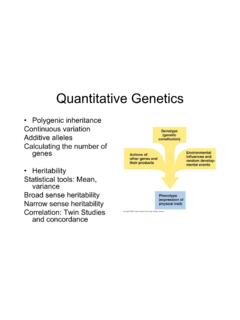
people.wou.eduQuantitative Genetics • Polygenic inheritance Continuous variation Additive alleles Calculating the number of genes • Heritability Statistical tools: Mean, variance Broad sense heritability Narrow sense heritability Correlation: Twin Studies and concordance . Polygenic inheritance • 2 or …

Basic Horse Genetics
ssl.acesag.auburn.eduBasic Color Genetics selecting qualitative traits is a good place to review some basic genetic principles because most horse colors are controlled by relatively few genes and are easily identified phenotypically. the key to basic genetics is to remember that the horse contributes only one gene for any allele that he or she has to the offspring.

Introduction to quantitative genetics - An-Najah Staff
staff-old.najah.eduQuantitative genetics, on the other hand, is a branch of genetics in which individual genotypes are unidentified, and the traits of individuals are measured. Genotypic values are assigned to genotypes in the popu-lation. Quantitative genetics emphasizes the role of selection in controlled populations of known ancestry. Some topics of ...

Behavioral Genetics - AAAS Home
www.aaas.orgmatter of behavioral genetics—mental disease, personality, intelligence—is controver-sial. Moreover, in the past, research in behavioral genetics has been used to support hateful prejudices, and so perhaps this has led many otherwise-interested …

The MIQE Guidelines: inimum Information for Publication of ...
www.gene-quantification.deThe MIQE Guidelines: Minimum Information for Publication of Quantitative Real-Time PCR Experiments Stephen A. Bustin,1* Vladimir Benes,2 Jeremy A. Garson,3,4 Jan Hellemans,5 Jim Huggett,6 Mikael Kubista,7,8 Reinhold Mueller,9 Tania Nolan,10 Michael W. Pfaffl,11 Gregory L. Shipley,12 Jo Vandesompele,5 and Carl T. Wittwer13,14 BACKGROUND: Currently, a lack of …

Quantitative Trait Locus (QTL) Analysis
www.reed.eduQuantitative trait locus (QTL) analysis is a statistical method that links two types of information— phenotypic data (trait measurements) and genotypic data (usually molecular markers)—in an attempt to explain the genetic basis of variation in complex traits (Falconer & Mackay, 1996;